Archive

Posts Tagged ‘philosophy’

Multisense Continuum Still Life

June 5, 2015 Leave a comment

stilllife2

Leaving Space, Time, and Spacetime Behind

May 12, 2015 2 comments

Are Space and Time an Illusion? Considered in this video:

  • 1. Give up your intuitions of how space and time work.
  • 2. Facts about observers (particles are considered observers):
    • a. observers disagree on how much time passes between events.
    • b. observers disagree on how much space there is between things at any given moment.
    • c. observers don’t fully agree on the chronological order of events.
    • d. observations are consistent so that no observer can be ‘wrong’.
  • 3. Spacetime is emergent from a deeper objective reality of causality.
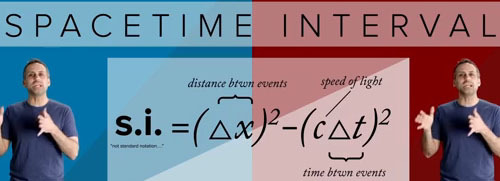
    • a. all observers agree on spacetime interval
      image
    • b. Spacetime intervals tell us about which causes influence which effects.
    • c. Causality is more objectively real than spacetime.
    • d. Spacetime is a tenseless, Non-Euclidean 4D mathematical Minkowski space.
    • e. Our intuitions of space and time are arbitrary and abstract.
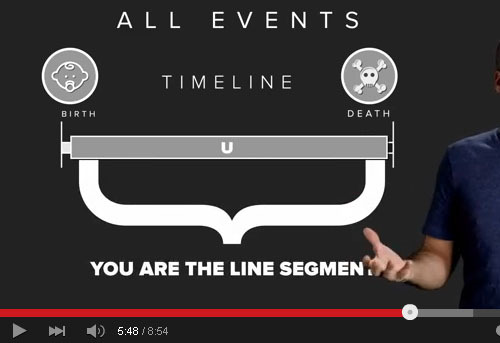
    • f.  We are real, however, if we think of our entire lives as a fixed geometric object in spacetime rather than a moving window on the line segment of our life:
image

He begins to sum up at 6:03

“Imagine we’re all reading a flip book made of graph paper. We agree on the events of the story, but we don’t agree where they happen on the page, on how many pages there are between events, or even on the order of some of those events, and yet we’re all reading the same book…only there’s no graph on the paper, there are no pages, and there is no book. All of that is just an imposition our brains make in order to perceive whatever it is. So why do we perceive reality in such a vividly spatial and temporal way? Good question, No one really knows.”

At this point is where I jump up and raise my hand. I think that I might know the answer to that question:

The mistake being made in our sophisticated rewrite of naive intuition about space and time is that the constancy of the spacetime interval is due to an objective ‘same book’ (or bookless book or whatever we are supposed all be reading.) To go to the next step into multisense realism, we must not only give up our intuitions about space and time being different, but we must give up our counter-intuitions about spacetime being literal.

If we consider instead that there is no final Minkowski block time universe out there, no ‘same book’, or even same language out there, but rather a shared capacity to read/write, in here, then both the naive intuition and sophisticated counter-intuition makes sense as perspectives within a larger context. Not just in human experience, or even within particles or probability laws, but deeper than that.

In this new schema all is read/written beyond spacetime but still ‘within’. Within us as well as ‘within’ every kind of non-human experience. This pervasive context ‘within all awareness’ would be an absolute context which is pervasive and devoid of any formal sense of distance or time. An anti-void. This absolute frame of reference can be understood as sense itself (something like “ference” rather than reference): Direct participation of perceptual qualities that need not be realistic, but also extend to phenomena which we are familiar with as fiction, imagination, myth, etc.

This is not to say that human imagination could necessarily describe the entire continuum of sense, but like the visible spectrum is to electromagnetism, it defines a range which is a thin slice of the whole, but much more than merely one color. The one ‘color’, call it white, would correspond to the single combined sense of timeless, spaceless realism that is studied under math and physics, but is nevertheless bereft of aesthetic qualities such as emotion, flavor, or (other) colors.

All that has ever been experienced can be seen, in this absolute frame of reference to be ‘right here and right now’, but for our local inhibitory conditions of human limitation. From our human perspective there is a cost in making awareness so immense that it embraces all other partitions; it becomes unreal or fictional, delusional, supernatural, absurd, or accidental*. The ‘heavens’ are not only causally closed at one level of awareness, but on another, they open up to non-linear, surreal mythscapes with no temporal rooting but deep symbolic meaning.

Jung spoke of the collective unconscious, Australian aborigines refer to a primordial Dreamtime, and many a psychedelic explorer have reported such aesthetically saturated realms. Anthropologists find that it is very common for cultures to assume that children are born into this world from a dreamier, more divine kind of world. These shamanistic-psychotic surrealities need not be considered ‘real’, however neither can their surreality and flirtation with prophetic intuitions be dismissed as mere accident. Even as a kind of placebo effect, the transcendental levels of experience must be accounted for in any would-be-complete view of the universe.

There is a lot to understand about our own spectrum of consciousness before we can even begin to approach the totality of awareness, which may be an unbounded, or self-binding rather than a fixed continuum. Non-human states of awareness might be both ‘larger’ and ‘smaller’, faster and slower than we can conceive of. This conception of the totality of experience as beyond causality turns causality into a kind of ‘nozzle’ of spacetime. Causality focuses the ocean of creativity; interiorizing some and exteriorizing others into relative degrees (the ancestor of our ‘five senses’ in which, for example, feeling seems ‘closer to us’ than seeing).

The pieces of this puzzle of human consciousness can, in my estimation, reveal a kind of ‘red shift’ and ‘blue shift’ which can be thought of in human terms as the stereotypically** autistic and psychotic extremes of human consciousness.

To return to the video, the multisense realism view would add:

  • 4. Nonlocal spacetime and “space ⊥ time” as (space and time in their naive, perpendicular local appearance) both emerge from a deeper common sense, which is trans-local.
    • a. this common sense can be thought of as the capacity for sense itself, or rather, for the particular kind of worldly sense of causality and agreement, which we might call realism.
    • b. realism is a common, but not exclusively common sense but is the reflection of an even more fundamental sense, which is novel and unprecedented rather than probabilistic or determined by laws.
    • c. the common sense of realism divides experience mechanistically and unintentionally
    • d. the uncommon sense beyond realism multiplies intentionally, seeking and building significance.
    • e. what we call causality is itself caused. Our distanced observations of realism is a kind of low-res substitute or icon that carries some semblance of the totality, but in an aesthetically neutralized, minimalistic form.
    • f. by using the built in, self-organizing clues of nature, we can begin to see how the holographic universe must be extended to include our own ‘visible spectrum’.
  • 5. The agreement of the Spacetime Interval is not evidence of a rigid body of 4D absolute reality, but rather evidence of the potential for agreement itself, i.e. the revelation of underlying local sensory unity with distant sensory conditions.
    • a. this is what the constancy of light speed and gravity are ‘really about’: not photons or forces, but ordinary sensory experience in self-diffraction.
    • b. light is not a particle or a wave, it is a local sensation on the cusp of spacetime emergence. Light is local sensation, and sensation is a boundary condition within sense.
    • c.  this means that sensation is more of a temporary subtraction from the eternal than an isolated piece of information.
    • d.  the extremes of human consciousness should be seen as a richer, more significant version of a guiding theme in all of sense: that of psychotic-unpredictable-figurative entropy and autistic-static-literal information.
    • e.  the phenomenon of seeing can be used metaphorically to begin to understand these extremes, as well as ordinary experiences of common sense, by working with the idea of language as a gravitational lensing in which the light of sense is bent by local accumulations of significance (mass).
  • 6. Paradoxically, what all observers agree on is their potential for agreement and fact of their own disagreement.
    • a. We can reclaim our naive intuitions about space and time being different, as this perpendicular aesthetic is an accurate reflection of our own subjective tunnel through eternity.
    • b. We can claim the Minkowski counter-intuition as a brilliant, and useful creation myth which is derived from common insensitivity, rather than common sense.

This is way too much to take in all at once (even for me), and I have no doubt that it sounds crazy to most people (that too is part of the Lorentz-like contractions and dilatations of sense-making). This is only the very tip of the iceberg…just something to get down in writing…for now.

*Whether the out-of-range portions of the spectrum of sense appear to be insane, error, or divine depends upon the frame of reference from which they are experienced.

**not talking about real people who demonstrate autistic or psychotic symptoms, but the themes exposed by the stereotyping of those symptoms, some of which are being researched under Imprinted Brain Theory.

Thesis Rewrite Project

April 25, 2015 Leave a comment

MSR’s Case Against Emergence

Within the MSR website, there are several entries talking about the inadequacy of the concept of emergence when applied to consciousness emerging from unconsciousness. Briefly, emergence only has any explanatory power when applied to two phenomena which have a logical similarity. We can understand that water molecules which are tightly packed would seem to us to have the emergent property of being ice, where molecules which are contacting each other but sliding around would have the emergent property of seeming to us like a liquid. What is meant when emergence is applied to consciousness however, is not like that at all. There is no arrangement of particles in a void that is isomorphic to a flavor, color, or feeling like dizziness. Emergence which cannot be anticipated by the behavior of the fundamental phenomenon is known as Strong or Brute Emergence, and under the best of circumstances can be dismissed as an argument from ignorance. In the circumstance of consciousness emerging from objects or information processes, we are smuggling in our own evidence of experience as the entire explanation of that experience. To claim emergence of consciousness is to answer the question of why molecules seem like flavors or emotions by shrugging it off as the way that molecules seem…as if seeming could exist in physics in the absence of consciousness.

Here’s a thought experiment to consider:

Let’s say that you have a two dimensional collection of six squares in a cross formation, like this:

hi-d_figure3
Now we know that this could be folded into a cube, however, couldn’t we also have a program which treats the edges as if it were a cube, but use it as a graphic character in a 2d video game? In other words, can’t we show that just because the edges and corners of this figure behave in a way which is isomorphic to a 3d figure, no cube ’emerges’ necessarily? We could run this program in Flatland without folding it up as cube and all of the computational outcomes would be the same.

The emergentist position overlooks the difference between the squares and the cube, claiming the latter not to be anything additional added on top of the flat avatar. The idealist position is that there is a difference between a cube and the avatar, and that this difference is the most important and interesting thing…the whole point is that there doesn’t need to be a cube logically, but yet there is.

Intellectual fads come and go. Even long held scientific frameworks change over time to accommodate new knowledge. For centuries Ptolemaic astronomy was presumed accurate, so much so that when anomalies were found in the predictions of its deferent and epicycle model, the response was famously to ‘add epicycles’ to make finer tuned predictions rather than to suspect what Galileo and Copernicus later found. The heliocentric revolution changed our understanding of our position in the universe from one of divine center or paradise lost to a statistical fluke in a dying cosmos. For the 1200 years between 200 and 1400 AD, why did we stick to the geocentric model? Why was it more natural to think that the universe revolved around us?

Like the fish which has no name for water, or the Flatland square who has no way to conceive of flatness as a dimension which lacks volume, it was difficult for people to doubt those assumptions that they didn’t even know they were making. The Earth feels motionless – as stable and static as anything we can imagine. Who would guess that the very property of motion is a relative condition? Once we have that piece of information, we can find, as Einstein did, examples of it everywhere – on trains, when we can’t tell whether our seat is moving forward at a constant speed or whether the train out the window is moving past us and we are standing still. One favorite thought experiment of mine is to think of a universe in which only one object exists; a smooth, ideal sphere like a ping pong ball. In this universe, nothing can be seen to move. Without making ourselves an invisible voyeur who can look around into the void, there is no true sense of space or change. There is no difference between moving and standing still because there is no frame of reference from which to compare and see that a position has changed. Video games can help us conceptualize this also. The player who pilots a spaceship avatar has only the attitude of their ship to cue their sense of acceleration when traveling through empty space.

whisperingwater
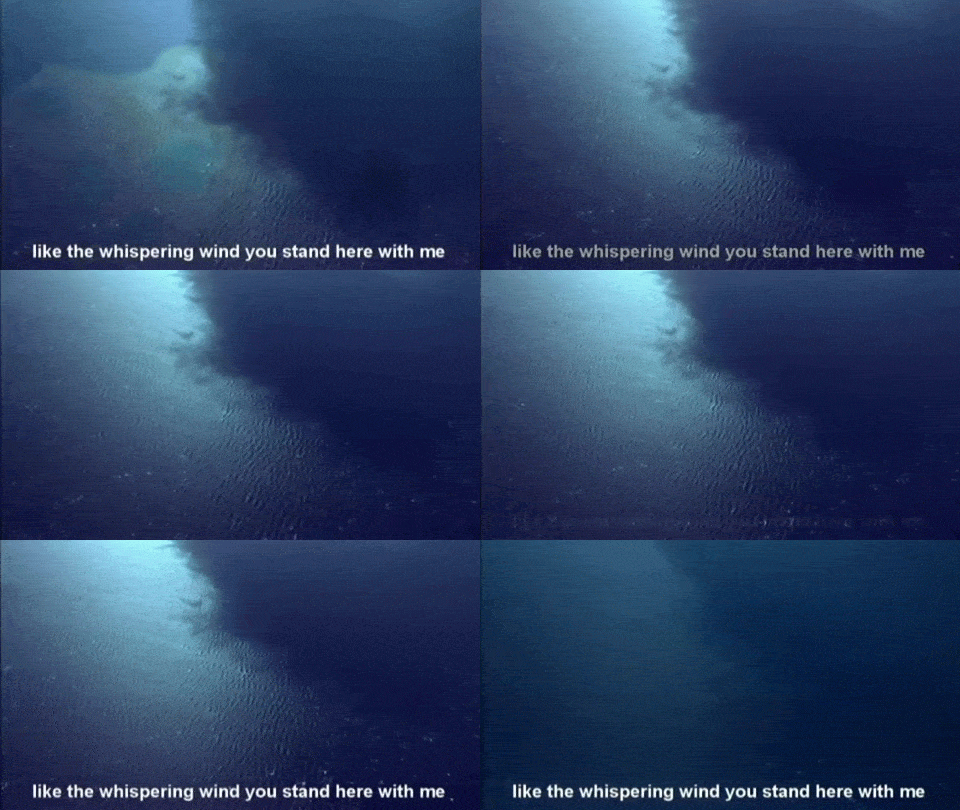
Notice how ocean waves stop moving when seen from high above.

(Sound gif, Source)

The shift that is proposed by MSR would twist our view of the universe, so that the universe itself becomes a kind of twisting or gyrating between different ways of experiencing.

Yeats System

Yeatsgyre

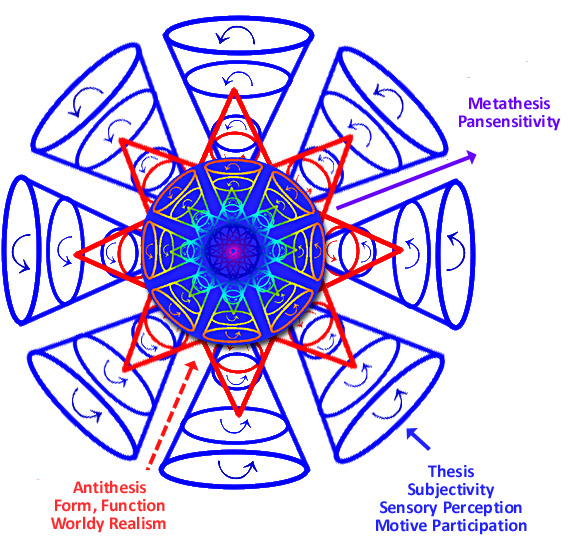
Yeats, like Locke and Galileo before him, conceived of the worldly half of the universe as “Primary”, which is perfectly natural considering that when we are awake we find ourselves surrounded by a physical world which is so much larger and more durable than ourselves. MSR proposes not that we invert this relation into solipsism, where internal phenomena are primary and the external world is secondary, but to see our own subjectivity as just one tier in a continuum which is much more vast and durable than even physics. Under MSR, both the dualistic Western and non-dualistic Eastern views both exist within the total continuum of sense.

msr_mandalabr_cap

The Yeats system is multiplied so that it is realism which is emergent rather than subjectivity. The aesthetic objectives of Yeats are no longer the antithesis, but the thesis and meta-thesis.

msr_mandalabr_cap2

mess

Multisense realism = The elaboration of sense into layers and modes which objectify and subjectivity.

A Couple of Scientific Conversations

April 17, 2015 2 comments
Quantum and the Bell

EM Imagine I set up Schroedinger’s cat and a machine that will open the box after 10 seconds and ring a bell if the cat is alive. I set it up, and wait 10 seconds, and don’t hear a bell. What’s happened to the wavefunction?

CM What happened is that a person, you, have made an observation based on an expectation that you have of a particular experiment.

EM But I didn’t interact with the apparatus. No signal was transferred between me and it.

CW If you didn’t interact with the apparatus then how do you know the bell didn’t ring?

EW Because I’ve noticed 10 seconds passing and not registering a bell ringing in that time?

CW Why would you expect to hear a bell ringing unless you know that you can hear that bell and that bell is part of the apparatus?

EM I wouldn’t do, but are you trying to say that being aware of that counts as interacting with the apparatus?

CW Of course. Does RAM exist if it’s just filled with 0s?

EM Sure, but the idea of RAM in my head isn’t RAM in reality.

CW Being able to hear a bell isn’t in your head either. Being able to hear a bell and infer a meaning to the apparatus from that sensory experience (or your unfulfilled expectation thereof) is what your interaction consists of.

EM Yes, and neither unfufilled expectation or potential ability to hear a bell are real interactions with the real apparatus.

CW They are if you can really hear a bell (which is part of the apparatus) and if you can really understand that hearing the bell constitutes a result of your experiment.

If a dead person doesn’t hear the bell is it still a valid observation?

EM As far as the mathematics was concerned, it was “observed” (decohered) by the time the bell rang. But “being able to hear the bell” is not an interaction. *Actually* hearing the bell is, but that doesn’t happen.

CW Your view takes sense for granted to the point that it denies a difference between a living observer and no observer.

As far as the mathematics was concerned”
Which proves my point. Mathematics truncates consciousness.

EM Your point is… what? Believing in single observers and WF collapse is more rational then just interpreting the mathematics that explains your results in the first place?

CW The mathematics don’t explain the results, they only diagram a skeleton of one measurement of the results. The actual experiment and results take place outside of mathematics.

Are molecules conscious?

Does polymerase have any sense when it transcribes DNA into RNA? Do ribosomes have any sense when they translate RNA into amino acids?

What we can say is that DNA, ribosomes, etc are all expressions of consciousness on a certain scale (microbio-chemo) as seen through another scale of consciousness (anthro),

There is a story, an experience going on that is represented to us as a ribosome, a molecule, etc, and we are seeing its body through our body. A facade that is filtered by another filtering facade. I call this Eigenmorphism. Form itself, like matter and energy, is relativistic. Whether a given phenomenon is a feeling or a structure depends on the distance across the frames of reference involved. Nothing is an object in its own frame of reference, including the universe. Our mistake since the Enlightenment is in Over-Copernicanising physics and dismissing the native frame of reference (sense) as an epiphenomenon or emergent property of the distant frame (physics)

The Holo-solo-meta-sema-graphic Principle

February 21, 2015 1 comment

holographic

Think of the multisense continuum as a clarification of the holographic principle. What people often mean by holographic when ascribing it to the universe as a whole is something like ‘The Universe is not really real, but is a Matrix-like projection in which the totality is reflected in each part.’ If we ignore that theory for a moment and examine the linguistic origins of the word holographic instead, there are some worthwhile tie-ins to Multisense Realism. MSR is a way of stretching out this concept of holography, so that the extent to which it seems holographic is part of the hologram. Realism is not a fixed, absolute foundation, but an aesthetic quality of orientation. Realism is not a neutral designation of that which is factual versus that which is not, but also has a set of qualities, almost a personality which opposes the fantastic qualities of imagination, dreams, and psychosis. Where the aesthetics of fantasy are typically saturated, vivid, or florid, realism is relatively bland or rigid. Realism supports rigorous logic and causality. A graph can be thought of as the essence of realism in a way – not reality itself, but the mapping of the mappable aspects of reality…a realistic approach to realism.

Notice that holos and graph are polarized. They aren’t simple opposites where graph = parts and holos = whole, although graphing does break wholes into regular parts, but there is also a sense of a graph is of a static mental resource; an object or so called rigid body which we use to index information. A graph is a chart.* By contrast, holos is the uncharted and boundless context which does not respect strict divisions.

Holos means whole, but if you look up the etymology of hologram there is something interesting:

hologram (n.)1949, coined by Hungarian-born British scientist Dennis Gabor (Gábor Dénes), 1971 Nobel prize winner in physics for his work in holography; from Greek holos “whole” (in sense of three-dimensional; see safe (adj.)) + -gram.”

So holos doubles as a term that has something to do with feeling ‘safe’:

safe (adj.) c.1300, “unscathed, unhurt, uninjured; free from danger or molestation, in safety, secure; saved spiritually, redeemed, not damned;” from Old French sauf “protected, watched-over; assured of salvation,” from Latin salvus “uninjured, in good health, safe,” related to salus “good health,” saluber “healthful,” all from PIE *solwos from root *sol- “whole” (cognates: Latin solidus “solid,” Sanskrit sarvah “uninjured, intact, whole,” Avestan haurva- “uninjured, intact,” Old Persian haruva-, Greek holos “whole”). “

This root sense of wholeness as safety, solidity, health, healing, etc is the natural anchor of anchors…the foundational aesthetic (of the aesthetic foundation). All experiences in all possible universes must begin from this un-locused locus. Un-locused because it precedes its own definition or observation. The baby at the boob has no frame of reference, no learning process to understand the importance of nutrition or survival – there is only to appreciate the experience of being re-connected to the womb’s holos in a new and disorienting context…What is this context?

-graph modern word-forming element meaning “instrument for recording; that which marks or describes; something written,” from Greek -graphos “-writing, -writer” (as in autographos “written with one’s own hand”), from graphe “writing, the art of writing, a writing,” from graphein “to write, express by written characters,” earlier “to draw, represent by lines drawn” (see -graphy). Adopted widely (Dutch -graaf, German -graph, French -graphe, Spanish -grafo). Related: -grapher; -graphic; -graphical.”

Compared with holos, -graph is a very different kind of term. Where holos is a rich and profound metaphor, -graph is a relatively prosaic and literal term about something in the real world…writing or recording. Holos is an appreciation of primordial safety; an orientation to a frame of reference which is absolute and beyond thought. Once someone is born into a human life or an animal’s life, this holos is buried in a cocoon of defenses which face the anti-holos of spacetime and physics and the sense that was formerly whole is averaged out as

“sole (adj.) “single, alone, having no husband or wife; one and only, singular, unique,” late 14c., from Old French soul “only, alone, just,” from Latin solus “alone, only, single, sole; forsaken; extraordinary,” of unknown origin, perhaps related to se “oneself,” from PIE reflexive root *swo- (see so).”

As a sole individual in a physical world, we have developed ways to re-connect with each other. Some of them are ways of reconnecting to our shared history as mammals and primates, and some, like writing are more recent human inventions. The idea of writing is to inscribe a thin stream of thought into physics, into spacetime so that others can recreate it in their local experience. It’s a bridge, a trans-fer or meta-phor, which means carrying over of feeling or meanings. What is the carrier?

semaphore (n.)”apparatus for signaling,” 1816, probably via French sémaphore, literally “a bearer of signals,” ultimately from Greek sema “sign, signal” (see semantic) + phoros “bearer,” from pherein “to carry” (see infer). Related: Semaphoric (1808).”

The sema- or sign is a recontextualized piece of the world. We use it to passively bear our sharing of communication, as an insulator would bear a conducting wire, or a conducting wire would bear an electromagnetic flux. There are layers of nesting which span the continuum from holos to solus to meta to sema to graph.

Wholeness to self to likeness to sign to signed. The distance between our human self and the ‘signed’ or ‘graphed’ physical world is what gives that physical world its gravitas…its grave realism. Mortality adds a layer of biological gravity…the signs which threaten the self of the experience of life. The closer that a given phenomenon is to the whole, the more it is metaphorical and self-referential.

Once we grasp this continuum, we can see how subjective and objective phenomena are an elaboration of a theme of awareness and degrees of alienation from the whole. We can go into more advanced areas of understanding the continuum and see that while the graph end of sense reflects in micro the holos itself, it is only a reflection and has no generative power of its own. Even though we locally experience a tension between the holos and graph which seem equal, or even overpowered by physics, that is only because of how deeply our human experience is nested within billions of sensations, feelings, and thoughts since the beginning of spacetime.

In the absolute frame of reference, all is consumed by, with, and for holos. The graph appearance, and even the holographic principle is the local view of the self’s experience of being alienated. It’s a compromise between Descartes’ substance dualism and Eastern/perennial philosophy’s holism, but it is still fixed in the Cartesian graph of spacetime and Newton’s mechanics of mass and energy. We imagine that each physical particle is a packet containing a ghost of the whole, but I think that it now makes more sense to say that it is the particle itself which is, in the absolute frame or reference, more like the ghost. It’s relativistic, but all relation traces back to the orientation of the absolute. There is no orientation derived purely from disorientation, which is why we cannot build a sign or a self or a holos from a machine (graph).

*Descartes, whose family name means ‘of the charts’, and also can be associated with the French word charteus, meaning pertaining to papyrus/paper has an interesting connection to the role of Rene Descartes in developing the digital view of space in terms of Cartesian coordinates. Cards, charts and papers refer to objects which carry meaning – blank vehicles to be used either as a container for metaphor, or as the medium of choice for a stream of digital semaphores. The critical place that Descartes holds in the development of the Early Modern Period, cannot be overstated. In his 1641 Meditations, Descartes divided the cosmos, for better or worse, into mind and matter (res cogitans and res extensa), paving the way for Newton, Leibniz and others to see physics as an expression of precise mathematical truths. The Enlightenment Era marks the Western world’s separation from perennial, Eastern philosophy and the discovery of a new, Cartesian world of purely mechanical objects. The card, or graph aspect of the cosmos is seen as the new orientation, a counter-aesthetic to one which assumes theistic holos. The Western counter-aesthetic of modernism questions the beliefs of the past, asserting instead that the natural world is innocent of religious enchantment until proven otherwise.

How to Tell if Your p-Zombie has Blindsight, Falling in a Chinese Forest

January 26, 2015 Leave a comment

In order to make the question of philosophical zombiehood more palatable, it is a good idea to first reduce the scope of the question from consciousness in general to a particular kind of awareness, such as visual awareness or sight.

consciousness (general awareness)     |    particular awareness (sight)

Building on this analogy, we can now say that an equivalent of a philosophical zombie (p-Zombie) as far as sight is concerned might be a person who is blind, but uses a seeing eye dog to ‘see’.

As with blindsight, there seeing eye dog provides a case where a person is informed about optical conditions in the world, but without the benefit of first person phenomenal experience of seeing. The blind person sees no visual qualia – no colors, no shapes, no brightness or contrast, yet from all appearances they may be indistinguishable from a sighted person who is walking their dog.

Staying with the analogy to consciousness in general:

(a p-Zombie) is to (a Blind person w/ guide dog)
as a
(Conscious subject) is to (a person walking dog)

Some might object to this analogy, saying that because a p-Zombie is defined as appearing and behaving in every way like a conscious subject, and a sighted person walking their dog might not always act the same as a blind person with a guide dog. It’s true, in the dark, the sighted person would be at a disadvantage avoiding obstacles in their path, while the blind person might not be affected.

This, however, is a red herring that arises from the hasty definition of philosophical zombie as one who appears identical in every way to a conscious subject, rather than one who can appear identical in many ways. Realistically, there may not even be a way to know whether there is any such thing as a set of ways that a conscious being behaves. A conscious being can pretend to be unconscious, so right away this is a problem that may not resolvable.

Each conscious being is different at different times, so that presuming that consciousness in general has a unique signature that can be verified is begging the question. Even if two simple things seemed to be identical for some period of time, there might be a chance that their behavior will diverge eventually, either by itself, or in response to some condition that brings out a latent difference.

So let’s forget about the strong formulation of p-Zombie and look instead at the more sensible weak formulation of w-Zombie as an unconscious object which can be reliably mistaken for a conscious subject under some set of conditions, for some audience, for some period of time.

By this w-Zombie standard, the guide dog’s owner makes a good example of how one system (blind person + sighted dog) can be functionally identical to another (sighted person + sighted dog), without any phenomenal property (blind person gaining sight) emerging. As with the Chinese Room, the resulting output of the room does not reflect an internal experience, and the separate functions which produce the output do not transfer their experience to the ‘system’ as a whole.

From the guide dog analogy, we can think about bringing the functionality of the dog ‘in house’. The dog can be a robot dog, which can then be miniaturized as a brain implant. In this way a blind person could have the functionality of a guide dog’s sight without seeing anything. It would be interesting to see how the recipient of such an implant’s brain would integrate the input from it. From neuroscientific studies that have been conducted so far, which shows that in blind people’s brains, tactile stimulation such as reading Braille, shows up in the visual cortex. I would expect that the on-board seeing-eye dog would similarly show up, at least in part, in the regions of the brain normally associated with vision, so that we have a proof of concept of a w-Zombie. If we had separate digitized animals to handle each of our senses, we could theoretically create an object which behaves enough like a human subject, even within the brain, that it would qualify as a weak p-Zombie.

As a final note, we can apply this understanding to the oft misquoted philosophical saw ‘If a tree falls in a forest…’. Instead of asking whether a sound exists without anyone to hear it, we can reverse it and ask whether someone who is awakened from a dream of a tree falling in the forest which nobody else heard, was there a sound?

The answer has to be yes. The subjective experience of a sound was still experienced even though there is no other evidence of it.  In the same way, we can dream of seeing sunlight without our eyes receiving photons from the sun. We can say that seeing light or hearing sound does not require a concurrent physical stimulation but we cannot say that physics requires any such qualia as seeing light or hearing sound. To the contrary, we have shown above that there is no empirical support for the idea that physical functions could or would automatically generate qualia.Thus, the case for materialism and functionalism is proved in the negative, and the fallacy of the systems reply to Searle is revealed.

And if the cloud bursts, thunder in your ear
You shout and no one seems to hear.
And if the band you’re in starts playing different tunes
I’ll see you on the dark side of the moon. – Pink Floyd

Sun, Earth, and Understanding Idealism

January 16, 2015 Leave a comment

No description of the relation between the Sun and Earth is complete without including the geocentric view as well as the heliocentric view. This is not to suggest that the archaic views of astronomy should be considered the equal of the modern view, but that there was ever an alternative to the modern view in the first place makes the universe impossible to describe accurately by leaving it out.

Even without suggesting that we might someday find a third alternative to both geocentric and heliocentric astronomy which we can scarcely imagine now, we can still appreciate that the fact that it took thousands of years for heliocentricism to be widely accepted is a testament to how relative relativity really is. Physics makes us feel brilliant for understanding that the relation between Sun and Earth is conserved regardless of which way we choose to interpret it locally, but that brilliant feeling distracts us from the mystery of why there could be or should be any interpretation at all. What is a frame of reference, and what is doing the framing?

Another thought experiment to consider, in the vein of ‘What is it like to be a bat?’…what is it like to be the Sun? The world from a star’s point of view would be one in which everything that could be detected would already be illuminated – but without any apparent connection that you are the source of the illumination. So it is with consciousness. Everything that we see is reflecting the capacity that we have to see. It cannot be seen on its own, or else we would not need eyes (holes in our head would suffice).

The novice philosopher will say that it is a case of “If a tree falls in a forest…does it make a sound?”, but this is not about epistemology, it’s about ontology. The epistemological realm is concerned with verification. “Does it make a sound or not?”. The ontological question is much deeper…it asks, what is a sound and is it even true to assume that a tree falling ‘makes’ one.

In light of the many clues that we have, from Heisenberg’s uncertainty, to relativity, to incompleteness, we can begin to see how perception is not only a passive receiving of objective truth, but a participation across multiple frames of perceptual reference. In an ironic twist, the scientific project that has brought us to a weltanschauung which values only objective facts has found only facts with no objects and objects with no facts. Meanwhile, the one incontestable fact, our own perception, has been overlooked completely, like the Sun losing touch with it’s light completely and accepting that it is part of the empty space and surrounded by planets that must light themselves.

Could the Internet come to life?

December 20, 2014 Leave a comment

Could the Internet come to life?

It sounds like a silly proposition and it is a little tongue in cheek, but trying to come up with an answer could have ramifications for the sciences of consciousness and sentience.

Years ago cosmologist Paul Davies talked about a theory that organic matter and therefore life was intrinsically no different from inorganic matter – the only difference was the amount of complexity.

So when a system gets sufficiently complex enough, the property we know (but still can’t define) as ‘life’ might emerge spontaneously like it did from amino acids and proteins three billion years ago.

We have such a system today in the internet. As far back as 2005 Kevin Kelly talked about how the internet would soon have as many ‘nodes’ as a human brain. It’s even been written about in fiction in Robert J Sawyer’s Wake series (Page on sfwriter.com)

And since human consciousness and all the deep abstract knowledge, creativity, love, etc it gives us arises from a staggering number of deceptively simple parts, couldn’t the same thing happen to the internet (or another sufficiently large and complex system)?

I’m trying to crowdsource a series of articles on the topic (Could the Internet come to life? by Drew Turney – Beacon) and I know this isn’t the place to advertise, but even though I’d love everyone who reads this to back me I’m more interested in getting more food for thought from any responses should I get the project off the ground

I think that the responses here are going to tend toward supporting one of two worldviews. In the first worldview, the facts of physics and information science lead us inevitably to conclude that consciousness and life are purely a matter of particular configurations of forms and functions. Whether those forms and functions are strictly tied to specific materials or they are substrate independent and therefore purely logical entities is another tier of the debate, but all those who subscribe to the first worldview are in agreement: If a particular set of functions are instantiated, the result will be life and conscious experience.

The second worldview would include all of those who suspect that there is something more than that which is required…that information or physics may be necessary for life, but not sufficient. That worldview can be divided further into those who think that the other factor is spiritual or supernatural, and those who think that it is an as-yet-undiscovered factor. Those in the first worldview camp might assert that the second worldview is unlikely or impossible because of

1) Causal Closure eliminates non-physical causes of physical phenomena
2) Bell’s Theorem eliminates hidden variables (including vital essences)
3) Church-Turing Thesis supports the universality of computation

1) Causal Closure – The idea that all physical effects have physical causes can either be seen as an iron clad law of the universe, or as a tautological fallacy that begs the question of materialism. On the one hand, adherents to the first worldview can say that if there were any non-physical cause to a physical effect, we would by definition see the effect of that cause as physical. There is simply no room in the laws of physics for magical, non-local forces as the tiniest deviation in experimental data would show up for us as a paradigm shifting event in the history of physics.

On the other hand, adherents of the second view can either point to a theological transcendence of physics which is miraculous and is beyond physical explanation, or they can question the suppositions of causal closure as biased from the start. Since all physical measurements are made using physical instruments, any metaphysical contact might be minimized or eliminated.

It could be argued that physics is like wearing colored glasses, so that rather than proving that all phenomena can be reduced to ‘red images’, all that it proves is that working with the public-facing exteriors of nature yields a predictably public-facing exterior logic. Rather than diminishing the significance of private-facing phenomenal experience, it may be physics which is the diminished ‘tip of the iceberg’, with the remaining bulk of the iceberg being a transphysical, transpersonal firmament. Just as we observe the ability of our own senses to ‘fill-in’ gaps in perceptual continuity, it could be that physics has a similar plasticity. Relativity may extend beyond physics, such that physics itself is a curvature of deeper conscious/metaphysical attractors.

Another alternative to assuming causal closure is to see the different levels of description of physics as semi-permeable to causality. Our bodies are made of living cells, but on that layer of description ‘we’ don’t exist. A TV show doesn’t ‘exist’ on the level of illuminated pixels or digital data in a TV set. Each level of description is defined by a scope and scale of perception which is only meaningful on that scale. If we apply strong causal closure, there would be no room for any such thing as a level of description or conscious perspective. Physics has no observers, unless we smuggle them in as unacknowledged voyeurs from our own non-physically-accounted-for experience.

To my mind, it’s difficult to defend causal closure in light of recent changes in astrophysics where the vast bulk of the universe’s mass has been suddenly re-categorized as dark energy and dark matter. Not only could these newly minted phenomena be ‘dark’ because they are metaphysical, but they show that physics cannot be counted on to limit itself to any particular definition of what counts as physics.

2) Here’s a passage about Bell’s Theorem which says it better than I could:

“Bell’s Theorem, expressed in a simple equation called an ‘inequality’, could  be put to a direct test. It is a reflection of the fact that no signal containing any information can travel faster than the speed of light. This means that if hidden-variables theory exists to make quantum mechanics a  deterministic theory, the information contained in these ‘variables’ cannot be transmitted faster than light. This is what physicists call a  ‘local’ theory. John Bell discovered that, in order for Bohm’s hidden-variable theory to work, it would have to be very badly ‘non-local’ meaning that it would have to allow for information to travel faster then the speed of light. This means that, if we accept hidden-variable theory to clean up quantum  mechanics because we have decided that we no longer like the idea of assigning probabilities to events at the atomic scale,  we would have to give up special relativity. This is an unsatisfactory bargain.” Archive of Astronomy Questions and Answers


From an other article ( Physics: Bell’s theorem still reverberates )

As Bell proved in 1964, this leaves two options for the nature of reality. The first is that reality is irreducibly random, meaning that there are no hidden variables that “determine the results of individual measurements”. The second option is that reality is ‘non-local’, meaning that “the setting of one measuring device can influence the reading of another instrument, however remote”.


Bell’s inequality could go either way then. Nature could be random and local, non-local and physical, or non-local and metaphysical…or perhaps all of the above. We don’t have to conceive of ‘vital essences’ in the sense of dark physics that connects our private will to public matter and energy, but we can see instead that physics is a masked or spatiotemporally diffracted reflection of a nature that is not only trans-physical, but perhaps trans-dimensional and trans-ontological. It may be that beneath every fact is a kind of fiction.

If particles are, as Fritjof Capra said “tendencies to exist”, then the ground of being may be conceived of as a ‘pretend’-ency to exist. This makes sense to me, since we experience with our own imagination a constant stream of interior rehearsals for futures that might never be and histories that probably didn’t happen the way that we think. Rather than thinking of our own intellect as purely a vastly complex system on a biochemical scale, we may also think of it as a vastly simple non-system, like a monad, of awareness which is primordial and fundamentally inseparable from the universe as a whole.

3) Church-Turing Thesis has to do with computability and whether all functions of mathematics can be broken down to simple arithmetic operations. If we accept it as true, then it can be reasoned through the first worldview that since the brain is physical, and physics can be modeled mathematically, then there should be no reason why a brain cannot be simulated as a computer program.

There are some possible problems with this:

a) The brain and its behavior may not be physically complete. There are a lot of theories about consciousness and the brain. Penrose and Hameroff’s quantum consciousness postulates that consciousness depends on quantum computations within cytoskeletal structures called microtubules. In that case, what the brain does may not be entirely physically accessible. According to Orch OR, the brain’s behavior can be caused ultimately by quantum wavefunction collapse through large scale Orchestrated Objective Reductions. Quantum events of this sort could not be reproduced or measured before they happen, so there is no reason to expect that a computer modeling of a brain would work.

b) Consciousness may not be computable. Like Bell’s work in quantum mechanics, mathematics took an enigmatic turn with Gödel’s Incompleteness Theorem. Long story short, Gödel showed that there are truths within any axiomatic system which cannot be proved without reaching outside of that system. Formal logic is incomplete. Like Bell’s inequality, incompleteness can take us into a world where either epistemology breaks down completely and we have no way of ever knowing whether what we know is true, or we are compelled to consider that logic itself is dependent upon a more transcendent, Platonic realm of arithmetic truth.

This leads to another question about whether even this kind of super-logical truth is the generator of consciousness or whether consciousness of some sort is required a priori to any formulation of ‘truth’. To me, it makes no sense for there to be truths which are undetectable, and it makes no sense for an undetectable truth to develop sensation to detect itself, so I’m convinced that arithmetic truth is a reduction of the deeper ground of being, which is not only logical and generic, but aesthetic and proprietary. Thinking is a form of feeling, rather than the other way around. No arithmetic code can produce a feeling on its own.

c) Computation may not support awareness. Those who are used to the first worldview may find this prospect to be objectionable, even offensive to their sensibilities. This in itself is an interesting response to something which is supposed to be scientific and unsentimental, but that is another topic. Sort of. What is at stake here is the sanctity of simulation. The idea that anything which can be substituted with sufficiently high resolution is functionally identical to the original is at the heart of the modern technological worldview. If you have a good enough cochlear implant, it is thought, of course it would be ‘the same as’ a biological ear. By extension, however, that reasoning would imply that a good enough simulation of glass of water would be drinkable.

It seems obvious that no computer generated image of water would be drinkable, but some would say that it would be drinkable if you yourself also existed in that simulation. Of course, if that were the case, anything could be drinkable, including the sky, the alphabet, etc, whatever was programmed to be drinkable in that sim-world.

We should ask then, since computational physics is so loose and ‘real’ physics is so rigidly constrained, does that mean that physics and computation are a substance dualism where they cannot directly interact, or does it mean that physics is subsumed within computation, so that our world is only one of a set of many others, or every other possible world (as in some MWI theories).

d) Computation may rely on ungrounded symbols. Another topic that gets a lot of people very irritated is the line of philosophical questioning that includes Searle’s Chinese Room and Leibniz Mill Argument. If you’ve read this far, you’re probably already familiar with these, but the upshot is that parsimony compels us to question that any such thing as subjective experience could be plausible in a mechanical system. Causal closure is seen not only to prohibit metaphysics, but also any chance of something like consciousness emerging through mechanical chain reactions alone.

Church-Turing works in the opposite way here, since all mechanisms can be reduced to computation and all computation can be reduced to arithmetic steps, there is no way to justify extra-arithmetic levels of description. If we say that the brain boils down to assembly language type transactions, then we need a completely superfluous and unsupportable injection of brute emergence to inflate computation to phenomenal awareness.

The symbol grounding problem shows how symbols can be manipulated ‘apathetically’ to an arbitrary degree of sophistication. The passing of the Turing test is meaningless ultimately since it depends on a subjective appraisal of a distant subjectivity. There isn’t any logical reason why a computer program to simulate a brain or human communication would not be a ‘zombie’, relying on purely quantitative-syntactic manipulations rather than empathetic investment. Since we ourselves can pretend to care, without really caring, we can deduce that there may be no way to separate out a public-facing effect from a private-facing affect. We can lie and pretend and say words that we don’t mean, so we cannot naively assume that just because we build a mouth which parrots speech that meaning will spontaneously arise in the mouth, or the speech, or the ‘system’ as a whole.

In the end, I think that we can’t have it both ways. Either we say that consciousness is intrinsic and irreducible, or we admit that it makes no sense as a product of unconscious mechanisms.

The question of whether the internet could come to life is, to me, only different from the question of whether Pinocchio could become a real boy in that there is a difference in degree. Pinocchio is a three dimensional puppet which is animated through a fourth dimension of time. The puppeteer would add a fifth dimension to that animation, lending their own conscious symbol-grounding to the puppet’s body intentionally. The puppet has no awareness of its own. What is different about an AI is that it would take the fifth dimensional control in-house as it were.

It gets very tricky here, since our human experience has always been with other beings that are self-directed to be living beings which are conscious or aware to some extent. We have no precedent in our evolution to relate to a synthetic entity which is designed explicitly to simulate the responses of a living creature. So far, what we have seen does not support, in my opinion, any fundamental progress. Pinocchio has many voices and outfits now, but he is still wooden. The uncanny valley effect gives us a glimpse in how we are intuitively and aesthetically repulsed by that which pretends to be alive. At this point, my conclusion is that we have nothing to fear from technology developing its own consciousness, no more than we have of books beginning to write their own stories. There is, however, a danger of humans abdicating their responsibility to AI systems, and thereby endangering the quality of human life. Putting ‘unpersons’ in charge of the affairs of real people may have dire consequences over time.

Nothing is an o…

March 24, 2014 Leave a comment

Nothing is an object in its own frame of reference.

A simple thing to say, but the implications are profound when taken literally. I do take them literally, so that like time and length, objectivity itself is relativistic*. There are no truly objective objects, only experiences which are frozen by distance and unfamiliarity. What is truly objective is, ironically, subjectivity. The sense of perceiving and participating, while nested in an elaborate way for human participants, is, in my view, the simplest possible phenomenon within which all other phenomena are described. The capacity for experience is absolute and irreducible, even though the capacity for human qualities of experience is contingent upon a Matroyshka doll nesting of continuous non-human experiences.

*I call this variation of object and non-object qualities by proximity and similarity ‘eigenmorphism’ (proper form).

Syzygy Integrals and Other Neoquantisms

February 26, 2014 Leave a comment

Syzygy Integral

Syzygy Integral with labels

When applying the syzygy integral to a sense modality such as vision, the Δæ would refer to the difference in the microphenomenal qualities, such as pixel hue, saturation, value, or contrast/edge detection, etc.. the entire palette of what I would call entopic or generic visual encounters. As shown in optical illusions, these elemental graphic features depend on their surrounding context, and two pixels or shaded regions which are measured to be optically identical can be perceived quite differently.

For this reason and others, I suggest that the fundamental nature of all phenomena is only definable in terms of specific properties, but of a pseudo-specific quorum of detectable differences. It looks like a lighter grey on the bottom because of the adjacent contrasts, and it is my conjecture that this kind of pseudo-specificity is at the heart of all measurements, particularly those which we have used to define subatomic particles.

On the top of the integral, the Æ would refer to an entirely different, top-down mode of visual perception. Instead of a delta (Δ) to stand for a the difference of generic micro-phenomenal qualia, the nabla symbol () is used to stand for a divergence from a larger perceptual context. This relates to the binding problem, i.e., when we see two dogs walk behind the same fence, we do not perceive them as becoming the same dog – the narrative continuity does for our overall understanding what the ‘illusory’ plasticity does on a microphenomenal level. To see the ) as a smile in the emoticon  : – )  requires both a low level fudging of pixels into a curve, as well as the ability for our expectation of a face to be projected from the top down. The emoticon is a minimalist example, but a better example would be something like this:

Terms like pareidolia, apophenia, simulacra, and eidetic hallucination all have in common this potential to misread a more proprietary, macrophenomenal text on top of a relatively generic, microphenomenal context.

What the syzygy integral is supposed to model is that any given sense modality is a special kind of integration between top-down or holotrophic orientation and bottom up, entropic orientation. In the case of visual sense, the top-down images are encountered like those in an Rorschach inkblot, as endless wells of imaginative psychosexual association. The personal range of the psyche is here encountering influences from the super-personal range of the overall presence of this moment in relation to their lives, and their lives in relation to eternity.

The bottom-up ‘entopic’ confabulation (entopic hallucinations are those which are geometric designs, etc as opposed to eidetic hallucinations which are images such as specific faces) is where the personal psyche encounters the sub-personal influence of neurological, biological, and chemical events as it impinges on them visually. An entopic hallucination presumably maps much more directly to neurochemical patterns in the visual cortex, whereas the eidetic, storytelling hallucinations would be much more obscure and proprietary. A hallucination of Darth Vader or Dick Cheney might be hard to tell apart from looking at an fMRI, but it should not be so difficult to get a fix on zig zag patterns vs concentric circles, etc.

The syzygy integral of vision then would be this continuum between the sub-phenomenal adhesive that holds the graphic canvas together and the cohesive that renders the meta-phenomenal meanings and figures phenomenally visible. It’s not an ordinary integral, since it has an encircled triple bar in the center, which denotes a participatory intent (motive effect), and an aesthetic contour (sense affect). The term syzygy, an old favorite of mine (its a real word), refers to a union of opposites, either figuratively as in yin-yang, or literally as in an solar eclipse where the Moon is opposite to the Sun behind the Earth.

In the syzygy integral for vision, the vast sweep of possible interpretations from the meta to the micro level is interrupted by the inflection point of the moment as it is localized from eternity (the absolute). That which is seen had been both filtered from above and built up from below, but the visual encounter is defined even in opposition to that. The seeing is not the seen. All visual forms are opposed to an equally rich continuum of possible ways to appreciate those forms and images. The syzygy integral is not just a map of what there is ‘there and then’ but the entire domain of what each and every there and then still means ‘here and now’.

As the syzygy integral can be used to describe vision (vision  = the participatory integration of graphic differences and imaginative likeness) or sound (sound = the participatory integration of phonic differences and psychoacoustic likeness), so too should it be able to describe the character of all phenomena. The underlying formula (Grand syzygy ingegral) uses the * asterisk and # pound to denote the limit of infinite figurative unity and the limit of literal, finite granularity respectively. In this case, the encircled triple bar refers to the Primoridal Identity Pansensitivity, from which all other syzygies are diffracted.

Grand Syzygy Integral

The syzygy integral without the contour circle I am calling the information integral.

Information Integral

Unlike the syzygy integral, which defines every piece of information as an aesthetic encounter or re-acquaintance, the information integral refers only to the skeletal functionality of sense. Locally we may experience novel encounters or acquaintances, but some would argue that all experiences can only be re-acquaintances from the absolute perspective. I think that it may make the most sense to think of even that either-or condition as just another superimposed quality of the absolute. Awareness is infinitely novel, infinitely repeating, and paradoxically non-paradoxical. It is only the disorientation of locality which provides orientation.

The information integral strips away all of the mystical trappings – the supertext and subtext contours, and refers instead to the conventional concepts of information theory. Here, the triple bar is still a participant and intentional arbiter of interpretation between signal and noise, but without the aesthetic complication. This is the standard view of information processing as a functional exercise, only with the additional acknowledgement of a core superposition of telic intention and ontic unintention, absolute improbability and immaculate reliability.

The Third Eve

Who we are becoming.

Shé Art

The Art of Shé D'Montford

Astro Butterfly

Transform your life with Astrology

Be Inspired..!!

Listen to your inner self..it has all the answers..

Rain Coast Review

Thoughts on life... by Donald B. Wilson

Reflections

Steven Colborne's Philosophical Theology Blog

Amecylia

Multimedia Project: Mettā Programming DNA

SHINE OF A LUCID BEING

Astral Lucid Music - Philosophy On Life, The Universe And Everything...

I can't believe it!

Problems of today, Ideas for tomorrow

Rationalising The Universe

one post at a time

Conscience and Consciousness

Academic Philosophy for a General Audience

yhousenyc.wordpress.com/

Exploring the Origins and Nature of Awareness

DNA OF GOD

BRAINSTORM- An Evolving and propitious Synergy Mode~!

Paul's Bench

Ruminations on philosophy, psychology, life

This is not Yet-Another-Paradox, This is just How-Things-Really-Are...

For all dangerous minds, your own, or ours, but not the tv shows'... ... ... ... ... ... ... How to hack human consciousness, How to defend against human-hackers, and anything in between... ... ... ... ... ...this may be regarded as a sort of dialogue for peace and plenty for a hungry planet, with no one left behind, ever... ... ... ... please note: It may behoove you more to try to prove to yourselves how we may really be a time-traveler, than to try to disprove it... ... ... ... ... ... ...Enjoy!

Creativity✒📃😍✌

“Don’t try to be different. Just be Creative. To be creative is different enough.”

Political Joint

A political blog centralized on current events

zumpoems

Zumwalt Poems Online