Archive
Book Discussion: Aping Mankind (part one)

I have been reading Raymond Tallis’ Aping Mankind: Neuromania, Darwinitis, and The Misrepresentation of Humanity. I have not quite finished it yet but I wanted to post this while it is still fresh.
His critique of contemporary models of consciousness so exactly aligned with my own that I am glad that I did not read the book until now because I would have thought that I had lifted my entire opinion from his. Tallis sees with the same crystal clarity how neurology and evolution fail completely to address the fact of conscious experience itself. He uses some of the same terms I do, pointing out as I often do that a “re-presentation” can only exist as a way of transferring or transmitting a presentation and cannot itself replace the presentation.
The first half of the book makes the same case that I do for consideration of human experience as a completely different phenomenon from either Darwinian evolution (which he and I both respect completely in its original sense as pertaining to natural selection for species development, and the extension into heredity by genetic probability), neuroscientific materialism, or information-theoretic idealism.
Yes – I agree that consciousness is neither information, function, nor matter.
Yes – I agree the human consciousness may be fundamentally different from other species.
Yes – I agree that the compulsive overconfidence in evolution and neuroscience to explain human consciousness is misguided and ultimately pathological if taken literally (as he says, ‘Darwinitis’ and ‘Neuromania’)

Yes – I strongly agree with his characterization of exactly how the resultant philosophy of this amounts to closing the door on the validity of experience. The similarity between his “disappearance of appearance” (p. 140-145) to my “De-presentation” convinces me that we both see the Emperor’s New Clothes aspect of all of this in the same glaringly-obvious way. We both understand that despite the dismissive assurances, there is an unbridgeable chasm between what neural activity actually is and what it is supposed to produce (qualia, intention).
With the author’s medical background, I appreciate his critique of neuroscientific epistemology. While I’m not qualified to give an opinion on that, I do see his point that the success of neurological mapping of consciousness may be closer to a modern descendant of phrenology than we are led to believe.
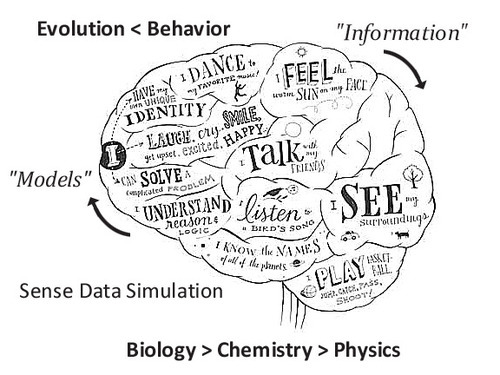
It does seem hard to justify the redundancy and ambiguity of neurotransmitter roles in the presumed functioning of consciousness. If I asked what neurotransmitter is most responsible for generating the feeling of reward, there doesn’t seem to be any that do not qualify. Arousal and reward applies equally to the Noradrenaline, Dopamine, and Cholinergic systems, with the Serotonin system’s correlation to “mood” easily applicable. If neuroscientific correlations with conscious experience were put up against pseudoscientific correlations I wonder how they would fare? How many scientists would submit to a reality show exhibition of medical vs astrological predictions like “Are You Smarter Than A Telephone Psychic?”
Not to diminish the medical application of neuroscience, but when it comes to stepping up to a theory of emotion and sensation, isn’t it a case of the pot calling the kettle unfalsifiable? Are we using fMRI’s and EEGs as a kind of occidental neuromancy – oracles of disorientation? Is the foundation of the neuron doctrine a placebo for scientists? I submit that any given group of ordinary people interpreting a canned astrological reading (or I Ching, numerology, etc), would have a similar level of consensus in a blind test against a group of neuroscientists trying to extrapolate character and destiny information from neurophysiological reports. Medical conditions, sure, but I would bet that when stacked up against Myers-Briggs or any kind of intuitive reading, the neuroscience is measurably more blind for predicting ordinary human personality characteristics.
When it comes to evolutionary genesis of consciousness, Tallis and I are also on the same page.
Think, after all, what unconscious mechanisms have actually achieved: the evolution of the material universe; the processes that are supposed to have created life and conscious organisms; the growth, development and most of the running of even highly conscious organisms such as ourselves. If you had to undertake something really difficult, for example growing in utero a brain with all its connections in place – consciousness is the last thing you would want to oversee the task. p. 176
In this light, we can see that consciousness is actually a disability that could only dilute the speed and efficiency of an automatic mental mechanism. In our weakness and prevarication, we waste precious time in making up our minds when a pure computation would simply yield the most probable success outcome and execute behavior accordingly.
He sees, as I do, that until there is awareness, what is the point of valuing ‘survival’? Without something to tell the difference between one species and another, what does it matter which invisible forms replace each other at any particular unexperienced time?
Tallis talks about the importance of seeing consciousness from the prospective view rather than the retrospective. Not taking consciousness for granted is the most critical aspect of approaching consciousness – to find consciousness from preconsciousness rather than taking the elements of consciousness for granted in justifying their own appearance. I have been calling this “The Elephant In Every Room” problem, and see it is the most significant hurdle that we face in building a 21st century understanding of consciousness.
I think that rigorously applying the prospect view of consciousness from preconsciousness is the only hope we have of not begging the question of the origin of awareness. Of course we can make a wireframe model of agents and actors operating in a world of interactive shadows (data), but why does this data need “us”? If you have actual information already, why invent some phenomenological layer of illusion and an illusory audience to imagine that it is not a simulation? (at least, until the illusory audience evolves to the point that it can teach itself to think that it is questioning the validity of the simulation…which somehow gives us the power to access another, unsimulated ‘reality’).
In his chapter “Bewitched by Language”, professor Tallis exposes the sentimental bias and wishful thinking behind computational models of intelligence. He gets the Symbol Grounding problem, as did Leibniz in his Windmill Argument and Searle’s Chinese Room thought experiment. (Personally I like my example of the polite trash can that waves ‘THANK YOU’ every time you use it). He sees that information is only real in the context of conscious entities using communication devices, and not a primitive substance of pseudo-substance that haunts the universe from the outside.
While Darwinitis requires its believers only to impute human characteristics to animals (and vice versa), Neuromania demands of its adepts that they should ascribe human characteristics to physical processes taking place in the brain. – p.183
…when you personify the brain and bits of brain, then it is easy to “brainify” the person. – p. 187
The author gives us the best and least understood arguments for the failure of contemporary science to grasp the explanatory gap and hard problem of consciousness. It is interesting then, that out of this perfect and wholehearted agreement, I come to diametrically opposite conclusions than he seems to be coming to – which I will get into in the next post.
Sole Entropy Well Model
Another way of visualizing the integration of physics and psyche uses the concepts related to Boltzmann’s entropy curve to conceive of the Totality/Singularity/First Cause as a bottomless fractal entropy well, as follows:
Boltzmann’s idea, as I understand it, is to explain Loschmidt’s Paradox, which (also as I understand it) is basically “If the universe is always increasing from low entropy to high entropy, then where did the initial low entropy come from?”
Boltzmann’s hypothesis places the low entropy we know as the Big Bang as just one of many statistically inevitable fluctuations of entropy distribution. It’s a bubble or wave of non-disorder that we find ourselves in anthropically (because such a bubble is the only context that a low entropy phenomenon like human minds could evolve within). Other possibilities include a Big Crunch type negentropy that accounts for the entropy trough that must precede any entropy rise.
What I suggest is a bottomless low entropy, such that the one event in which any negentropy at all occurs would automatically be the singularity into which all subsequent fluctuations would be swept. Sort of like a black hole for negentropy, hogging all possible signals for all time, banishing any rival Multiverse possibility to perpetual delay.
What this does is place Boltzmann himself, his statistical rules, and their physical enactments all within the anthropic condition in which they are possible. Statistical rules, and laws of any kind including those which define entropy are themselves physical structures which can only emerge from a bottomless entropy well. These kinds of laws and their underlying sense of possibility, probability, events, succession, recursion, regularity, comparison, persistence, etc can only be universal if every part of the universe makes some kind of sense – i.e. has some piece of this infinite negentropy.
Entropy then becomes a property like velocity, (which ranges from stillness to c), a fraction of a totality rather than an open ended scalar quantity. Entropy is a relative measure which has meaning only in relation to significance, such that anything less than 100% entropy has some quantity of absolute significance (Totality-Singularity = 0.000…1% entropy)
This way, the Big Bang becomes a perpetually receding event horizon of absolute and eternal negentropy – a Borg-like ‘bright whole’ which tyrannically absorbs and subordinates all potentials and possibilities into a single continuum-schema. This continuum must accommodate all paradoxes which amounts to a lot of fancy plate spinning and superposition, using devices like nesting outer and inner realism within each other on multiple interrelated yet mutually isolated layers or castes. These devices accomplish what I call the Big Diffraction.


Feeling Real in the World of Sense
We have this idea, these days, that there is a real world outside of us which exists. It exists not because we experience it, but because it’s ‘just there’. The simple existence it has is thought to be absolutely real, but absolutely meaningless and unconscious. It is almost unanimously assumed that there was nobody home in the universe at all before living organisms were born on Earth (or maybe other life-friendly planets).
We also have the idea that there is an unreal world inside of us. We feel a sandwich in our hand, but really it is a vast collection of microscopic molecules and living cells, suspended in an even more vast expanse of emptiness. We see a sky above, but really it is a paper thin layer of gas clinging to the planet. Our sun, just another point of light in the oblivion of astronomical emptiness.
In this view, our perception is thought to mediate, to represent a real world that we can’t understand into an unreal experience that we can understand. The psyche is a transformer, turning meaningless reality into meaningful illusion.
Of course, this presents a bit of a problem when confronted with the fact that when we act on our illusions in the world, sometimes we know what we are doing. Sometimes we actually seem to know more than the illusion is showing us, and we are able to make changes in the real world, using only our illusion to guide us. How might that work exactly?
To my mind, the most plausible way that it can work is if the real world is not entirely meaningless and the illusions of our representations are not entirely illusion. The overlap between the two, is, what I would call sense. The overlap between the two I would call realism. That internal sense which agrees consistently with external conditions, and those external conditions which feel consistent with our internal expectations.
Where they don’t overlap, we get sense but not realism. Theory for the sake of theory. Empirical data which cannot be interpreted in way that we can conceive of (like a particle-wave or dark energy). These make sense in either a subjectively meaningful way or an objectively useful way, but not both.
The more I think about this worldview of an unconscious universe that is hogging all of the reality, and conscious illusion that is hogging all of the meaning, the more absurd it seems and the more it reminds me of the distribution of wealth, technology, and happiness in the world (hint: The happiness isn’t concentrated at the top with the money and tech). What an appropriately perverse worldview during such a perversely unbalanced phase of the Earth’s anthropological experiment.
If we can crack the door an inch and see that sense may not have been born anew with blue-green algae a billion years ago, but has been here all along. In the celestial blooms of nebula and the rattling molecular chains. Events. Happening everywhere. Peaceful places, violent times. Everywhere. Not just in our heads. Not an incomprehensible rock hard nothingness tagged and bagged inexplicably by nerve cells for an audience of one who is really a none.
Without that pre-biotic sense, you have 12.7 billion years of mathematical potentials, accumulating and discharging force in silent obscurity. Invisible and without any association with any human image you might have. A universe without a memory, without a here and now. A universe which, at it’s microcosmic level, cannot tell the difference between something and nothing, as it has no feeling, no awareness to know what those things might be.
Imagine instead a world that is as meaningful as you are, and a life as real and persistent in the cosmos as a galaxy. After all, it is only consciousness that makes a galaxy seem large and slow. Without the sense of perspective and scale, all 12.7 billion years before life goes by as an instant or an eternity. There was nobody there to tell the difference. We are here now to tell the difference, and that is what is real for us. That is the only reality that means anything to us. It makes sense and it’s how we make sense. Adding skeptical inquiry to our naive realism only gives us more of what we had before. If our senses are an illusion, then our judgements about our senses only amplify the illusion. If, on the other hand, we can make sense of the world, then we have only begun to scratch the surface of how such a thing is possible.
Panpsychism Refutation Refuted
From Panpsychism thread on Quora
All arguments in favour of panpsychism emanate from the “comprehending mind”. They are the equivalent of a corrupt programme analysing itself for corruption. The corruption resides in the analytic tools so all results are suspect. There are many arguments in favour of panpsychism, as Paul King and Craig Weinberg have noted, but these arguments absolutely depend on a comprehending mind comprehending itself and becoming entangled with not-self. No external arguments support panpsychism. We can see that complexity throws up unexpected results. Consciousness is an unexpected and counterintuitive result of complexity. We simply don’t understand its genesis. But. The alternative is to suppose that nothing exists until you discover it (there was no gravity until Newton was hit by an apple). That is an absurd position. Panpsychism is a semantic byproduct of thought.
The fantastic thing about sense is that everything in the universe, including the universe itself, makes sense in more than one way. Your argument is completely sensible, and I know first hand because I made sense of things that way for most of my life. At some point, however, I discovered that there was a different way to look at it that makes more sense. Consider the following:
If arguments for panpsychism depend on a comprehending mind comprehending itself like a corrupt program analyzing itself, then arguments against panpsychism depend on the same thing: A bug-ridden debugger debugging itself.
“No external arguments support panpsychism. We can see that complexity throws up unexpected results.”
First of all, I’m not sure what an external argument is. All human arguments begin and end in the ‘comprehending mind’ of the human having them. Evidence from outside of our bodies for things that relate to objects outside of our minds, sure, absolutely. But there is no external evidence of consciousness to begin with. You can’t prove to me that you exist and feel like a person.
Panpsychism (or panprotopsychism) explains this surprisingly well. It’s because evidence is an experience within consciousness and not the other way around (please see my ‘pencil-in-water’ rebuttal: http://www.quora.com/Craig-Weinberg/Consciousness-Insights/160835). You can generate complexity given awareness, but without awareness as an a priori possibility, complexity cannot even generate complexity. Something needs to feel or experience something in order for there to be a difference between simple and complex in the first place. Complexity may throw up results that defy our expectations, but they don’t defy the universe’s expectations if you deny awareness as a primordial ground of being to have expectations within.
“Consciousness is an unexpected and counterintuitive result of complexity.”
Complexity itself is utterly sterile. Without awareness, no amount of stacking of uniform bricks will result in anything other than bricks. Without some form of pattern recognition, we cannot say even how many bricks there might be, what size they are, how long they have been sitting there, etc. There is really no difference between anything and nothing without pattern and experience.
“We simply don’t understand its genesis”
For the same reason that we don’t understand a square circle. Consciousness has no cause, causality is dependent upon experience, memory, and analytical associations among remembered experiences. Without any of those, the universe could only be a single instant of inchoate fragments. To say that we haven’t figured out its genesis yet is to my mind now, a naive assertion of religious faith – wishful thinking in the supremacy of Enlightenment Era approaches to science.
“The alternative is to suppose that nothing exists until you discover it (there was no gravity until Newton was hit by an apple). That is an absurd position.”
No, that is not the only alternative, and yes that position is absurd. It makes the hasty supposition of conflating human consciousness with awareness in general. When applied to criticism of panpsychism, this is a fallacy of begging the question since the panpsychic proposition is itself that awareness is a property that is irreducibly present in the universe, and for me, more importantly *as* the universe. You have to take the next step and realize that even though it wasn’t Newton, there was some first something (an atom? star? spacetime? the singularity?) that experienced gravity, and yes before that experience, gravity as we know it did not exist.
“Panpsychism is a semantic byproduct of thought.”
So are functionalism and materialism. Panpsychism addresses the universe directly, from the inside out. It begins with the Cartesian certainty, that if anything exists for sure around here, it is me. We cannot question that because it will only be ourselves doing the doubting. Only after having faith in our own sense, can we trust ourselves to make sense of empirical evidence from the world of our body. We see people get shot in the head and die. This gives us good reason to believe that a human mind supervenes on a human brain. In the last 500 years we have taken that kind of faith in matter to the extreme. It definitely works on a gross material level…at least until you start choking on the industrial and social backlash.
Now we stand poised on the edge of a next age of Enlightenment. This time the transition may be much more precarious than the last, as unlike in the 17th century, the discoveries are not in-your-face experimental demonstrations of principles that have a chance at shaking bright people out of their religious ignorance. This time, the 21st century discoveries may have to be reinterpretations of what we already thought we understood. We have to face the reality of a world, not that we bring into existence, but which has been brought into existence through billions of years of sense experience on different scales, and which anticipates a temporal unity in which all of those years and all that are to come are but a single moment of totality. This tension, between the retrocausality of the eternal now and the feed forward sense of linear causality, are, I think, where consciousness ‘comes from’. It is not panpsychism that is semantic, it is the entire universe. A sense of significance which divides itself into insignificant fragments which return back to their source on their own. A respiration meta-cycle of meaning and entropy oscillation. Thought is the product of panpsychism. Sense does not emerge from nonsense.
Bent Pencil
“Let us consider the pencil-in-water example. The representation of the pencil in your head is bent. The real pencil is not bent. That which misrepresents reality is, by definition, wrong.”
That is right in one sense, but only when you extend your naive realism (the pencil looks bent) to additional levels of biased realism (I can tell that it only looks bent, and I understand that it is possible for things to seem one way in one sense and a different way in another sense).
What this means is that when you say “The real pencil is not bent. That which misrepresents reality is, by definition, wrong.” you assume that there is a “real pencil” based purely on the bias of perceptual capacities of your human body. Your psychological capacities elevate that low level perception to a more subtle level of interpretation (which is still a form of perception of perception) in which you can entertain a difference between a real pencil and a visual appearance.
I submit that the bent pencil is, in a sense, a much more ‘real’ pencil than the understood straight pencil in that it reflects not only the distant object of physical surfaces of a pencil and water, but it conveys a condensed encyclopedia on optics and perception which lead directly to discoverable neurological truths.
It is the simplistic interpretation of a literal reality that ‘simply is’, independent of a perceptual experience of that reality which seems to be a misrepresentation of reality.
That’s right. Fiction is primordial, fact is contrived.
The Field, Part I
I’m about halfway through Lynne McTaggart’s “The Field”, which is worthwhile even if a little New Agey in style for my current tastes. She does a good job of telling the stories of scientists who have been studying consciousness, and painting a picture of a universe of quantum coherence that consciousness can tune like a radio. In many ways I agree. If I had to flatten my model of the universe, it would probably look just like The Field. I can almost accept a universe of vacuums full of energy and matter as charged space, but I think with a simple inversion, we can find ourselves in a universe of sense and reality, rather than simulation and holography.
I feel that Multisense Realism picks up where The Field leaves off. The notion of zero-point field and holographic transformation of wave interference patterns through microtubule quantum superposition being responsible for human consciousness is visionary, and I think almost true, but it still doesn’t jump from the easy problem to the hard problem. This view doesn’t explain why, if you have holographic interference patterns that contain tremendous amounts of information, why would it get transformed into anything other than what it is? Why does the transmission and reception of zero-point light feel like something?
If we turn this model inside out however, we might say that it is not wave interference patterns that are transformed holographically into experience, but multidimensional experience casting a 3-D shadow as holographically interrelated waving objects. It’s not wave patterns being reconstituted as a simulation or projection, but fantastically rich experiential realism that is being stepped down into flat quantitative mechanisms across space.
In the same way, the observation that “Consciousness at it’s most basic, was coherent light” would make more sense as “Light, at it’s most basic, is coherence (sense)”. Instead of this metaphysical notion of matter being eddies in a cosmic sea of light, we should ask why it is that our naive realism always seems to show us the opposite – a universe of objects in space, islands of light and coherence in a field of emptiness. We should ask why it is that tiny bits of substance can profoundly impact our minds and bodies, but rhythms and frequencies don’t seem to have much of a universal semiotic consistency. Seeing a graphic visualization of music has only vaguely consistent association with the aural experience of it. I’m not advocating naive realism, but rather than a counterintuitive metaphysics of quantum mechanical waves in space time creating a holographic consciousness, I suggest a counterintuitive physics of matter creating time and space by waving at itself. We are who is waving. Hollow, boundary-less, and eternal, but concrete and real – local temporal confinements of a timeless experiential firmament. There is no ‘light’ in space, only in our experience. Our ability to sense visually is activated through illumination of the sense organs themselves.
Where we are now, most of us can only conceive of an exteriorized universe. Even though our every moment of life is clearly spent as an interior narrative of an exterior circumstance, we assume that this is limited to living creatures. If we extend the possibility of interiority to all matter, we find that the external symptoms of consciousness – energy, coherent light, patterns, zero point field, etc is only the surface layer that is available to us through the stepped down architectures of our body and the instruments we have made for it. In a universe where matter is literally experience, the temporal distortions of General Relativity can give us a clue as to how different kinds of perception might co-exist, nested within each other, not just holographically but holotemporally. Time within time that can be modeled as inertial frames of scale from microcosm to macrocosm, confined to particular ranges of experience by frequency and wavelength. Not energy in space pretending to be matter, pretending to feel, but feeling through time re-presenting itself as energized matter across space.
Philosophy of Mind Reblog
Reblogging a post on consciousness that I like, and trying to chart a course from it’s logical conclusion to one which I think makes more sense.
omegaphilosophia: Utilize Philosophy: On Consciousness
Our method for perceiving objects is to look upon them from the outside of them, though granted we may perceive the innards of an object, but even then we are outside the innards looking upon them. However, for ourselves, we appear to be an object inside our bodies looking outwards at phenomena….
Ah, so close. I love what he has done with explaining how even the innards of objects are really still just the outside of smaller objects. The snag comes toward the end, and this is the snag that I think most people encounter with consciousness, and that is taking awareness or sense for granted. The OP writes:
Let us return to the basic description of consciousness, which is “awareness of one’s own existence.”
I disagree here, and it is a subtle but critically important point. Consciousness is awareness period. ‘One’s own existence’ is part of the contents of experience. I can dream without the existence of a self or a dreamer. I can watch movies and be immersed in the story and world of the movie without being conscious of my own existence.
If the consciousness is an object that looks upon other objects from the inside of some object, how is it aware of its own existence?
It’s not an object. It’s the opposite. I would say that it is a subject but it’s not even that…consciousness is the source of subjectivity – the capacity for awareness itself. It is the non-object which contains (metaphorically) all subjects.
How is it aware of it’s existence? Through sense. Our sense ‘insists’ that we be made aware of influences which are potentially significant to ourselves, our body, our social group, our species, etc. Sense is the bridge between the self and the universe, but sense is also the continuum which manifests as self, universe, and the anomalous symmetrical continuum between them.
For consciousness appears to be aware of many objects, but none of them can firmly be considered consciousness. And consciousness doesn’t seem to possess the ability to look upon itself, and if it has, how will we know?
“How will we know?”, again, through sense. Truth makes sense. That’s how we can know anything, and there is no other way that anything has ever known anything. Knowledge is nothing but an agreement of multiple sense-making channels which convinces or fails to convince the executive senses (self) to internalize that agreement.
We become aware of the existence of other objects, physical or mental, by a perception of them. However, we claim such a thing as consciousness exist, without having any perception of such a phenomena;
If it helps, don’t think of consciousness as something that exists, but something that insists. Existence is a subset of insistence. We are a mind in a brain, but the only way we know what a brain is and how it might work are through the mind. It’s a Mobius loop of involuted, self-referential, redundantly redundant ontology (see also).
for we can not perceive consciousness physically nor mentally.
This is the trap of disorientation. It is overthinking it to try to perceive perception. Sense is the bottom layer, there is no description level beyond that as consciousness contains description itself. It is to say ‘I can’t move my arm because I can’t perceive how exactly I do that’. Right. That’s because it’s actually your arm. You just move it directly. No mechanism is required subjectively for you to move it – it’s like The Force…”reeach out with your feelings Luke”.
how can we claim to know the information we are receiving is true?
We don’t have to. We can say with absolute certainty that is seems true, and that is the epistemological standard for subjectivity, because subjectivity is not an object. It doesn’t work that way. Fact is actually a type of fiction, and fiction is the only fact (ie, existence is a function of perspective, which is a function of detection and response).
My personal fix to this dilemma is to be rid of the concept of consciousness completely.
This is the same solution offered by Daniel Dennett and others as well. It’s sort of setting yourself on fire to make it easier to find wood for the fireplace. How does one have a “personal fix” to “dilemmas” without being conscious?
This, however, would require some alteration to one’s model of reality, particularly a will caused solely by the brain. For we would no longer be able to claim we were in control of our bodies unless when we use the term “we” or “I”, we are referring to our brain.
Not so fast. My interpretation requires a bit more alteration to one’s (now nonexistent?) model of reality. Just because the mind and the brain are the same thing doesn’t mean that the brain is real and the mind isn’t. We command our brain consciously, and our brain commands us as well. We can’t claim that we can no longer claim something if that which we disclaim is the ability to claim anything at all in the first place. We don’t have the power to deny our awareness. It is not an option.
It all comes back to the initial assumptions:
Our method for perceiving objects is to look upon them from the outside of them, though granted we may perceive the innards of an object, but even then we are outside the innards looking upon them.
So far so good…
However, for ourselves, we appear to be an object inside our bodies
No, non, nein, nay, negative…. We have no appearance inside our bodies. We appear to be looking outside of our body, to feel things inside of our bodies with special personal significance that seems close to us, but at no time do we appear to ourselves natively as an object. We can embody objects or characters, or we could try to objectify who we are with terms like soul or essence, but ultimately we are not even that. We are the subject. We insist through time, but do not exist across space. Unsettling, yes, but this is how reality works. If you had to make the universe from scratch, you could not leave this most important feature out – how it feels to participate in a world, how narrative experiences work.
looking outwards at phenomena. This is not only the case for physical phenomena, but also for mental phenomena; for when we utilize the mechanics of imagination, we still appear to be an internal object looking upon some external phenomena (inside ourselves)
Same for dreams and imagination. We aren’t an internal object until we try to label ourselves as such. This is the ‘elephant in every room‘ phenomenon. All you have to do is understand that sense is what allows us to look through the mirror rather than look at just the silvered glass. It allows our subjectivity to extend through matter on many different scales simultaneously, providing discrete access with selective attention even as it condenses all of the meaning in a generalized presentation (I call a perceptual inertial frame, or you might say niche or world).
Once you see how this extension might work, from the figurative through the literal to the figurative, you can perhaps see how the literal and figurative nature of things can only be considered qualities of perception or qualia. What is solid rock for a human being is like a thin fog for a flying neutrino (if there even is such a thing). In the same way, our human thoughts and experiences may seem like evanescent puffs of nothingness fading through ‘time’, on some more inclusive inertial frame may seem like concrete crystalline towers of juicy, aromatic human suffering and joy. Musical monuments of lives being lived in visible 3-D terrain.
Consciousness is a real as a brick or a donkey’s ears. It’s also more than real and less than real, in its super-signifying projections of heroic perfection and fantastic delusions. The contents aren’t always consistent with every other inertial frame we live through. Not everything makes sense on every level. Some shows are just for us personally, and have no value for others or the world at large. Some shows are unreal but we can make them more substantial over time with attention and effort.
Antonio Damasio: The quest to understand consciousness
In this TED Video, about two thirds of the way through, he mentions something I didn’t know about the brain stem which I think supports both the idea of a sense-motive primitive in consciousness, and the idea that consciousness scales relativistically from being to being. He says:
“This is so specific that, for example, if you look at the part that is covered in red in the upper part of the brain stem, if you damage that as a result of a stroke, for example, what you get is coma or vegetative state, which is a state, of course, in which your mind disappears, your consciousness disappears. What happens then actually is that you lose the grounding of the self, you have no longer access to any feeling of your own existence, and, in fact, there can be images going on, being formed in the cerebral cortex, except you don’t know they’re there. You have, in effect, lost consciousness when you have damage to that red section of the brain stem.
But if you consider the green part of the brain stem, nothing like that happens. It is that specific. So in that green component of the brain stem, if you damage it, and often it happens, what you get is complete paralysis, but your conscious mind is maintained.”

I had previously posted this image which correlates the brain-spine morphology with head-tail morphology and implies an underlying isomorphism of concentric-polar or radial symmetry being related to afferent (inbound) perception and linear-projective or Cartesian x,y,z+t sequential relations being associated with outbound, efferent motives.

Even though we are so much larger and more sophisticated than mammalian gametes, this pattern of an active emitter and a passive collector remains surprisingly simple. The upper part of your brain stem gives you access to sense, the lower part lets your motives access your body (and by extension, the world).
As good as Damasio is at revealing the consequences of brain architecture, I think that he, and really everyone else that I have been paying attention to, are still unintentionally sweeping the hard problem under the carpet. In every case, possibility of awareness itself is taken for granted. Patterns have only to be present in the brain for us to assume that there would be some sort of ‘awareness’ of them as patterns and a capacity to ground that awareness somewhere else besides within the tissue of the brain. Sure, once you have a such thing as experience, we can understand how the brain can modulate, suppress, and organize that experience, but there is still no sign of anything that converts such quantitative neurological functions into anything other than what they seem to be in an MRI – groups of cells signalling each other. No different really than any organ except perhaps in sophistication.
To think about consciousness clearly, it is important to recognize the difference between the afferent-efferent (inbound-outbound) form of the communication and the sense-motive (qualia of afferent-efferent) content of experience. It is difficult to break the habit we have been acculturated to of seeing the world outside of our body as being the container of the self rather than the other way around, but with practice, we can begin to see how perception and experience have produced not just one world, but many worlds within worlds.
War of the Worldviews
In comparing popular worldviews and philosophies of mind, a distinct polarizing pattern arises which I call ACME (Anything Can Mean Everything) and OMMM (Only Material Mechanisms Matter). While each side has compelling reasoning, best intentions, and powerful claims to authority, it is the symmetry and ferocity of their opposition to each other that I think proves enlightening.
What I am attempting to show here is how extremism in either camp stereotypes the other camp, making itself an unreasonable caricature of reason in the process. To begin with, the two camps disagree on basic definitions:
ACME OMMM
universe = absolutely spiritual universe = absolutely material
subjective imagination rules objective empiricism rules
Tarot, I Ching, Prayer Quantum Mechanics, Economics
charismatic love cause and effect
‘top down’ meaning and order ‘bottom up’ probability
superstition, mania, pareidolia, woo cynicism, depression, reactionary
naive, simplistic jaded, dismissive
identification with the divine will identification with inanimate logic
life=spirit-ghosts, matter=illusion life=zombie-robots, matter=fact
objective world is a dream, maya subjective world irrelevant
time = synchronicity, zeitgeist time = uniform duration; t
I AM THAT I AM i = square root of negative one
How OMMM sees ACME:
Like the ubiquitous manufacturer of cartoon products, ACME is Cargo Cult optimism. A naive belief, rooted in pareidolia/apophenia that the cosmos exists to provide one with whatever one wants, (so long as the recipient is worthy of said blessings).
This is Santa Claus, pure and simple. The universe is your vending machine, with all the universe’s comforts and satisfactions available to you simply for the asking. A prayer, a sacrificial offering, some mumbo jumbo, and a bit of humble narcissism is the only coin required to nudge the supreme creator of existence into doing your bidding. God is your parent, partner, confessor, forgiver, and servant. He loves you even though you mainly talk to him when you think you might want something from him. He’s omniscient, but really he can’t see through your transparent pretense of needy, fear-based petty egotism. He really favors you only because you’re more deserving – you’re special, you’re saved. Your accidents happen for a reason. There are no coincidences. ACME provides everything for free in a universe devoid of respect for real world circumstance.
How ACME views OMMM.
Like a mantra of determinism, OMMM is so Western that it has become Eastern without knowing it. Meaningless and repetitive, the worldview of physical facts and figures literally leaves nothing to the imagination. We are the universe’s powerless prisoner. Rooted in the strong teleology that the universe is devoid of strong teleology, OMMM is blind faith in the power of transcending blind faith.
The human subject is conceived of as a solipsistic blob of deluded protoplasm that nonetheless is the sole source of rich perception in an unconscious universal machine. Human consciousness is seen as an impressive but unexceptional function of a machine; a statistically inevitable consequence of complexity and simple physical-arithmetic laws.
OMMM takes the role of a voyeur, detached from the cosmos as a medium of pure skeptical logic, yet its fundamental terms are a rich tongue-in-cheek mythology of dark matter, black holes, anti-particles (that are also anti-waves?), indivisible quark trinities, etc. What we don’t find is any sign of ourselves or our lives.
Instead the pinnacle of human development seems to be to function as an empty vessel of observation, a pristine and empirical anti-guru who has shed all human identity and mortality to bestow upon the foolish masses the crystal clarity and unflinchingly defiant message of enlightenment. Its Anti-Cogito: ‘There is no proof of consciousness – you just think that you think, therefore you aren’t.’ You have ‘become none’ with the epistemological supremacy of the Youniverse. Dissolved into the bliss of science. OMMM.
Having experienced being a supporter of each side of ACME-OMMM battlefield, I now see them as natural extremes that human consciousness is prone to. That the theme of subjectivity and objectivity is embodied directly in these extremes should be a clue to us that they are only at war on one level but are essentially the same impulse on a deeper level. I feel like I have benefited over the years from exploring both sides, but that ultimately I find the extremes to be crutches to help us lean on one side of reality or the other without having to embrace full spectrum realism. We get comfortable in our familiar psychological territory and we reinforce that tunnel reality, selectively ignoring, distorting, and denying those aspects of the continuum outside of our comfort zone.
Cosmos is a word for order, and that’s what the cosmos is and that’s what it does. It makes sense, it builds private pockets of significance through experience and it kicks out entropy in the form of dissolving forms across public space. Some order is subjective, pulling us toward meaning and the self, some is objective, falling meaninglessly into habit and evanescence. When we contemplate a universe in which either the objective and subjective sense monopolizes the other completely, I think that what we get is a monosense unrealism. What I suggest, is that we incorporate even those extreme specializations in the opposite ontology: A Multisense Realism, in which every nonsense makes a kind of sense from some perspective, and every sense is nonsense from some perspective.
In between the two ACME/OMMM poles, we may find a spectrum of worldview that honors the empirical realities without sacrificing the enchantment of the Cosmos and the Self. No Santa Claus, no Frankenstein, but fully real people, real worlds, real characters and destinies, with all their dream filled, deluded dramas and scientific revolutions.
Ultimately the neurological processes that support our human conscious experience are no different from those of the rest of the Cosmos. If there is meaning in here, there is at least the capacity to support meaning out there. The idea of a Cosmos that manages to evolve a hundred trillion cell organism with an experience that is positively dripping with layers of meaning, order, and purpose without getting even a speck of it on itself is a little far fetched. By the same token, the existence of those hundred trillion cells, their molecules and atoms, seems a little elaborate for a universe that could get by on abracadabra if it wanted to. I suggest that it is the symmetry of fact and fiction, knowledge and mystery that is closer to the primordial firmament. If I had to build a universe from scratch, that is how I would begin the recipe.
Primordial Syzygy
syz·y·gy
[siz-i-jee] noun, plural -gies.
1.Astronomy . an alignment of three celestial objects, as the sun, the earth, and either the moon or a planet: Syzygy in the sun-earth-moon system occurs at the time of full moon and new moon.
2. any two related things, either alike or opposite.
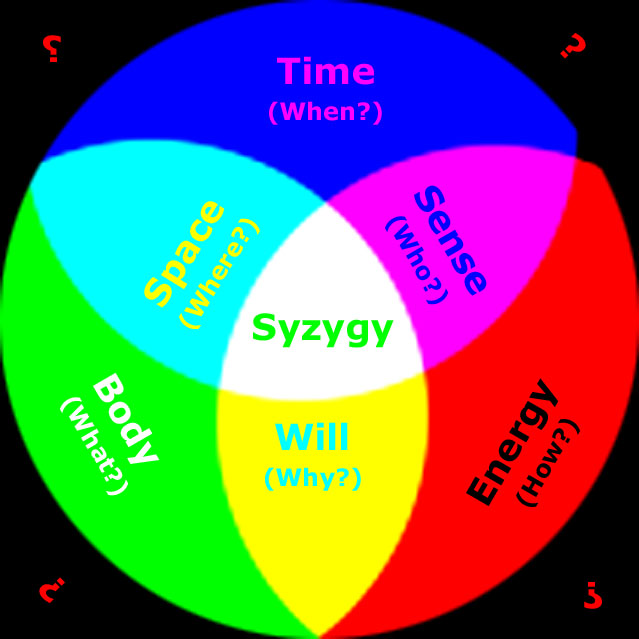
This is the primordial syzygy for multisense realism. The overlapping RGB regions can be grouped in different ways to bring out different meanings.
The primary spectral hues with the perimeter orientation are juxtaposed with the pastel hues having center-radial orientation. This produces a dialectic of subjective introversion versus objective extroversion as well as a three syzygies:
Subject Thesis (Who & Why, Sense & Motive, Pink & Yellow) minus Space (Subjects are always ‘here’)
Object Antithesis (What & How, Matter & Energy, Green & Red) minus Time (Objects are always ‘now’)
Realism Synthesis (When & Where, Time & Space, Light Blue & Deep Blue) is inferred by triangulating Subject & Object
Using this symmetry to solve the Hard Problem and bridge the Explanatory Gap:
Think of the living brain as the what and how of what we are, and consciousness is the who and the why. Neither supervenes on the other but, neither are they separable entirely. Like the syzygy, they are elements which are separate in some sense, united in some sense, overlapping and underlapping in some sense, defined by each other in some sense, and defining a super-signifying whole which is more than the sum of its parts in another sense.
Consider that of the seven billion people alive today, each one has a different identity and life, yet we all share more or less the same physiology. We cannot expect to locate the who & why of our identity in the what and how terms of our body.
The question marks outside of the circle represent the another dialectic, between the anthropic significance of the syzygy and the a-signifying mechanism of entropy.
”?” is used to connote the unconscious fully. Not merely the absence of awareness but the absence of the capacity for awareness of the absence. There is nothing there to signify a label of nothingness or oblivion, it simply is not anything.
Syzygy vs ?:
acceleration vs inertia
sequence vs consequence
significance vs entropy
pattern vs coincidence
initiative vs randomness
signal vs noise
orientation vs disorientation
teleology (purpose) vs teleonomy (evolution)
animism vs mechanism
augmentation vs cancellation
positive vs negative
multiplication vs division
Tags: consciousness, cosmology, explantory gap, hard problem of consciousness


Recent Comments