Archive
Merely Mortal
Merely Mortal: Qualia and Nonformation, Part I
Ever since being introduced to mereology by my friend and philosophical co-presenter/mentor, Stephen P. King, (you can hear one of those introductions in our recent radio chat), I have thought in the back of my mind that there is either something promising or distracting about it. Is it a piece to the puzzle, or a piece that doesn’t belong? This itself is something of a mereological question.
Underlap Uxy =df ∃z(Pxz ∧ Pyz)
Overlap Oxy =df ∃z(Pzx ∧ Pzy)
Proper Parthood PPxy =df Pxy ∧ ¬ Pyx
Equality EQxy =df Pxy ∧ Pyx
Proper Parthood PPxy =df Pxy ∧ ¬ Pyx
Proper Extension PExy =df ¬Pxy ∧ Pyx

Reflexivity Pxx
Transitivity(Pxy ∧ Pyz) → Pxz
Antisymmetry (Pxy ∧ Pyx) → x=y
Mortality and mereology seem like an unlikely pairing at first glance. Mortality is such a powerfully real and ubiquitous influence on living beings and this philosophical study of parthood relations is so abstract and obscure, but what is it death except a cessation of wholeness? A bullet hole will perforate and fragment, a heart attack will stop the circulatory support for the brain, old age will chip away at all of the systems until one part fails to prop up the whole. Death, decay, and disintegration are closely related.
With Stephen’s knowledge of mathematics and philosophy, we have long been trying to put our finger on the precise nature of the subject-object dualism. While my mind favors word pairings rooted in direct experience, like literal-figurative, sensorimotive-electromagnetic, perceptual-relativity, and significance-entropy, his intellectual territory covers more formal models of analytical mathematical truth, the Stone duality, The Pontryagin duality, Bisimulation, Non-wellfounded Set Theory, etc.
Stone Duality relates algebra to geometry:
Putting Stone’s programme in categorical language, let A be some category of “algebras” and S one of “spaces”, the exact nature of which we leave open. Then by a Stone duality we mean an adjunction
in which TX is the algebra (maybe of open subspaces) associated with a geometrical object X, and PA is the space of primes of an algebra A.

What is Abstract Stone Duality?
It is a revolutionary theory of topological spaces and continuous functions that treats them directly, just as traditional geometry was about lines and circles, without smashing the continuum into dust. ASD provides a natural language for real analysis that describes the solution-space of an equation continuously in its parameters, even across singularities. Since it is presented syntactically, in a way that generalises ordinary algebraic notation, it is inherently computable. It was inpired by Marshall Stone’s study of the categorical duality between topology and algebra, taking his slogan “always topologize” seriously by topologising the topology. It also exploits the analogy between continuous and computable functions, on which Dana Scott built the theory of denotational semantics of programming languages.
Pontryagin duality (file under ‘how can anyone understand this):
The 2-adic integers, with selected corresponding characters on their Pontryagin dual groupthe Prüfer p-group or the p-quasicyclic group or p∞-group, Z(p∞), for a prime numberp is the unique p-group in which every element has ppth roots


Non-wellfounded sets and Bisimulation:
From the trusty SEP:
“The term non-wellfounded set refers to sets which contain themselves as members, and more generally which are part of an infinite sequence of sets each term of which is an element of the preceding set.
…The topic of bisimulation is one of the earliest goals in a treatment of non-wellfounded sets.
Let (G,→) be a graph. A relation R on G is a bisimulation if the following holds: whenever xRy,
- If x → x′, then there is some y → y′ such that x′ Ry′.
- If y → y′, then there is some x → x′ such that x′ Ry′.
These are sometimes called by the suggestive names zig and zag.

The Stone duality in particular has come up early and often as a natural fit for what I see as the ACME-OMMM continuum (is it too pretentious to call it the אΩc?). Stephen has suggested that my conception of the אΩc maps to the Stone duality; that the relation between subjecthood and objecthood is equivalent to the equivalence between topological spaces and logical algebras.
I agree that topological spaces are a good match for the ‘Occidental/West’ OMMM side, but I’m not sure that logical algebras could define the subjective picture completely because logic does not persuade us in our poetic modes. Algebra might offer something, given the etymology of the word:
Algebra (from Arabic al-jebr* meaning “reunion of broken parts”)
This is important because it fits with my idea of qualia as subtractive gestalts. By subtractive I mean that our experience of making sense is of recovering gestalt wholeness through eliding or subtracting out the gaps. In this sense, qualia can be described as the ur-algebra, from which all algebra follows.
In the Stone duality too, algebra is distinguished from geometry especially because of its ability to represent a continuous process rather than a static grouping of vectors. This continuous nature of algebraic process fits with my understanding that ‘time’ is not a natural primitive but an artificial derivative of experienced qualities like sequence, symmetry, and repetition.
Repetition requires at minimum that something can identify that something seems:
- identifiable as different from everything or anything
- identical in some way, even though it is instantiated separately
- identical to an instantiation that is remembered as a previous instantiation
Here I am trying to get under the floorboards of the Church-Turing and question what mathematics takes for granted: Pattern, pattern recognition, sense-making. Symbol grounding and realism will come later as a consequence of multiple sense channels.
The word algebra then has two important pieces to the ACME side – the idea of subtractive gestalts and continuous process. So far so good. The problem I have is with the mathematical constraint. Logic, binary or otherwise, is the life’s blood of all of mathematics and while life is filled with logics, I am convinced that we cannot get to feelings and participation from number operations alone.
With the poetic heights and psychotic depths of far ACME (‘Oriental/East’) phenomenology, it must be recognized that there is a reason that logic seems to fail us. Logic gives us ideal truth values of 1 or 0, but not experiential-particpatory values of good or bad. Our sense of ‘awesome’ or ‘horrifying’ is not simply doubleplus true/untrue. I think it is more accurate to say that our qualities of experience cast shadows that can be quantified, but it is not possible to reconstruct the experience from only those shadows.
If someone had to recreate our universe from scratch using only our descriptions of it, there is no way they could wind up with anything like what we experience using only a logical, rational framework. We need something beyond forms and scripted processes, beyond parts and wholes, something like Trans-Rational Algebras and Immereology.
Merely Mortal: Symmetry and The Self, Part II
In part I, I looked at applying (my limited understanding of) the Stone Duality to the multisense continuum. The idea of logical algebras vs topologies makes sense in many ways to describe how subjectivity contrasts with objectivity, especially if we treat the topology side literally and the algebra side figuratively.
Algebra is interesting because it distills the representational power out of numbers and uses it against them. The idea of “x=” is a spectacular bit of basic intellectual gymnastics, and I would say the foundation of all higher math and science. One of the reasons why it is so important is that it represents a discovery of something about how we think in the real world. Put these together and algebraic transformations give us the power to mechanize real world processes. A formula is a kind of template of formed sense, an idea of a set of ideas which are crystallized or fixed like a mold through which we can conduct a customized yet auto-matic process. Automatic: Self-willing. It does the work for us.
To accomplish this automation of logical function, algebra relies on certain active ingredients besides ‘x=’, such as symmetry. Symmetry is so fundamental that it is difficult to explain what it is beyond simply pointing to an example of it. The Wiki on symmetry defines it with a familiar dualism:
Symmetry (from Greek συμμετρεῖν symmetría “measure together”) generally conveys two primary meanings. The first is an imprecise sense of harmonious or aesthetically pleasing proportionality and balance; such that it reflects beauty or perfection. The second meaning is a precise and well-defined concept of balance or “patterned self-similarity” that can be demonstrated or proved according to the rules of a formal system: by geometry, through physics or otherwise.
Although the meanings are distinguishable in some contexts, both meanings of “symmetry” are related and discussed in parallel.
That parallel is also the same parallel of ACME-OMMM. Symmetry is a both a subjective aesthetic experience and it is a deferred experience of calculation also. Symmetry imparts both a feeling of significance and it can be computed as an arithmetic relation. How does it do this? Understanding symmetry seems to hold the key to understanding sense itself.
To experience symmetry, first there has to be pattern recognition to separate and define something as distinct from everything. You need a form of attention that not only allows attention to forms, but qualitatively appreciates form in general. This would seem to transcend the assumptions of theories of qualia based on representation alone, as symmetry detection evaluates not only what a particular form means but the degree to which it fulfills an expectation of completeness. Symmetry is part of that completeness, and but it is a part which has a special twinkle. It amplifies significance, so that the more nested levels of symmetry you add, the more of an impression (for better or worse) it makes.
This is at the heart of how sense makes sense; to present, to represent, and to infer the representation through the unpresented difference. We are compelled by what is absent to infer it ourselves. In this way we are personally woven into our experience of the world. Our participation is embedded in the presentation from the start through metaphorical feedback loops which continuously augment underlying expectations of wholeness, equality, fairness, etc. Symmetry. The degree of explicitness and robustness with which these expectations are fulfilled is the wave function of mood and the glue that holds the particles of logic. (Note the Stone duality of mood topology vs logic algebra)
To quote Intothecontinuum:
“Symmetry is merely an expression of how something stands in relation to itself.”

This strikes me as more profound even than it seems. So much so that I would excise the word ‘merely’. The idea of something standing in relation to itself is nothing short of a miracle. In order to relate to itself, something has to be able to, in some sense, also not be itself. This is how identity functions. To say A=A only works because the sameness of A and A is brought to our attention by presenting them grammatically in two separate instances. We mentally fill the gap between the two lines of the equals sign, which is the same gap between the two A’s. Through a presentation symmetry, we are invited to infer an unpresentable relation.
This happens through time as well, through tempo and rhythm. Wholes become parts by reflecting wholes. This is what vertically integrates the different levels (castes) of perception and structure. Each level recapitulates the others in a fisheye distortion of frequency and scale that presents its own inertial frame, with itself as the nucleus, as the maximally significant frame. The good news: sanity. We don’t have to be aware of the problems of every part of the cosmos. The bad news: isolation. To have richly qualitative subjective experience, you have to borrow the significance from somewhere.

Where experienced consciousness differs from anything that logical algebras can produce is in the way that problems are solved rather than savored. To solve (here we go again…solace, solar, soul) is to stand, to make still, but not to understand. It does accounting but no explaining. Our experience of self shaped not only by the need to solve (like gravity, to seek static unity) but to revolve:
(from L. revolvere “turn, roll back,” from re- “back, again” + volvere “to roll” (see vulva). Meaning “travel around a central point”)
Most everything we do is a circuit. It’s Monday, again. It’s summer, again. Time to do the laundry again, etc. Circuits within circuits, we revolve around a multi-symmetrical meta helix of nested perception.
I remain convinced that these purely mathematical approaches are too aloof from the kind of visceral substantiation that I am looking for. Logical algebras can solve parts into a whole*, but the whole is still an abstraction no different than the parts. There is no symbol grounding, no core authenticity to lend realism.
Add a new kind of mereology to this though, and maybe we can get somewhere. In the actual universe in which we live and breathe, perhaps we need to compare apples to pomegranates instead of apples to apples (this is opening up a whole other Middle Eastern synchronicity apparently).

The parthood that we see in mereology is one which turns logic toward understanding the computable aspects of parts and wholes from a topological perspective: a literal or conceptual compartmentalization.
(16) Everything is part of itself.
(17) Any part of any part of a thing is itself part of that thing.
(18) Two distinct things cannot be part of each other.
If we turn this around however, and focus on the orthogonal axis: time/subjectivity instead of space/objectivity, I think we can see a different picture. If our wholes and parts are subjects rather than objects, participatory ‘apartments’ rather than bounded compartments, then the idea of selfness and ‘itself-ness’ takes on an entirely different, opposite meaning. Note the difference; selfness is like Leibniz monad, solipsistic and divided while itself-ness includes defines sense of self as a sense of a sense of self. This relates to what I call solitropy.
- Every ‘one’ is an awareness of the availability of the experience of being alone or apart, which has a quality of solitude.
- Being apart can only be defined against a background of being unified or ‘together’.
- All experiences are a part of each other, but not identically so. For this to be possible, ‘likeness’ is how sense organizes and orients itself.
*Algebra (from Arabic al-jebr* meaning “reunion of broken parts”)
Merely Mortal Part III, Qualia and Language
Since we can use mereology to address topologies, and through the Stone duality we see how topologies and algebras are related, then what is required to understand subjectivity is a kind of anti-mereology. Unlike measurable forms and functions, every felt ‘thing’ (experience) is defined not only by being a part of any one thing, but instead reflects meaningful gestalts that potentially relate to all other experiences. The qualities or qualia that we experience seem to be part of an orderly palette which serves to bind us to an orderly life experience. The inexplicable perceptual notes and pigments make up this palette are exquisitely granular yet broadly inclusive, and through this, they bind us as caring participants to each moment of our life in the cosmos.
Qualia doesn’t stop there, though. Serving as the orientating principle of what is sane and real to us is just the beginning. The connection of self to umwelt (niche which reflects the expectations and requirements of ourselves>culture>species>physical form) is the basis of all significance, but we have elaborated these presentational bookends of I and it into a hyper-universe of dynamically self-enriching extensions. Re-presentations. Symbols. Quantitative models, maps, and metaphors. Words.
Human language utilizes multiple sets of qualia which ‘insist’ within various inertial frames or channels of perception. Within the cognitive channel of our understanding, these frames of perceptual relation can be seen to be like horizontal slices of a vertically stacked whole:
- Meaning: Sensory-motive layer. The raw feels of our afferent perception and efferent participation as conscious living beings. It is this ground floor of qualia that is the direct presentation to which all layers of representation must ultimately resolve.
- Showing: Gestural-emotive layer. Body expression and non-verbal communication. Steven Pinker has some interesting things to say on this, although I think focusing on linguistic formalism is not the way to understand consciousness itself – rather, language is a container or vehicle for consciousness.

- Speaking: Laryngeal-acoustic layer. Humans are great at making and controlling sounds with our larynx and we are good at distinguishing them from other sounds. We have taken it to a whole other level, with precise mimicry and richly communicative vocal textures. Voice is not only for yelling and and whispering, but singing, orating, dramatizing, etc.
- Writing: Optical-graphological layer. Our visual system is good for seeing and remembering shapes and our hands allow us to inscribe those shapes on whatever suitable objects we have available.
- Communicating: Linguistic-symbolic layer. Speaking, writing, and expressing communication are direct qualia in themselves, but they are multiplexed also. Our understanding begins where the limits of the physical acts associated with communication leave off. Our lives continue in the hyper-reality of symbolic extension, seamlessly blended with our perception of the outside world. We see and hear direct meaning through the semiotic forms that we have adopted.
Language has given us a new hyper-dimension of sense through an explosion of grammatical conventions and multi-layered semantic logics. It has opened a synthetic channel of verbal semiosis which bridges the gap between minds (as well as widening the chasm between them). In one sense, communication is a simulation of multiple separate instances, but in another sense it is a dissemination of a potentially unified common sense which is accessible from multiple locations or times. Language provides a truer isomorphism to interior experience than gross physical behaviors can provide. As in a dream, many hours or lifetimes can be condensed elliptically into a single story-time that is passed from person to person and group to group. The story itself evolves and takes on the qualities of different groups as it accumulates character specific to the times, places, and people who participate in the communication.
Communication allows us to elide the gaps among the elements of stories so that what can be expressed goes well beyond the limitations of the here and now, increasing our mental capacities immensely. The spread of communicated forms elides the distance between subjects themselves and weave an invitation to commune upon a common sense. Combining these two propensities to converge subjects and subjectivities, we make possible a recovery not just of an actual whole but of a potential whole; thesis, hypothesis, communicated ideas and ideas about improving communciation of ideas. A symmetry not only of parts across space but of participation through time that intentionally amplifies and consolidates intentionality. Human creativity is a revelation of novelty, a dis-covery of a future, not only a production of useful accessories.
This is not to say that all experiences exist as a priori complete facts somewhere and we are just reissuing them, but that experiences insist as potentials, and it is our participation and voluntary interest which brings them from fictional insistence into factual existence. Interest alone doesn’t magically cause things to exist, but interest motivates us to find opportunities which progress our efforts or convince us to give up. This experiential psychscape doesn’t make sense from a mechanistic perspective. Unlike conventional mereology, with subjectivity, every part of every experience is itself independent of that experience, and every distinction between experiences can only be made in the context of underlying unity between them.
The functionalist has no way to ground motive in anything purely qualitative. A musical masterpiece cannot be explained in terms of quantitative terms, where any composition with the same amount of harmony and variation would have to be equally esteemed. There is no appreciation for the semantics of language, the aesthetic dimension of poetic resonance not just of forms to forms, but content to content, content to form, and formed content to novelty and revelation of unified communal truths.
Merely Mortal Part IV: Making Some Sense of Subjectivity
The multisense realism approach includes the following convictions and conjectures:
- Something very important is missing from all of our current models of consciousness.
- The missing piece is not an obscure and distant mechanism but rather is the plainly obvious coherence and qualitative significance of experience itself.
- Instead of looking for this piece as a consequence of forms and functions in the world, we might also consider that forms and functions are symptoms of perception and participation. (Not necessarily human perception, of course).
- Reality or realism arises through the recovery of agreement between multiply diffracted channels of perception and participation (aka ‘sense’ and ‘motive’ or afferent/inbound and efferent/outbound phenomenology)
The relation between forms and functions (geometric topologies and logical algebras) has been formalized through the Stone duality. For every geometric form there is a corresponding algebraic function. I have proposed a similar correspondence in what I consider to be a more authentic representation of the cosmos in the form of the ACME-OMMM continuum (אΩc). In the אΩc, the forms and functions covered by the Stone duality are only half of the big picture. The other half, the ‘Eastern’, ACME facing half can be understood as having qualities which are perpendicular or orthogonal to those conceived of by Stone, while at the same time having common themes.
Quantitative relations are rooted in the mereology of objectivity. Rules about set membership and well-foundedness present a schema of precise internal consistency. I suggest that the lack of such a schema of certainty and discrete mereology in subjectivity is not an accident, but actually is a clue as to the genuine and concretely real nature of phenomenology. Where algebra employs logical functions, aesthetics and emotion extend far beyond that to raw feeling and creative imagination. If anything, it seems more reasonable to see logic as a narrow subset within a much larger range of possible experiences – ‘transrational algebras’ which use ‘immereological’ leaps to recover gestalts from broken fragments.
Algebra is anabolic, building up complex sequential functions from simpler digits. Using meaningless variable names, it extends the power of numbers to allow for the ‘coining’ of fixed relations through which a continuous process of variable value can flow. Transrational algebras, in contrast, are experiential truths which are ‘chipped off the old block’.
The idea that there are a relatively small number of basic literary plots figures into this:
1 Plot:
“Foster-Harris claims that all plots stem from conflict.”
3 Plots:
- “’Type A, happy ending’”; Foster-Harris argues that the “Type A” pattern results when the central character (which he calls the “I-nitial” character) makes a sacrifice (a decision that seems logically “wrong”) for the sake of another.
- “’Type B, unhappy ending’”; this pattern follows when the “I-nitial” character does what seems logically “right” and thus fails to make the needed sacrifice.
- “’Type C,’ the literary plot, …does not hinge upon decision, but fate…
7 Plots
7 basic plots as remembered from second grade by IPL volunteer librarian Jessamyn West:
- [wo]man vs. nature
- [wo]man vs. [wo]man
- [wo]man vs. the environment
- [wo]man vs. machines/technology
- [wo]man vs. the supernatural
- [wo]man vs. self
- [wo]man vs. god/religion
20 Plots:
Tobias, Ronald B. 20 Master Plots.
- Quest
- Adventure
- Pursuit
- Rescue
- Escape
- Revenge
- The Riddle
- Rivalry
- Underdog
- Temptation
- Metamorphosis
- Transformation
- Maturation
- Love
- Forbidden Love
- Sacrifice
- Discovery
- Wretched Excess
- Ascension
- Descension.
36 Plots
Polti, Georges.
- Supplication (in which the Supplicant must beg something from Power in authority)
- Deliverance
- …
Note that the three Plots are all explicitly contrary to logic. This is the story we never get tired of hearing: Don’t trust logic alone. Why should we tell this to ourselves and to our children, especially if it isn’t true? Why do we want to be told this?
Even the most cynical explanation for this assumes that there is an inherent draw toward fantasy. Something about consciousness prefers fiction to fact, despite all evidence to the contrary. We can say that magical thinking is simply wishful thinking and that wishful thinking is simply orphaned wants which stem from conflicting and unfulfillable biological agendas, but how does that explain how we clothe these wishes in an inexhaustible variety of textures?
It has been said for instance that Star Wars is really just a Western dressed up as science fiction. Indeed, all popular stories can be reduced to Westerns or myths, the basic plot, the Hero with A Thousand Faces, etc, but it isn’t just faces that have been randomly swapped or names that have been changed, it is a mythos, an entire world of compelling details which cohere together harmoniously, revealing an alternate realism to our own but which is added in some sense to our collective experience. Unlike logical algebra, the eidetic transrationality of fiction uses function as a skeleton on which to hang the meat of meaningful names and places. Trans-rational algebras emphasize aesthetic richness rather than computation or pragmatic function. This supports my assertion that quanta are flat qualia or even inside-out qualia.
We can learn a lot just by understanding the various dialectics of subjectivity and objectivity, the literal vs the figurative, private vs public, entopic vs eidetic, qualitative vs quantitative, etc, but we can go further if take those anomalous symmetries as an indication of a deeper unity of realism. I suggest that participation and perception are not ‘energies’ which are unlike forms, but that they are the sole presentation of tangibility, and as such are neither axiomatic nor non-axiomatic. Just as the yellow light on a traffic signal is neither ‘stop’, ‘go’, nor ‘do not stop or go’, the roots of subjectivity are ‘immereological’. Think of the red and green signals as the extremes of yellow, the deterministic periphery to which perception and participation are the quasi self-deterministic center. Our ‘good’ and ‘bad’ are not only built up of generic collections of true and false but are dynamic expressions of ourselves. Just as an image on the surface of a bubble reflects the entirety of its optical context, consciousness does not require assembly from basic elements – it already is everything, it only pretends to be something in particular.
The idea of ellipsis gives us a way of distinguishing how a computer assembles programmatic functions from how subjective experience is accessed. In a dream we are not aware when we have begun dreaming, or what the transition was like from sleep to dream. The ellipsis (…) in this case extends prior to the experience. Instead of elliptically referring to a pattern that continues predictably as might an arithmetic sequence (0,1,1,2,3,5,8…) the nature of subjectivity is such that we can derive an implicit sense of what is going on without having to be explicitly told – even if, as in a dream, what is going on may not make much rational sense. We find ourselves in a dream environment, with no introduction of characters or plot but without any sense of the absence of such an introduction. We are amnesiacs who may not even have the capacity to be aware of our amnesia. We arrive in our lives this way too, with a …”I must have previously joined my own life, already in progress”.
It is possible that our biology prepares for us a boot sequence with an elliptical quality like this to mask any jarring questions that compromise our chances for survival, but that seems unlikely to me owing to the universality of it. What would be the big deal if we booted up like a computer, a tabula rasa that requires drivers be loaded to know how to detect inputs and outputs? Why have an illusory pretense of false continuity? Maybe a survival machine would benefit from sensing the truth about its own mechanism? Instead, I think this elliptical quality of being able to broadly generalize both before and after the fact of experience exposes one of the fundamental difference between subjective experience and objective process. We care whether things make sense or not. A machine doesn’t.
With the Stone duality’s equivalence of geometry and algebra can help us understand some important aspects of subjectivity, but like all purely quantitative models, it lacks the immersion and exigency which underpins subjective realism. Although algebra can give us a key piece of the puzzle of consciousness in its etymological sense of recovery of a whole from broken parts, that recovery is generic and a-signifying. We need an algebra which begins as a division of everythingness instead of an assembly from nothingness – an elliptical transrationality which honors the many layers of perception and participation which contribute to experience.
We can use Boolean algebras and game theory to model some of functions of participation such as self modeling or self interest, but this alone does not and cannot evoke the visceral realities of subjective agency. The realism of pain and pleasure cannot be simulated mathematically. This is not begging the question, it is a self-evident truth: Daffy Duck does not feel pain when he is shot in the face with a shotgun. It doesn’t matter how many Daffy Ducks, or how sophisticated their rendering is, there is still no experience of what it is like to be Daffy Duck. Unlike Conway’s game of life, biological life seems to require that there are qualities associated with their experiences rather than just the fact of the significance of those experiences to the outcome of the game. The desirability of survival may seem like a given to us, but ultimately there is no formal correlation that follows. A scripted machine needs only the ability to process the script provided – experience or quality would not and could not logically enhance that process.
Talking about models and representations in the context of consciousness can get us lost so that we overlook the pool of sense from which all models are initiated and into which they all must be resolved. We make models so that we can better understand what we are modeling. To model modeling itself, we should not assume that this can be accomplished by treating the originating phenomenon the same way as we have treated the targets. I suggest that psyche is founded on the trans-rational presentations which are algebraic in the sense of recovering gestalts, but they are not limited to the logic and reason of numbers, nor does that make them imaginary or irrelevant.
Consciousness is natively loose, casual, and simple. It is elliptical in the sense of being not-too-fussy about filling in the details, but at the same time giving the impression that the details are there. It doesn’t write an algorithm to dream up a character or story, it captures a feeling and jumps to a conclusion. It guesses and hopes, it lies and schemes. It is trans-rational.
Mortality
What started this whole series off was thinking about how causes of death, even from natural causes, is a mereological problem. Some piece is missing somewhere in the body which cascades into countless causes with a single irrevocable result. A bullet hole, a drowning, a cumulative unraveling of telomeres which stops cells from replacing themselves…its all about defective parts that break the integrity of the whole.
With consciousness, the whole is not a composite of parts, it is a multiplicity of nested temporal narratives in which we play parts. It is the who and why that anchors us into the weave of space-time existence. We are not only like, as some may sneer, ‘unique snowflakes’. We are much more than that. We are uniqueness itself, turned inside out into billions of microscopic meat-puzzles that we complete. To this collection of cells, we are like an escapement mechanism; an arrow of time leading inevitably from wholeness to corruption and death. For us, the body’s escapement is our encasement, our mortal coil of cycling causes and conditions. Each lifetime another meta-mythos of experience, giving time to timeless themes again and again.
Book Discussion: Aping Mankind (part two)
As promised, here is part two of my discussion on Raymond Tallis’ Aping Mankind. In part one, I went over how impressed I was with the fact that his reasons for rejecting evolutionary and neuroscientific explanations of consciousness (without involving religious ideas) are the same as my own. I have never read another author who has so closely expressed my views in one place – the underlying weakness of “information” as an objectively real system and the unscientific assumptions that arise from the retrospective (reverse engineered) view of consciousness.
I can’t fault the author for leaving off where he does, sort of painted into a corner where all scientific and spiritual explanations are unworkable. I feel like he spent so much intellectual energy mounting a strong critique of the status quo that he has not had the time or wherewithal to develop a path forward – a path, which I think I have been on.
Midway through the book, Tallis’ views take a turn toward human exceptionalism which leaves little room for relating the human experience to the universe in general – something which to me is the most important part of understanding consciousness. He rightfully defends the humanities against the encroachment of the various neuro-prefixed replacements, pointing out the essential gulf between things like art, literature, religion, law, and what can possibly be modeled from neuroscience or evolutionary biology. He talks about how even if we started out with a world that could be generated by a brain, we have long since transcended that with a whole semiosphere of accumulated inter-brain constructs that can no longer be considered neurological or biological.

The book does a good job, at least for me, of pointing out the fallacy that all of these new sciences make in ‘sawing off the limb that they sit on’ – how science itself can only be a meaningless flood of neurotransmitters evolved into yet another ‘hard wired’ plumage of peacock feathers to attract mates. The author correctly says that talent is not always positively linked to show-off behaviors, and that often times genius goes unappreciated while lesser lights attain celebrity due to their extroversion and marketing efforts.
I agree. If we were to take the “Neuromaniac-Darwinitic” view of humanity seriously, then “truth” itself could only be certain neurotransmitters or truth-correlate signals in a particular area of the brain. In that case, we should no longer require that we do experiments with our flawed perception of a simulated universe, but instead simply dump a few thousand micrograms of some isomer here or there, tweak a bit of brain matter with the right combination of electromagnetic stimulation, and voila – truth must appear, just as the delusion of God appears when we stimulate the “God spot” of the brain.
However, I think that Professor Tallis misses the opportunity to get on the right side of history in recognizing the sentience of other organisms, though they are different and arguably less significant kinds of awareness in comparison to our own. We know about bacteria and plants communicating. We know about the strange properties of entanglement and uncertainty. These understandings I think are not compatible with an isolationist view of psyche. Human psyche, sure, but it’s still on the same continent as other animals. Dolphins understand zero, ants ranch aphids, etc. We also know that the brain isn’t the same thing as a foot. fMRIs don’t predict the existence of consciousness, but once we know what we are looking for, I don’t agree that they will continue to be the blunt instruments that they are now. We won’t be able to live in a hard drive, but we may live to see the day when we computers will help us blur the boundary between our inner and outer worlds – living other lives as other people, producing our own full sensory movies, etc. That’s not the same thing as making a computer that cares or leaving our brain behind to live in a computer program.
The door that I think Tallis has missed – or maybe he tried the doorknob too few times, is panpsychism (or panexperientialism). While he understands perfectly Searle’s Chinese Room and why a computer can never feel like a person feels, he doesn’t look carefully enough at our own blindness to different kinds of consciousness. I talk a lot about how poor the record is of human beings recognizing consciousness even within our own species through history, but even within our own families our prejudice against the consciousness of children is substantial. When we think of human exceptionalism, we really mean adult normative human exceptionalism.
As adults, we routinely dismiss the significance of childhood awareness, seeing it only as a functionally important but materially trivial developmental stage, valid only in relation to the development of productive skills as an adult. As we grow up, we often subject younger people, siblings, classmates, etc to derision – accusing them of immaturity, being a baby, etc. Like a dream or drug experience, we grow to see our childhood hopes and dreams as lacking realism, while our current hopes and dreams are elevated to a more worthwhile status. Of course, children see through adults more than we think. They, more than even adults do, sense just how tremendously boring, hypocritical, and full of crap grown ups really are. They have good memories and are more observant of us than we are of them.

My view is that this is more than a social custom. I think it reveals a structural feature of consciousness itself – not only human consciousness but the scientific nature of what awareness literally is. Awareness is how whole entities care more about the things that are important to them or define them and less about other things. This can’t happen just by giving us an electric shock until we ‘care’ about something. Instead it happens by qualitatively foregrounding channels of experiential content and backgrounding others. This isn’t a process of invention where clever ways of multiplexing data must be developed out of whole cloth in each species or individual. I think that it is a case of attaining larger ‘chips off the old block’; recovering more of the sense of the totality through the juxtaposition of multiple channels of sense. Our presentation of the world is presented to us as a unified experience worth caring about, propped up by tent poles of super-signifying semantic motives. These are not literal props, but narrative devices. Characters, scenes, plot elements.
I think this kind of panpsychism is not at all unlikely. Just as we cannot see microwaves with our eyes, we cannot participate in parts of the universe with which we share no common spatiotemporal scope. We can’t fit the human big-top circus into the flea circus. We can look at an anthill and reluctantly admit that they are doing something intelligent, but I do not think that we should insist, as Tallis does, that ants have nothing more than dovetailed automaticity to explain their behavior. That’s what it looks like to us, and they are likely to be objectively more automatic than we are, but they probably still participate in an ant universe as individual ants. I agree with Tallis that human civilization represents a quantum leap, maybe the final leap in animal evolution, but I don’t think that there is anything objectively improbable about that, given the improbability of life and awareness itself. Tallis makes a lot of presumptuous dismissals of the possibility of animal intelligence which I think are overstated and will not age well as more ecological science comes to pass.
The question for me is not whether human exceptionalism is justified or not but to what degree our feeling of exceptionalism is anthropic (the inevitable feeling that we would wind up having because we are humans and humans are so great) or…’soliopic’ (the experience that every participant in the universe must have as an inevitable consequence of subjectivity and therefore casts their own species-centric universe with inferior seeming characters).
The way human consciousness has proved to be biased in favor of the self and others who in some way seem likeable to us, and with the microcosmic universes opened to us through scientific instruments, I have no trouble understanding how we might be blind to some level of awareness in every piece of the material universe. Speed up a galaxy a million times and it’s like a whirlpool or sparkler in a cosmic fireworks show. Slow down a human voice and it sounds like a whale. It’s all related.
I don’t think that this contradicts human exceptionalism though, it just places it in a context of exponential sensorimotive development – we host a Cambrian Explosion of perceptual depths…condensed histories experienced from a single vantage point – an “I myself”. This exponential explosion is qualitative, not merely quantitative, so that it is like having more spectra of primary colors, not just more black and white pixels. In this sense, we are unique in the universe.
Each person exists on the same level of unrepeatable idiopathy that water or the color read exist on. Original, genuine, root level. More than the sum of our cells and experiences, not just in an emergent way like dry metal bearings would have, in a group, an slippery quality, but in a novel, unprecedented way like blue is to yellow. My conjecture is that these are not emergent properties, but recovered properties – like leveling up in a game.
This is why the internet isn’t going to suddenly become self aware like Skynet. It can’t level up for the same reason that silicon has never leveled up to a single celled organism. It’s either not possible or it hasn’t happened yet. Either way, in the mean time, our Cambrian Explosion of human interiority has subdivided time exponentially into intervals so brief that the evolution of Silicon has seemed to stop in its tracks by comparison (or maybe literally stopped it by being first…there’s that cosmic anthropic principle again). It’s the ‘by comparison’ part that is key. I don’t think we can tell exactly how biased we are as to what constitutes life or awareness but I suspect that the bias is very great and perhaps absolute – i.e. our view of silicon may ultimately be nothing more than that, a view, a character in our story.
Tallis view of panpsychism then, I think is a naive one. He hasn’t really committed to the premise for long enough to find what is behind the front door. He, like most people, are thinking that the idea of panpsychism has to mean that every atom would have to be like an independent living being, instead of a micropsychic experience that might be as foreign to us as a bolt of lightning is compared to our own body. Once we entertain the idea that the symmetry of mind and matter is significant, we can see how interior evolution is much different and more private than anything we could conceive of as a three dimensional material phenomenon. We have to really get down on the floor of existence here and see how the inside of our mind is truly and utterly unlike anything that is outside of the mind. Then we can imagine that our entire interior is but one ‘temporal apartment’ in a universe of interior-temporal solar systems and galaxies. Not talking about literal planets and apartments, but just how your self seems to you now, an ‘apart’-ment. This is what time and space are really made of.
The simple formula of matter-energy-space versus sense-motive-time should give us an idea of how the idea of panpsychism is just the beginning, just the tip of an infinity of icebergs with qualitative experiences more diverse than all of the forms of matter that we can imagine put together. Eternity exists for these subjects to multiply and discover their universe and each other through their experientially acumulated filters.
I think that this is the path forward the author is looking for. A way to honor the depth and realism of human consciousness without falling back on pre-scientific assumptions. We don’t need to go ‘back to the drawing board’ as he suggests – neuroscience and evolutionary biology are not as entirely malignant as he fears, but we do need to recontextualize them in a much, much larger physical universe built on symmetry and sense. Not on matter or information, but on that which is informed and matters. At the same time, we need a much smaller universe which is not built on anything in particular except everythingness and the fragmentation-reconnection-respiration thereof.
Book Discussion: Aping Mankind (part one)

I have been reading Raymond Tallis’ Aping Mankind: Neuromania, Darwinitis, and The Misrepresentation of Humanity. I have not quite finished it yet but I wanted to post this while it is still fresh.
His critique of contemporary models of consciousness so exactly aligned with my own that I am glad that I did not read the book until now because I would have thought that I had lifted my entire opinion from his. Tallis sees with the same crystal clarity how neurology and evolution fail completely to address the fact of conscious experience itself. He uses some of the same terms I do, pointing out as I often do that a “re-presentation” can only exist as a way of transferring or transmitting a presentation and cannot itself replace the presentation.
The first half of the book makes the same case that I do for consideration of human experience as a completely different phenomenon from either Darwinian evolution (which he and I both respect completely in its original sense as pertaining to natural selection for species development, and the extension into heredity by genetic probability), neuroscientific materialism, or information-theoretic idealism.
Yes – I agree that consciousness is neither information, function, nor matter.
Yes – I agree the human consciousness may be fundamentally different from other species.
Yes – I agree that the compulsive overconfidence in evolution and neuroscience to explain human consciousness is misguided and ultimately pathological if taken literally (as he says, ‘Darwinitis’ and ‘Neuromania’)

Yes – I strongly agree with his characterization of exactly how the resultant philosophy of this amounts to closing the door on the validity of experience. The similarity between his “disappearance of appearance” (p. 140-145) to my “De-presentation” convinces me that we both see the Emperor’s New Clothes aspect of all of this in the same glaringly-obvious way. We both understand that despite the dismissive assurances, there is an unbridgeable chasm between what neural activity actually is and what it is supposed to produce (qualia, intention).
With the author’s medical background, I appreciate his critique of neuroscientific epistemology. While I’m not qualified to give an opinion on that, I do see his point that the success of neurological mapping of consciousness may be closer to a modern descendant of phrenology than we are led to believe.
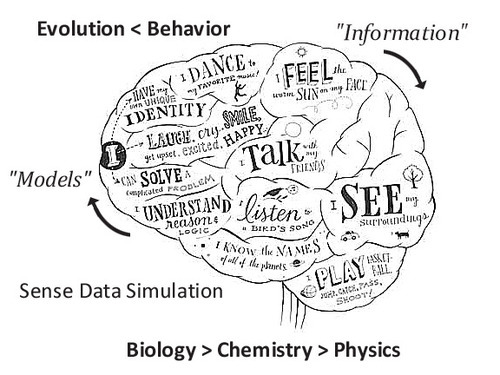
It does seem hard to justify the redundancy and ambiguity of neurotransmitter roles in the presumed functioning of consciousness. If I asked what neurotransmitter is most responsible for generating the feeling of reward, there doesn’t seem to be any that do not qualify. Arousal and reward applies equally to the Noradrenaline, Dopamine, and Cholinergic systems, with the Serotonin system’s correlation to “mood” easily applicable. If neuroscientific correlations with conscious experience were put up against pseudoscientific correlations I wonder how they would fare? How many scientists would submit to a reality show exhibition of medical vs astrological predictions like “Are You Smarter Than A Telephone Psychic?”
Not to diminish the medical application of neuroscience, but when it comes to stepping up to a theory of emotion and sensation, isn’t it a case of the pot calling the kettle unfalsifiable? Are we using fMRI’s and EEGs as a kind of occidental neuromancy – oracles of disorientation? Is the foundation of the neuron doctrine a placebo for scientists? I submit that any given group of ordinary people interpreting a canned astrological reading (or I Ching, numerology, etc), would have a similar level of consensus in a blind test against a group of neuroscientists trying to extrapolate character and destiny information from neurophysiological reports. Medical conditions, sure, but I would bet that when stacked up against Myers-Briggs or any kind of intuitive reading, the neuroscience is measurably more blind for predicting ordinary human personality characteristics.
When it comes to evolutionary genesis of consciousness, Tallis and I are also on the same page.
Think, after all, what unconscious mechanisms have actually achieved: the evolution of the material universe; the processes that are supposed to have created life and conscious organisms; the growth, development and most of the running of even highly conscious organisms such as ourselves. If you had to undertake something really difficult, for example growing in utero a brain with all its connections in place – consciousness is the last thing you would want to oversee the task. p. 176
In this light, we can see that consciousness is actually a disability that could only dilute the speed and efficiency of an automatic mental mechanism. In our weakness and prevarication, we waste precious time in making up our minds when a pure computation would simply yield the most probable success outcome and execute behavior accordingly.
He sees, as I do, that until there is awareness, what is the point of valuing ‘survival’? Without something to tell the difference between one species and another, what does it matter which invisible forms replace each other at any particular unexperienced time?
Tallis talks about the importance of seeing consciousness from the prospective view rather than the retrospective. Not taking consciousness for granted is the most critical aspect of approaching consciousness – to find consciousness from preconsciousness rather than taking the elements of consciousness for granted in justifying their own appearance. I have been calling this “The Elephant In Every Room” problem, and see it is the most significant hurdle that we face in building a 21st century understanding of consciousness.
I think that rigorously applying the prospect view of consciousness from preconsciousness is the only hope we have of not begging the question of the origin of awareness. Of course we can make a wireframe model of agents and actors operating in a world of interactive shadows (data), but why does this data need “us”? If you have actual information already, why invent some phenomenological layer of illusion and an illusory audience to imagine that it is not a simulation? (at least, until the illusory audience evolves to the point that it can teach itself to think that it is questioning the validity of the simulation…which somehow gives us the power to access another, unsimulated ‘reality’).
In his chapter “Bewitched by Language”, professor Tallis exposes the sentimental bias and wishful thinking behind computational models of intelligence. He gets the Symbol Grounding problem, as did Leibniz in his Windmill Argument and Searle’s Chinese Room thought experiment. (Personally I like my example of the polite trash can that waves ‘THANK YOU’ every time you use it). He sees that information is only real in the context of conscious entities using communication devices, and not a primitive substance of pseudo-substance that haunts the universe from the outside.
While Darwinitis requires its believers only to impute human characteristics to animals (and vice versa), Neuromania demands of its adepts that they should ascribe human characteristics to physical processes taking place in the brain. – p.183
…when you personify the brain and bits of brain, then it is easy to “brainify” the person. – p. 187
The author gives us the best and least understood arguments for the failure of contemporary science to grasp the explanatory gap and hard problem of consciousness. It is interesting then, that out of this perfect and wholehearted agreement, I come to diametrically opposite conclusions than he seems to be coming to – which I will get into in the next post.
Sole Entropy Well Model
Another way of visualizing the integration of physics and psyche uses the concepts related to Boltzmann’s entropy curve to conceive of the Totality/Singularity/First Cause as a bottomless fractal entropy well, as follows:
Boltzmann’s idea, as I understand it, is to explain Loschmidt’s Paradox, which (also as I understand it) is basically “If the universe is always increasing from low entropy to high entropy, then where did the initial low entropy come from?”
Boltzmann’s hypothesis places the low entropy we know as the Big Bang as just one of many statistically inevitable fluctuations of entropy distribution. It’s a bubble or wave of non-disorder that we find ourselves in anthropically (because such a bubble is the only context that a low entropy phenomenon like human minds could evolve within). Other possibilities include a Big Crunch type negentropy that accounts for the entropy trough that must precede any entropy rise.
What I suggest is a bottomless low entropy, such that the one event in which any negentropy at all occurs would automatically be the singularity into which all subsequent fluctuations would be swept. Sort of like a black hole for negentropy, hogging all possible signals for all time, banishing any rival Multiverse possibility to perpetual delay.
What this does is place Boltzmann himself, his statistical rules, and their physical enactments all within the anthropic condition in which they are possible. Statistical rules, and laws of any kind including those which define entropy are themselves physical structures which can only emerge from a bottomless entropy well. These kinds of laws and their underlying sense of possibility, probability, events, succession, recursion, regularity, comparison, persistence, etc can only be universal if every part of the universe makes some kind of sense – i.e. has some piece of this infinite negentropy.
Entropy then becomes a property like velocity, (which ranges from stillness to c), a fraction of a totality rather than an open ended scalar quantity. Entropy is a relative measure which has meaning only in relation to significance, such that anything less than 100% entropy has some quantity of absolute significance (Totality-Singularity = 0.000…1% entropy)
This way, the Big Bang becomes a perpetually receding event horizon of absolute and eternal negentropy – a Borg-like ‘bright whole’ which tyrannically absorbs and subordinates all potentials and possibilities into a single continuum-schema. This continuum must accommodate all paradoxes which amounts to a lot of fancy plate spinning and superposition, using devices like nesting outer and inner realism within each other on multiple interrelated yet mutually isolated layers or castes. These devices accomplish what I call the Big Diffraction.


In a Nutshell
By request, an attempt to sum up Multisense Realism in jargon-free language:
- The universe will seem to support either faith or reason. Reason requires belief in disbelief and faith requires disbelief in disbelief. In between reason and faith is reality, but neither reason without faith nor faith without reason can make sense of everything. The insistence that it can is ultimately a bias that tends to become crazy and dangerous if acted upon in real life as if it were the whole truth.
- All of the shortcomings of religion and science can be accounted for by each side mistaking objects for subjects and subjects for objects.
- We can fix this by looking at how we look at the universe, so that we take our own experience more literally and physical existence more figuratively. Photons become nothing but atomic experiences. Consciousness becomes the physical inertia of events which tie body, brain, world, and lifetime together.
- Consciousness is what divides the universe into symmetrical parts. It separates being, doing, and time from matter, energy, and space. This division makes it so that the former are presented as interior and ranging widely in quality, realism, and meaning while the latter is presented as exterior, real, and meaningless.
- This division replaces the idea of the Big Bang as an event in time and space, so that the Big Bang is the division of the universe into subjective times in objective places.
- The symmetry is not limited to subjective and objective groupings, so that consciousness can be used to focus on many different ways of making sense of itself and the universe.
Why Light Isn’t Made of Photons
1. Your rod and cone cells are constantly pumping glutamate into the synapse, and when light hits the Vitamin A molecules stuck inside the opsin proteins that make up the rod.
2. The Vitamin A molecule changes from it’s alcohol-shaped isomer to longer aldehyde shape, which pushes the protein around in whatever way it can.


“The molecule undergoes a series of shape changes to try and better fit the binding site. Therefore, a series of changes in the protein occurs to expel the trans-retinal from the protein.”(source)
3. The mechanical changes in the opsin protein cause the rod cell to change its electric charge.
4. Hyperpolarization of the rod cell stops it from releasing glutamate, which has the effect of simultaneously
5. Turning off (hyperpolarizing) the main on-center group of cells that stimulate each ganglion and turns on the surrounding off-center group of bipolar cells that lead to the ganglion. (YouTube)
6. It appears that the elongating of the retinal (Vitamin A isomer) molecule allows the rod cell as a whole to absorb more visible light – so that detecting light makes your eye become more sensitive to light. Sort of like your eyes are opening their eyes.
7. “The nerves reach the optic chasm, where the nerve fibers from the inside half of each retina cross to the other side of the brain, but the nerve fibers from the outside half of the retina stay on the same side of the brain.” (each side of your brain gets a compete stereoscopic image, one L+R and the other R+L. It’s really a stereo stereo image.
This is just a casual overview. Feel free to correct me if I have it wrong.
The impression I get only makes me more convinced of my interpretation that photons cannot be considered light in any way. Photons are quorum synchronized reciprocal changes among atoms.
What our visual cortex would ‘see’ is nothing more than interruptions in the flow of glutamate in bipolar cells, which in turn are nothing more than responses of a stack of protein sheets to the adjustments in the shape of Vitamin A molecules. What is tickling our nervous system is not photons, but orchestrations of symmetric changes in cellular biochemistry.
The claims of vision being a transduction of optical information is misleading. It implies that we are getting a directly anamorphic imprint of photon impacts, when in fact, our visual experience, even if it could be described in biochemical terms, is quite indirect. What the brain detects is like news coverage of an electoral college voting on an issue in another country.
Of course, none of this begins to address the hard problem. Photons, molecule, cells and brains would have no way of producing seemingly non-molecular qualia like color, orientation, and beauty if they were the simple mechanical objects that we presume. The brain does not need to make an image out of glutamate fluctuation to be functionally informed by it. The data is already there, what more would be required?
Light is not a representation of photons, or glutamate, or cell polarizations, it is an anthropological scale sense of visual relation. Not a substance or an ‘energy’ but a sensitivity to objects being energized. As the so called ‘dark current’ of our retinal cells suggest, it is the job of our eyes to silence the noise of our brain and to open the bidirectional pathways of sense and motive; of receptive understanding, and projection of attention.
Listen to my radio debut yesterday:
- Awareness of awareness
- Blindsight
- Color qualia
- Sapir-Whorf, language and color
- Layered protocols
- Bent pencil
- Mind-Body dualism & paradox
- Artificial Intelligence
- Quorum Sensing
- assembled parts and divided wholes
- Information and sense
- Symbol grounding problem
- Complexity and consciousness
- Consciousness as accident, emergence, perceptual bias
- Significance of potential and similarity
- Intuiting truth and evolutionary obligation
- Space, time, and consciousness
- Panpsychism and sense
- Who, why, what, how
- scale & frequency
- fly story
- Big bang
- Randomness and symmetry
Quora on Soul
Soul is a legacy term for awareness or consciousness (I would say sense-motive phenomenology). Awareness doesn’t literally exist in space, but it figuratively insists “here” and “there” and it literally produces time, or rather subdivides time from the totality of potential awareness.
To say that the soul exists in your imagination is not incorrect either. The nature of subjectivity is such that the more interior and personal the subject, the deeper, richer, and more meaningful and enduring qualities it can have. The ‘soul’ would be the subject themselves, and therefore the most meaning-laden and enduring (life-long or even longer if you want to speculate on Earthly legacy or celestial brownie points) subject of all.
The relation of time to space is inversely proportionate, so that the body which does exist literally in space is constantly changing; growing, aging, and dying, but it is the public presentation of ‘what and how’ (matter and energy) realism. The body of the moment is an ephemeral occurrence, but the self who is represented by all of our body shapes throughout our life is single occurrence – an identity. The presentation of the body is real in it’s own right as a complex object seemingly frozen in time, but it also represents the private ‘who and why’ (sense and motive) realism which we experience through direct realism.
In the same way, the qualia we experience, the colors, sounds, stories of our life indirectly represent complex material configurations in space, but they are also direct presentations of sense-motive experiences which are no less real than hydrogen or spheres. They are real in a different way though – meaning multiplied through time rather than objects divided across space.
Note – I say that soul is a legacy term because I think it misrepresents awareness subtly by projecting it as a pseudo object. It makes ‘I’ a thing in space rather than letting it be the agency who defines and redefines all ‘things’.
Feeling Real in the World of Sense
We have this idea, these days, that there is a real world outside of us which exists. It exists not because we experience it, but because it’s ‘just there’. The simple existence it has is thought to be absolutely real, but absolutely meaningless and unconscious. It is almost unanimously assumed that there was nobody home in the universe at all before living organisms were born on Earth (or maybe other life-friendly planets).
We also have the idea that there is an unreal world inside of us. We feel a sandwich in our hand, but really it is a vast collection of microscopic molecules and living cells, suspended in an even more vast expanse of emptiness. We see a sky above, but really it is a paper thin layer of gas clinging to the planet. Our sun, just another point of light in the oblivion of astronomical emptiness.
In this view, our perception is thought to mediate, to represent a real world that we can’t understand into an unreal experience that we can understand. The psyche is a transformer, turning meaningless reality into meaningful illusion.
Of course, this presents a bit of a problem when confronted with the fact that when we act on our illusions in the world, sometimes we know what we are doing. Sometimes we actually seem to know more than the illusion is showing us, and we are able to make changes in the real world, using only our illusion to guide us. How might that work exactly?
To my mind, the most plausible way that it can work is if the real world is not entirely meaningless and the illusions of our representations are not entirely illusion. The overlap between the two, is, what I would call sense. The overlap between the two I would call realism. That internal sense which agrees consistently with external conditions, and those external conditions which feel consistent with our internal expectations.
Where they don’t overlap, we get sense but not realism. Theory for the sake of theory. Empirical data which cannot be interpreted in way that we can conceive of (like a particle-wave or dark energy). These make sense in either a subjectively meaningful way or an objectively useful way, but not both.
The more I think about this worldview of an unconscious universe that is hogging all of the reality, and conscious illusion that is hogging all of the meaning, the more absurd it seems and the more it reminds me of the distribution of wealth, technology, and happiness in the world (hint: The happiness isn’t concentrated at the top with the money and tech). What an appropriately perverse worldview during such a perversely unbalanced phase of the Earth’s anthropological experiment.
If we can crack the door an inch and see that sense may not have been born anew with blue-green algae a billion years ago, but has been here all along. In the celestial blooms of nebula and the rattling molecular chains. Events. Happening everywhere. Peaceful places, violent times. Everywhere. Not just in our heads. Not an incomprehensible rock hard nothingness tagged and bagged inexplicably by nerve cells for an audience of one who is really a none.
Without that pre-biotic sense, you have 12.7 billion years of mathematical potentials, accumulating and discharging force in silent obscurity. Invisible and without any association with any human image you might have. A universe without a memory, without a here and now. A universe which, at it’s microcosmic level, cannot tell the difference between something and nothing, as it has no feeling, no awareness to know what those things might be.
Imagine instead a world that is as meaningful as you are, and a life as real and persistent in the cosmos as a galaxy. After all, it is only consciousness that makes a galaxy seem large and slow. Without the sense of perspective and scale, all 12.7 billion years before life goes by as an instant or an eternity. There was nobody there to tell the difference. We are here now to tell the difference, and that is what is real for us. That is the only reality that means anything to us. It makes sense and it’s how we make sense. Adding skeptical inquiry to our naive realism only gives us more of what we had before. If our senses are an illusion, then our judgements about our senses only amplify the illusion. If, on the other hand, we can make sense of the world, then we have only begun to scratch the surface of how such a thing is possible.


Recent Comments