Archive
Absolute View vs Western View: Comparing Supreme Ultimate Diagrams

Contrasting two models of consciousness: The Multisense Realism model above uses an Absolute view, which accounts for all known phenomena, subjective and objective. Postulating a root “Qua” (aka, the Absolute, Totality) from which qualia are divided through quanta, Quanta is conceived of as a constraint on Qua, a partition within it. Qua is sense capacity or presence, and so Quanta is the diminished reflection of that capacity…non-sense, entropy, uncertainty, and an expectation of absence. I am trying to show this as the horizontal arrows between qualia, indicating that quanta is nothing more than a kind of negotiation protocol which allows qualia to coexist in the same public space while retaining their private integrity. This is a complete reversal of the Western view, which features Quanta in the role of Qua, as the arithmetic-logical source of all phenomena.
On the left side of the diagram, there is a very general sketch of how Qua recovers itself ‘with interest’ as a qualitative enhancement – a consequence of having reunited on the other side of entropy-disorientation. On a human level, our experience yields a net human significance. Civilization is the residue left behind, a collective perceptual inertial of technology which echoes the individual’s narrative journey of exposure to the exteriorized spaces and the celebrated return home. Significance is literally a promiscuity of association among qualia, a depth of feeling and meaning which compels participation. My view is that this principle motivates on many, if not every level of the cosmos, and is not limited to human beings or animals (even though arguably significance is exponentially more…significant for human beings, at least in our own eyes).
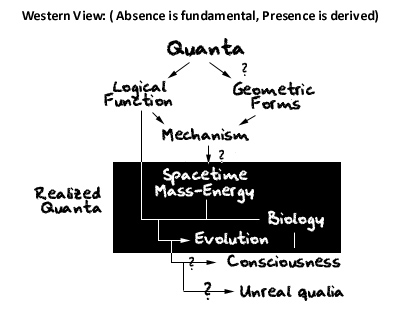
The Western view is a local rather than Absolute view. It does not account for sense or order itself, rather it begins from the assumption of physical matter and works backward to primitive mathematical functions. There are question marks included on the links which seem poorly understood or unjustified by the model as a whole. These include:
Why does geometry exist? I propose this as the Death of Computationalism. Along with the lack of support for Real numbers in computation, the universe or multiverse as a Turing emulation fails to account for the existence of forms like lines, circles, angles, etc. We know from our own computing and calculating devices that it is not necessary to physically draw a triangle in order to approximate correct computations about numbers which could correspond to triangular coordinates, so it really doesn’t make sense that any cosmic computation could or would invent geometric presentations of any kind. We don’t even need to get into questions of qualia, because computationalism fails to explain any sort of aesthetic forms to embody its functions. Mathematics is disembodied and anesthetic, and it works perfectly that way – no need for any strange magical fanfare.
Why do mathematical relations and laws give rise to physics? It’s all very well to have forms and functions mingle with each other as articulate mechanisms, but why should they ‘materialize’ as space-time, matter and energy?
The question of why consciousness exists when it does not appear to have any particular advantage over unconscious mechanism is a mystery. It is very difficult not to smuggle in our own retrospective view of consciousness as having enormous utility for our survival, but this is in no way an endorsement from the prospective view. If our immune system can orchestrate phenomenally complex responses to pathogens without a conscious experience attached to it, then why would a hominid’s humdrum quest for sustenance and reproduction lend itself to such an absurdly ornate aesthetic phenomenon? Indeed, if evolution can make a human brain, with all the trimmings, using unconscious methods, surely the operation of that brain would be better suited to that tried and true option.
The final question mark is related, but not identical. Even if you have consciousness as an option for some reason, and that option works better for humans than turtles or clouds of methane for some reason, why should such a phenomenon as consciousness produce feelings which are other than a record of the physical events which they represent? Why should there be different kinds of sensory experiences when all logical functions can be reduced more effectively to a single binary format of data processing? This alternative to reality is cast aside from the Western view, but what metaphysical never-never land is it cast to? How did we get outside of the real universe and into an ‘illusion’?
Biocentrism Demystified: A Response to Deepak Chopra and Robert Lanza’s Notion of a Conscious Universe.
1. I hope we all agree that our information about facts is incomplete, and will always remain so, at least in the foreseeable future.2. The only reality that makes sense to me is what Stephen Hawking calls ‘model-dependent reality’ (MDR).3. Other uses of the word ‘reality’ (other than MDR) imply ‘absolute reality’. If you disagree with this statement, please try defining ‘absolute reality’ in a logical way, using words which mean the same thing to everybody. My belief is that you will not be able to do that, and that means that MDR is all you have for discussion purposes.4. Naturally, there can be many models of reality. So which of the MDRs is the right one, and who will decide that? In view of (1) above, this is a hopeless situation, and that is why I avoid getting into philosophical discussions.5. At any time in human history, there are more humans favouring a particular MDR over other MDRs. Let us call it the majority MDR (MMDR).
6. An MMDR may well prove to be wrong when we humans acquire more information; from then we have a new MMDR, till even that gets demolished.
7. I believe that materialism is a better MDR than its opposite (called idealism, subjectivism, or whatever). For more on this, please read my article at http://nirmukta.com/2011/06/19/stephen-hawkings-grand-design-for-us/. Here is an excerpt from that article:
‘ There are several umbrella words like ‘consciousness’, ‘reality’, etc., which have never been defined rigorously and unambiguously. H&M argue that we can only have ‘model-dependent reality’, and that any other notion of reality is meaningless.
Does an object exist when we are not viewing it? Suppose there are two opposite models or theories for answering this question (and indeed there are!). Which model of ‘reality’ is better? Naturally the one which is simpler and more successful in terms of its predicted consequences. If a model makes my head spin and entangles me in a web of crazy complications and contradictory conclusions, I would rather stay away from it. This is where materialism wins hands down. The materialistic model is that the object exists even when nobody is observing it. This model is far more successful in explaining ‘reality’ than the opposite model. And we can do no better than build models of whatever there is understand and explain.
In fact, we adopt this approach in science all the time. There is no point in going into the question of what is absolute and unique ‘reality’. There can only be a model-dependent reality. We can only build models and theories, and we accept those which are most successful in explaining what we humans observe collectively. I said ‘most successful’. Quantum mechanics is an example of what that means. In spite of being so crazily counter-intuitive, it is the most successful and the most repeatedly tested theory ever propounded. I challenge the creationists and their ilk to come with an alternative and more successful model of ‘reality’ than that provided by quantum mechanics. (I mention quantum mechanics here because the origin of the universe, like every other natural phenomenon, was/is governed by the laws of quantum mechanics. The origin of the universe was a quantum event.)
A model is a good model if: it is elegant; it contains few arbitrary or adjustable parameters; it agrees with and explains all the existing observations; and it makes detailed and falsifiable predictions.’
>”Other uses of the word ‘reality’ (other than MDR) imply ‘absolute reality’. If you disagree with this statement, please try defining ‘absolute reality’ in a logical way,”
Absolute reality is the capacity for perceptual participation, aka, sensory-motor presentation, aka qua(lia-nta). That is the bare-metal prerequisite for all forms of order or matter, subject or object. Not only metaphysics but meta-ontology. The cosmos is not something which is, the cosmos actually invents “is” by “seeming not to merely seem”.
Please try defining ‘model’ in a way that does not assume some form of sensory presentation and participation. What is a model except a sensory experience which seems to refer our minds to another?
While I agree that no participant within a given experience has an absolute perspective of that experience, I disagree that the MDR is a solipsistic ‘model’ which is generated locally. The fact that we recognize the relativism of perceptual inertial frames (PIF = my term for MDR) is itself a clue that the deeper reality is this very capacity for relativism of perspective. Although the relativism itself may be the only final commonality among all perspectives, that commonality is not a tabula rasa. We can say things about this ‘common sense’ – things which have to do with contrasts and inverted symmetry, with proximity and intensity, relationship, identity, and division. These principles are beneath all forms and functions, all sensations and ideas, substances and patterns, and through them, we can infer more elusive fundamentals. Pattern recognition which is beyond pattern. Gestalt habits which are beyond mereology or cardinality…higher octaves of simplicity. Trans-rational, non-quantitative properties.
All mechanisms and all physics rely on a root expectation of sanity and continuity – of causality and memory, position, recursive enumeration, input/output, etc. If you are going to get rid of absolute reality, then you have to explain the emergence of the first MDR – what is modeling? Why does the universe model itself rather than simply ‘be’ what it is?
My solution is to accept that this assumed ‘modeling’ is physics itself, and that physics is experienced-embodied relativity. In the absolute sense, matter a special case of a more general (non-human) perception or sense. Not a continuum or a ZPE vacuum flux, but ordinary readiness to experience private sensory affects and produce (intentionally or not) public facing motor effects. What the universe uses to model is not a mathematical abstraction floating in a vacuum, but a concrete participatory phenomena, which we know as human beings to be sensory-motor participation. Not everything is alive biologically, but everything that seems to us to exist naturally as matter probably has a panexperiential interaction associated with it on some level of description. It’s about turning the field-force model inside out, turning away from the de-personalized objectivity of the last few centuries and toward a realization of personal involvement in genuine presentations (customized and filtered though they may be) rather than assembled representations.
The MMDR should not embrace materialism or idealism by default because one seems simpler than the other. We should accept only a solution which honors the full spectrum of possible experiences in the cosmos, from the most empirically public to the most esoterically private. This does not mean weighting the ravings of one lunatic the same as a law of gravity, but rather acknowledging that if there is a lunatic, then the universe is in some sense potentially crazy also, and within that crazy is something even more interesting and universal than gravity…an agenda for aesthetic proliferation… a Multisense Realism.
Illusion is a meaningless term in science as far as I can see. Illusion is about an experience failing to meet expectations of consistency across perceptual frames (models)…except that we know that inconsistency is likely the only such consistency, beyond the root common sense. Whatever illusions we experience as people are not necessarily absent on other levels of inspection. Quantum illusions, classical illusions, biological illusions, etc. Every instrument relies on conditions which create their own confirmation bias, including the human mind. We should not, however, make the mistake of allowing non-human, inanimate instruments tell us what our reality is. They can’t see our consciousness in the first place, remember? Our human equipment is not as sensitive in detecting public phenomena, we cannot see more than a small range of E-M, etc, but neither is a gas spectrometer sensitive in detecting human privacy.
We see that when we adopt the frame of mechanism, idealism seems pathologically naive and if we adopt the frame of idealism, mechanism seems pathologically cynical. This should be regarded along the lines of the double-slit test: evidence that our assumptions are not the whole story, and to seek a deeper unity than mechanistic or idealistic appearances.
 Multisense Realism
Recent Comments