Archive
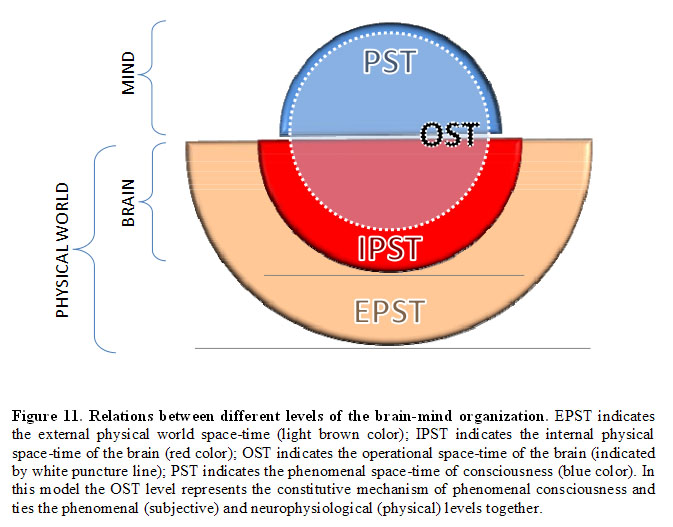

The first image is from a paper called Natural World Physical, Brain Operational,and Mind Phenomenal Space-Time. I haven’t read it yet, but from the looks of the image it seems like a step in the right direction. I have cannibalized their diagram to try to encapsulate the Multisense Realism model.
The bottom half remains almost unchanged, except for the removal of Time. In the original, the assumption was that SpaceTime is objectively real, but in my view this is an obstacle to understanding the relation between the public and private ranges of physics. The center of the bullseye then, in the modified chart, is the intersection of public space and private time, such that it reflects the ordinary sense we have of the public moment being infinitely fleeting so that the only remaining residue of any public moment is sustained exclusively through private memory. If we apply a strict literal read of public realism, the presence of the past is confined to a pure fiction of human sentiment. Past events must be inferred from material evidence and reconstructed deductively (forensics, archaeology).
The bottom half of the bullseye then recognizes this truth, that in fact public realism is devoid of temporal continuity, and exists as spatially nested bodies relative to the perspective of any particular private participant. The deeper into the IPS circle we get, the more the public structures of the brain are defined by electromagnetic and chemical activity which do not make sense without an inferred Time element. At this point, the EPT phenomenology similarly takes on its distributive spatial descriptions, such that private sensory affects are accessible as public motor effects. There is no transduction or homunculus translation, no cause and effect, the hypothesis is that there is a dual or multi-aspect spectrum of aesthetics.
The top of the bullseye is much more ambitious and experimental. I have rotated the private phenomenonlogy along a z-axis to underscore that sensory-motive experience is literally perpendicular or orthogonal to spacetime. The original diagram takes for granted that phenomenal consciousness should be considered to resemble space-time. It really doesn’t. To the contrary, our spatiotemporal memories merge seamlessly with imaginary places and times, or non-places and non-times. When we are sequestered from public interactions, we lose spatial and temporal continuity as daydream dissolves into dream or delusion and realism dissipates altogether. Significantly this total loss of realism is not generally missed. “Waking up” in a lucid dream, is typically not a cause of distress where we are terrified at having no idea where our body is, but tends to be very enjoyable and we would prefer to remain in the dream for as long as possible.
I apologize for the crazy looking bicycle gears look to the EPT and IPT, but I think it gives a hint of the kind of vast multivalence which would have to be included if we were to try to model visually the nature of private physics, which is implicitly anti-form and anti-function. (I call it Transrational Algebra or Apocatastatic Gestalt).
I have tried to give the impression of the presence of the past and anticipation of the future within what I call the ‘perceptual inertial frame’ known as ‘now’. Is now today? Is it last ten minutes? Is it 2013? Yes. It’s all of those things. The pointillised gears near the left hand side are labeled with a ‘memory’ bracket, indicating the complex nesting nature of temporal nesting. You can read these words without consciously remembering how to read English, but if you recall a particular memory, that gestalt can contribute to the feeling of the now, and can combine with other recollected associations, both conscious and subconscious. The nesting of meaning does not seem to have a finite capacity, and significance is constellated apocatastatically – as a rejoining of broken parts…increasingly transparent and reflective of other significant moments rather than dense and opaque with overloaded resource demands. This is just a fancy way of saying that our conscious experience is the tip of the iceberg of a vast reservoir of experiences which extends beyond our personal lives and into anthropology, zoology, biology, chemistry and physics.
On the far left is the legend showing the extension of private experience into public presentations necessitates an anesthetic gating or attenuation of sensory affect and motor effect. This is another fancy way of saying that public space is about defining limits to your private sense of omniscience and omnipotence…literally putting you in your place among countless local and universal agendas.
But Which Eye Is The Binocular One?
“He must learn that his extreme powers of discrimination do not make him weak and inferior – but rather strong and superior.” – Matthew Oliver Goodwin
“Regione caecorum rex est luscus.” (In the land of the blind, the one-eyed man is king.)
– Desiderius Erasmus
Here is a tale about the ontology of perception, or as I like to call it, the laws of private physics. It takes place not in regione caecorum, but in regione luscus – that is, it takes place in the country or land of the one-eyed rather than the blind. In this land, there was once born someone who claimed to have a second eye, and through it, they could see a kind of “depth” and experience an aesthetic of personal engulfment which could not be accessed or appreciated with only a single eye.
The wise men of the land heard these claims and set out to prove, with their one eyed instruments and one eyed reasoning, whether or not this magical experience of stereoscopic vision could exist. As they suspected, their results confirmed that there was no depth nor sense of “embeddedness” which could be felt visually. Vision, they said, was incapable of representing volume.
Two Eyed Sally protested, but to no avail. It was plain to everyone that volume cannot be communicated without touching an object with your body directly. The eye does not touch objects directly, so sensing depth by vision is a hallucination and Sally is crazy.
One day another person was born who also claimed to have a second eye and could see that Sally had two eyes also but that everyone else had one eye. To this, the wise men responded in their most scientific and rational way, doing the only thing that can be done in such a circumstance…
“Burn the witches!”, they bellowed.
Many years passed, and after many witches were burned, very few people spoke about their second eye experiences anymore. When they did it was, obliquely, through stories and metaphors, or as comedy. Increasingly, the one-eyed view of the world had become more and more successful, explaining nearly everything and producing amazing devices like the split-view monocle which allowed one to have two slightly different views of the same thing, allowing people who learned to use the monocle to become much better coordinated. Two views were better than one.
At this point, one of the wisest wise men accidentally ingested a few micrograms of a semi-synthetic fungal extract, and began to hallucinate that he had a second eye. His perceptual solitude became perforated with the legendary aesthetic depths and subjective embeddedness. He reported his amazing experience, and before he knew it, people all over the world were duplicating his unintentional experiment intentionally.
Around the same time, other wise men were playing with light. For years, they had observed an unexpected interference pattern whenever light was projected through a mask with more than one slit. This reminded some of the more unconventional thinkers of the myth of binocular vision, and for a time it seemed that stereoscopy could be a legitimate phenomenon. Strangely, social events seemed to mirror this loosening of constraint and a kind of renaissance or ‘mind opening’ seemed to be blooming on every front.
The more clear-headed of the wise men however, those whose single eyed vision was particularly sharp and acute, warned of trouble. The very thought of people with double the normal amount of eyes, idling in some kind of sickening optical illusion was revolting and they set out to figure out exactly what was the fucking problem with these patterns and slits, and with the strange reports from the fungus eaters as well.
They devised ingenious experiments in which the stereoscopic patterns could be explained. By using instruments which only could see one thing at a time, the validity of the monoscopic model could be deduced. Terms like ‘wave function collapse’ and ‘decoherence’ were a soothing balm for the anxieties of the wise men.
Gradually the rash of thinkers who took stereoscopic delusions seriously were drummed out of the wise man academy, and depth of field was discredited. Instead of being studied as a strange physical phenomenon, depth perception became something else – an ‘epiphenomenon’. Epiphenomena of this kind are an ’emergent property’ which sort of ‘un-exists’ in a never-never land hidden away in neurons…or maybe calcium ions…or radiological zappity zaps.
Even if some of the sensations of stereoscopic vision felt real to some people, it would be because of the ability of these zappings to compare and extract information about each other. Such information might be useful after all, because it allows more data to be simulated at once and more data about the environment means a better chance at survival and reproduction. It could be that the people with the two eyed delusion were not witches or criminally insane after all, they are just unfortunate mutants who have a disability.
There was still some question, however, about how the light knew which slit was the right one to go through, and about whether it was the second eye which was the defective one or whether it just corrupted the first eye. Interpretations abounded about multiple universes and entangled eyeballs. All of these interpretations had in common the same thing: they concluded by re-asserting the validity of flat vision. They could all agree on one thing – that three dimensional sight was supernatural hogwash. The details of how and why were complicated and esoteric, but they are consistent and verifiable, (as long as you use instruments and experiments which are designed to filter out anything unscientific and ignore your own corrupted judgments).
“And so, little by little, a little later
These critics set to work
To make nonsense out of the sense of what we were doing.
And they succeeded.
They destroyed our hero’s faith in himself.
He didn’t have it any more.
After a few, disappointing times
In the big auditorium.
The light gone out of him.
We all stopped going.
And the man who had once seemed so tall
And who now seemed so much smaller
Left our town
Saying no, no, no
[…]
They put us back on the narrow path.
This is the way things have been in our town
For as long as anyone cares to remember.
By the way
How are things in your town?”
 Multisense Realism
Recent Comments