Archive
Quora: What effect has the computer had on philosophy?
Quora: What effect has the computer had on philosophy?
What effect has the computer had on philosophy in general and philosophy of mind in particular?
Obviously, computing has facilitated a lot of scientific advances that allow us to study the brain. e.g., neuroscience research would not exist as it does today without the computer. However, I’m more interested in how theories of computation, computer science and computer metaphors have shaped brain research, philosophy of mind, our understanding of human intelligence and the big questions we are currently asking. (Quora)
I’m not familiar enough with the development of philosophy of mind in the academic sense to comment on it, but the influence of the computer on popular philosophy includes the relevance of themes such as these:
Simulation Dualism: The success of computer graphics and games has had a profound effect on the believability of the idea of consciousness-as-simulation. Films like The Matrix have, for better or worse, updated Plato’s Allegory of The Cave for the cybernetic era. Unlike a Cartesian style substance dualism, where mind and body are separate, the modern version is a kind of property dualism where the metaphor of the hardware-software relation stands in for the body-mind relation. As software is an ordered collection of the functional states of hardware, the mind or self is the similarly ordered collection of states of the brain, or neurons, or perhaps something smaller than that (microtubules, biophotons, etc).
Digital Emergence: From a young age we now learn, at least in a general sense, how the complex organization of pixels or bits leads to something which we see as an image or hear as music. We understand how combinations of generic digits or simple rules can be experienced as filled with aesthetic quality. Terms like ‘random’ and ‘virtual’ have become part of the vernacular, each having been made more relevant through experience with computers. The revelation of genetic sequences have further bolstered the philosophical stance of a modern, programmatic determinism. Through computational mathematics, evolutionary biology and neuroscience, a fully impersonal explanation of personhood seems imminent (or a matter of settled science, depending on who you ask). This emergence of the personal consciousness from impersonal unconsciousness is thought to be a merely semantic formality, rather than a physics or functional one. Just as the behavior of a flock of birds flying in formation can be explained as emerging inevitably from the movements of each individual bird responding to the bird in front of them, the complex swarm of ideas and feelings that we experience are thought to also emerge inevitably from the aggregate behavior of neuron processes.
Information Supremacy: One impact of the computer on society since the 1980’s has been to introduce Information Technology as an economic sector. This shift away from manufacturing and heavy industry seems to have paralleled a historic shift in philosophy from materialism to functionalism. It no longer is in fashion to think in terms of consciousness emerging from particular substances, but rather in terms of particular manipulations of data or information. The work of mathematicians and scientists such as Kurt Gödel, Claude Shannon, and Alan Turing re-defined the theory of what math can and cannot do, making information more physical in a sense, and making physics more informational. Douglas Hofstadter’s books such as Gödel, Escher, Bach: an Eternal Golden Braid continue to have a popular influence, bringing the ideas of strange loops and self referential logic to the forefront. Computationally driven ideas like Chaos theory, fractal mathematics, and Bayesian statistics also have gained traction as popular Big-Picture philosophical principles.
The Game of Life: Biologist Richard Dawkins’ The Blind Watchmaker (following his other widely popular and influential work, The Selfish Gene) utilized a program to illustrate how natural selection produces biomorphs from a few simple genetic rules and mutation probabilities. An earlier program Conway’s Game of Life, similarly demonstrates how life-like patterns evolve without input from a user, given only initial conditions and simple mathematical rules. Philosopher Daniel Dennett has been another extremely popular influence who maintains both a ‘brain-as-computer’ view and a ‘consciousness-as-pure-evolutionary-adaptation’ position. Dawkins coined the word ‘meme’ in The Selfish Gene, a word which has now itself become a meme. Dennett makes use of the concept as well, naming the repetitive power of memes as the blind architect of culture. Author Susan Blackmore further spread the meme meme with her book The Meme Machine. I see all of these ideas as fundamentally connected – the application of the information-first perspective to life and consciousness. To me they spell the farthest extent of the pendulum swing in philosophy to the West, a critique of naturalized subjectivity and an embrace of computational inevitability.
The Interior Strikes Back: When philosopher David Chalmers introduced the Hard Problem of Consciousness, he opened the door for a questioning of the eliminative materialism of Dawkins and Dennett. His contribution at that time, along with that of philosophers John Searle and Galen Strawson has been to show the limitation of mechanism. The Hard Problem asks innocently, why is there any conscious experience at all, given that these information processes are driven entirely by their own automatic agendas? Chalmers and Strawson have championed the consideration of panpsychism or panexperientialism – that consciousness is a fundamental ingredient in the universe like charge, or perhaps *the* fundamental ingredient of the universe. My own view, Multisense Realism is based on the same kinds of observations of Chalmers and Strawson, that physics and mathematics have a blind spot for some aspects, the most important aspects perhaps, of consciousness. Neuroscientist Raymond Tallis’ book Aping Mankind: Neuromania, Darwinitis and the Misrepresentation of Humanity provides a focused critique of the evidence upon which reductionist perspectives of human consciousness are built.
The bottom line for me is that computers, while wonderful tools, exploit a particular facet of consciousness – counting. The elaboration of counting into mathematics and calculus-based physics is undoubtedly the most powerful influence on civilization in the last 400 years, its success has been based on the power to control exterior bodies in public space. With the development of designer pharmaceuticals and more immersive internet experiences, we have good reason to expect that this power to control extends to our entire existence. With the computer’s universality as evidence that doing and knowing are indeed all there is to the universe, including ourselves, it is nonetheless difficult to ignore that beyond all that seems to exist, there is some thing or some one else who seems to ‘insist’. On further inspection, all of the simulations, games, memes, information, can be understood to supervene on a deeper level of nature. When addressing the ultimate questions, it is no longer adequate to take the omniscient voyeur and his ‘view from nowhere’ for granted. The universe as a program makes no sense without a user, and a user makes no sense for a program to develop for itself.
It’s not the reflexive looping or self-reference, not the representation or semiotics or Turing emulation that is the problem, it is the aesthetic presentation itself. We have become so familiar with video screens and keyboards that we forget that those things are for the user, not the computer. The computer’s world, if it had a world, is a completely anesthetic codescape with no plausible mechanism for or justification of any kind of aesthetic decoding as experience. Even beyond consciousness, computation cannot even justify a presentation of geometry. There is no need to draw a triangle itself if you already have the coordinates and triangular description to access at any time. Simulations need not actually occur as experiences, that would be magical and redundant. It would be like the government keeping a movie of every person’s life instead of just keeping track of drivers licenses, birth certificates, tax returns, medical records, etc. A computer has no need to actualize or simulate – again that is purely for the aesthetic satisfaction of the user.
David Sosa on Free Will in Waking Life
(my comments:
I think that just as free will spans the entire continuum from profound mystery to ordinary fact to most-convincing illusion to least convincing reality, so too does consciousness as a whole.
Will seems to be a self-contained, primordial feature of nature – intentional force. The projection of a single motive sequence from a multiplicity of private motives into a thermodynamically irreversible public consequence. The power to participate in public realism; from motive to motor, emotion to intention to extension as a unified gestalt at the personal level, but smeared across smaller spaces and times at the sub-personal levels (cellular, neurochemical). Will is consciousness oscillating from being to feeling to doing to knowing, an Ouroboran double-binary knot of sensory-motor qualities, pushing and pulling between private times and public spaces.
The ‘free’ part of free will seems more conceptual. Free compared to what? Nevertheless, it too has an aesthetic subtext which is compelling. Freedom is somehow the epitome of will. It suggests self seeking to amplify itself by transcending itself. When people use the expression ‘willful’ there is a sense of being unpredictable or ‘wild’. This connection comes up again and again in philosophy and science and is rejected again and again as well. Vital force. Kundalini. Qi. Animal Magnetism. We are ambivalent about physicalizing this most direct of all experiences – perhaps the only truly direct experience there is.
What I propose is sort of a ‘if you can’t beat em, join em’ strategy. Put the phenomena which we can’t explain in the center of the model. Neither sensory perception nor motive participation can, in my view, be reduced in any way. They are primordial, such that any conceivable physical force or field, any mathematical principle or information process would by definition supervene on some form of aesthetic presentation – some detection-participation capacity. Without such a capacity, nothing which has sense, or is itself defined by sense could possibly contact this non-sensed existence in any way. In this way, we can begin to see that being and sensory-motive participation are ultimately the same thing.
The effects of free will are cumulative, and as we free ourselves again and again from our own collective inertial consequences, initiating novel sequences out of personal preference, we also cut ourselves off from many experiences. We de-cide; kill off possibilities…we make a difference not only by what we choose but what our choice makes us indifferent to. The wild personal impulse gradually pivots to its opposite, and Homo sapiens raw nomadic drive to explore becomes the impersonal impulse of self-domestication. Now that the pendulum has perhaps reached the apogee of its swing, we seek to define the impulse in terms of its absence. This is an opportunity to step out of the system and look at the phenomenon as a whole – as we modulate with it through history. The unexpected truth – that free will and mechanism are two sides of the same oscillating coin is hard to consider, but like free will itself, we should place this enigma in the center of the model rather than try to flatten it into either mechanism or spirituality. Let it be what it is. Let us be who we are.)
Blue Roses, Blue Pills, and the Significance of the Imposter

What makes that which is authentic more significant than that which is fake or ‘false’? Why do proprietary qualities carry more significance than generic qualities? Commonality vs uniqueness is a theme which I come back to again and again. Even in this dichotomy of common vs unique, there is a mathematical meaning which portrays uniqueness as simply a common property of counting one out of many, and there is a qualitative sense of ‘unique’ being novel and unprecedented.
The notion of authenticity seems to carry a certain intensity all by itself. Like consciousness, authenticity can be understood on the one hand to be almost painfully self-evident. What does it really mean though, for someone or something to be original? To be absolutely novel in some sense?
The Western mindset tends toward extremism when considering issues of propriety. The significance of ownership is exaggerated, but ownership as an abstraction – generic ownership. Under Western commercialism, rights to own and control others are protected vigilantly, as long as that ownership and control is free from personal qualities.
The thing which makes a State more powerful than a Chiefdom is the same thing which makes the Western approach so invested in property rather than people. In a Chiefdom, every time the chief dies, the civilization is thrown into turmoil. In a State, no one person or group of people personifies the society, they are instead public officials holding public office for a limited time. Political parties and ideologies can linger indefinitely, policies can become permanent, but individual people flow through it as materially important, yet ultimately disposable resources.
The metaphysical and social implications of this shift from the personal to the impersonal are profound. The metaphysical implications can be modeled mathematically as a shift from the cardinal to the ordinal. In a Chiefdom, rule is carried out by specific individuals, so cardinality is the underlying character. In a State, ordinality is emphasized, because government has become more of a super-human function. It’s an ongoing sequential process, and the members within it (temporarily) are motivated by their own ambitions as they would be as part of a Chiefdom, but they are also motivated to defend the collective investment in the permanence of the hierarchy.
At the same time, cardinality can apply to the State, and ordinality would apply to a Chiefdom (or gang). The state imposes cardinality – mass producing and mass controlling through counting systems. Identification numbers are produced and recorded. Individuals under a State are no longer addressed as persons individually but as members of a demographic class within their databases. Lawbreaker, head of household, homeowner, student, etc. This information is never explicitly woven into a personal portrait of the living, laughing, loving person themselves, but rather is retained as skeletal evidence of activities. Addresses, family names, employment history, driver’s license, dental records. It is essential for control that identity be validated – but only in form, not in content. The personality of the consumer-citizen (consumiten?) is irrelevant, to an almost impossible degree – yet some ghost of conscience compels an appearance of sentiment to the contrary.
World War II, which really should be understood as the second half of the single war for control of human civilization on a global level for the first time, was a narrative about embodied mechanization and depersonalization. The narrative we got in the West was that Fascism, Communism, and Nazism were totalitarian ideologies of depersonalization. The threat was of authentic personhood eclipsed permanently by a ruthlessly impersonal agenda. Different forms of distilled Statehood, three diffracted shadow projections of the same underlying social order transitioning into cold automatism The mania for refining and isolating active ingredients in the 20th century, from DNA to LSD to quantum, ran into unexpected trouble when it was applied to humanity. Racist theories and eugenics, Social Darwinism, massive ethnic cleanses and purges. Were we unconsciously looking for our absent personhood, our authenticity which was sold to the collective, or rather, to the immortal un-collective? Did we project some kind of phantom limb of our evacuated self into the public world, hiding in matter, bodies, blood, and heredity?
So what is authenticity? What is an imposter? Does a blue rose become less important if it is dyed blue rather than if it grew that way? Why should it make a difference? (we tell ourselves, with our Westernized intellect, that it shouldn’t). If you never found out that the rose was ‘only’ dyed blue, would you be wrong for enjoying it as if it were genuine? Why would you feel fooled if you found out that you were wrong about it being genuine but feel good if you found out that you were wrong about it being ‘fake’.
Who is fake? Who is phoney? Who is sold out? (does anyone still call anyone a ‘sell out’ anymore, or are we now pretty comfortable with the idea that there is nobody left who would not happily sell out if they only had the chance?) These are terms of accusation, of righteous judgment against those who have become enemies of authenticity – who have forsaken humanity itself for some ‘mere’ social-political advantage.
There is a dialectic between pride and shame which connects the fake and the genuine, with that good feeling of finding the latter and the disgust and loss of discovering the former. The irony is that the fake is always perpetrated without shame, or with shame concealed, but the genuine is often filled with shame and vulnerability…that’s somehow part of what makes it genuine. It’s authority comes from within our own personal participation, not from indirect knowledge, not from the impersonal un-collective of the Market-state.
Where do we go now that both the personal and impersonal approaches have been found fatally flawed? Can we regain what has been lost, or is it too late? Does it even matter anymore? If mass media is any indication, we have begun not only to accept the imposter, but we have elevated its significance to the highest. What is an actor or a model if not a kind of template, a vessel for ideal personal qualities made impersonal? It is to be celebrated for acting like yourself, or being a character – a proprietary character, made generic by mass distribution of their likeness. Branded celebrity. A currency of deferred personalization – vanity as commodity. Perhaps in the long run, this was the killer app that the Nazis and the Russians and the Japanese didn’t have. The promiscuous use of mass media to reflect back super-saturated simulations of personhood to the depersonalized subjects of the Market-state.
More than nuclear weapons, it was Hollywood, and Mickey Mouse, and Levi’s and Coca Cola which won the world. Nuclear memes. Elvis and Marilyn Monroe. This process too has now become ultra-automated. The problem with the celebrity machine was that it depended on individual persons. Even though they could be disposed of and recycled, it was not until reality TV and the new generation of talent shows that the power to make fame was openly elevated above celebrity itself. Fame is seen to be increasingly elected democratically, but at the same time, understood to be a fully commercial enterprise, controlled by an elite. The solution to the problem of overcoming our rejection of the imposter has been a combination of (1) suppressing the authentic; (2) conditioning the acceptance of the inauthentic, and most importantly, (3) obscuring the difference between the two.
I’m not blaming anyone for this, as much as I might like to. I’m not a Marxist or Libertarian, and I’m not advocating a return to an idealized pre-State Anarchy (though all of those are tempting in their own ways). I’m not anti-Capitalist per-se, but Capitalism is one of the names we use to refer to some of the most pervasive effects of this post-Enlightenment pendulum swing towards quantitative supremacy. I see this arc of human history, lurching back from the collapse of the West’s version of qualitative supremacy in the wake of the Dark Ages, as a natural, if not inevitable oscillation. I can’t completely accept it, since the extremes are so awful for so long, but then again, maybe it has always been awful. Objectively, it would seem that our contemporary First World ennui is a walk in the park compared to any other large group in history – or is that part of the mythology of modernism?
It seems to me that the darkness of the contemporary world is more total, more asphyxiating than any which could be conceived of in history, but it also seems like it’s probably not that bad for most people, most of the time. Utopia or Oblivion – that’s what Buckminster Fuller said. Is it true though anymore, or is that a utopian dream as well? Is the singularity just one more co-opted meme of super-signification? Is it a false light at the end of the sold-out tunnel? An imposter for the resurrection? Is technology the Blue Pill? I guess if that’s true, having an Occidental spirituality which safely elevates the disowned authentic self into a science fiction is a big improvement over having it spill out as a compulsion for racial purity. A utopia driven by technology at least doesn’t require an impossible alignment of human values forever. Maybe this Blue Pill is as Red as it gets?
If “the self” is the product of internal cognitive processes communicating with each other, then where do “attention” and “willpower” com…
If “the self” is the product of internal cognitive processes communicating with each other, then where do “attention” and “willpower” come from?
Who or what is deciding to focus on something, and who or what is asserting one internal view over another (“exerting willpower”)?
As a more general question, how are such purely internal, subjective, yet fully pervasive experiences such as attention as a resource that can be focused, and willpower as a resource that can be used and depleted, explained in terms of an emergent view of consciousness where the self is an illusion?
In my view, the emergent view of consciousness lacks the depth of understanding of subjectivity to be viable. At this time, emergence and the illusory self is seen as a scientific alternative to discredited spiritualist views. This would make sense if we have painted ourselves into a corner, rejecting immaterialism on one hand and embracing the lack of evidence of any ‘feelings of self’ produced in the brain.
There is another option which is not religious, and not based on a disembodied entity haunting the cells of your brain, and I think that is to understand experience itself as a concrete physical conjugate to all forms and functions. Physics becomes the ordering not just of forces and fields in spacetime, but of feelings and beings through experience or lifetime.
In this question for example, willpower could only be a mechanical condition of the brain. How much willpower you have would be a consequence of your genetic capacities and how your brain has developed. In our real world experience however, willpower has at least as much to do with the semantic content of our experience. The conventional wisdom has been, and not without merit, that we are responsible for participating in our own exercise of willpower. It would be argued that whatever we might do to build our focus and discipline would also improve whatever neurological functions are involved, but it seems more like it has to be a push-pull.
In the end, no emergent view of consciousness can plausibly justify the sensory experience of consciousness itself. The idea of the illusory self, while seemingly supported by a consensus of inanimate instruments, can only be accepted or rejected by the self itself. The existence of an epiphenomenal self-model which is experienced aesthetically rather than loops of anesthetic self-referential data processing is really a deal breaker. Regardless of whether our private expectation of the effectiveness of our will match the public effect of it, the fact that there is any such thing as an expectation of self in the first place cannot be explained mechanically. The only way we can even entertain this fallacy is to smuggle our own undeniably real self awareness into the argument without noticing and then using our own minds to consider the idea of their own absence by the very evidence that it is actively weighing. You can’t have it both ways. If you are real enough to do science, then you can’t be irrelevant enough to be illusory.
Making Sense of Computation
In my view, matter and energy are the publicly reflected tokens* of sense and motive respectively. As human experiences, we are a complicated thing to try to use as an example – like trying to learn arithmetic by starting with an enormous differential equation. When we look at a brain, we are using the eyes of a simian body. That’s what the experience of a person looks like when it is stepped all the way down from human experience, to animal experience, to cellular experience, to molecular experience, and all the way back up to the animal experience level. Plus we are seeing it from the wrong angle. If I’m right, experience is a measure of time, not space, so looking at the body associated with an experience that lasts 80 or 100 years from a sampling rate of a few milliseconds would be a radically truncated view, even if we were looking at it in its native, subjective form. Every moment we are alive, we are surfing on a wave that has been growing since our birth – growing not just in synch with clock time, but changing in response to the significance of the experiences in which we participate directly. This is what I mean by sense. A concretely real accumulation of experience, a single wave in constant modulation as the local surface of an arbitrarily deep ocean.
Information is not sense, and neither is it matter or energy. Information is the shadow of all of these, of their relation to each other, which is cast by sense. Information is like sense as far as it being neither substantial nor insubstantial, but it is the opposite of sense also. Matter, energy, and information are all opposite to each other and opposite to sense. They are the projections of sense. If you break down the word information into three bites, the “in” would be sensory input, the ‘form’ would be ‘matter-space’ and the ‘ation’ would be ‘energy-time’. When most people think about information though, they undersignify the input/output aspect, the “in”, – which is sense, and conflate consciousness with senseless formations. Formations with no participating perceiver are non-sense and no-thing.
The difference between sense and information is that sense is anchored tangibly in the totality of events in all of history. It is the meta-firmament; the Absolute, and it potentially makes sense of itself in every sense modality. Information only makes sense from one particular angle or method of interpretation. It is a facade. As soon as information is removed from its context, its ungrounded, superficial nature is exposed. Information so removed does not react or adapt to make itself understood – it is sterile and evacuated of feeling or being. It is purely a feeling being’s idea of doing or knowing and does not exist independently of its ‘host’. Because of this it is tempting to conceptualize information as self-directing memes, but that would only be true figuratively. In an absolute sense, memes are a figure-ground inversion, i.e it puts the cart before the horse and sucks us into strong computationalism and the Pathetic fallacy. From what I can see, information has no autonomy, no motive. It is an inert recording of past motives and sensations.
Previously, I have written about computation, numbers, mathematics as being the flattest category of qualia. Flattest in the sense of being almost purely an tool for knowing or doing that has to borrow rely on being output in some aesthetic form to yield any feeling or ‘being’.
Computation can be represented publicly through material things like positions of beads on an abacus, the turns of mechanical gears, the magnetic dispositions of microelectronic switches, the opening and closing of valves in a plumbing system, the timing and placement of traffic signals on a street grid, etc. All of these bodies rely on the ability to detect or sense each others passive states and to respond to them in some motor effect. It makes no difference how it is represented, because the function will be the same. This is precisely the opposite of consciousness, in which rich aesthetic details provide the motivation and significance. Evolutionary functions are never nakedly revealed as a-signifying generic processes. For humans, food and sex are profoundly aesthetic, social engagements, not just automatic functions.
Computation can also be represented publicly through symbols. One step removed from literally embodied aesthetics, computation can be transferred figuratively between a person’s thoughts and written symbols through the sensory-motor medium of mathematical literacy. We can imagine that there is a similar ferrying of meaning between the mathematician’s thoughts and some non-local source of arithmetic truth. Arithmetic truth seems to us certain, rational, internally consistent, universal but it is also impersonal. Arithmetic laws cannot be made proprietary or changed. They are eternal and unchanging. We can only borrow local copies of numbers for temporary use, but they cannot be touched or controlled. They represent disembodied knowledge, but no doing, no being, and no feeling.
In the first sense, mathematics is represented by mechanical positions of public bodies, and therefore almost completely ‘flat’ qualitatively. Binary interactions of go/on-stop/off have no sense to them other than loops and recursive enumeration. In the second sense, a written mathematical language adds more qualia, clothing the naked digital states in conceptual symbols. The language of mathematics allows the thinker to bridge the gap between public doing of machines and private knowing of arithmetic truth.
Although strong computationalists will disagree, it seems to me that a deeper understanding reveals of computation reveals that arithmetic truth itself requires an even deeper set of axioms which are pre-arithmetic. The third sense of mathematics is the first sense we encounter. Before there is mathematical literacy, there is counting. Counting to three gives way to counting on fingers (digits), as we learn the essential skills of mental focus required. As we learn more about odd and even numbers, addition and subtraction, the aesthetics of symmetry and succession are not so much introduced into the psyche as foreign concepts, but are recovered by the psyche as natural, familiar expectations. Math, like music, is felt. Before we can use it to help us know essential truths or to cause existential effects, we have to be able to participate in counting and the solving of problems in our mind. When we do these kinds of problems, our awareness must be very focused. We are accessing an impersonal level of truth. Our human bodies and lives are distractions. Machines and computers have always been conspicuously lacking in what people refer to as ‘soul’, or ‘warmth’, feeling, empathy, personality, etc. This is consistent with the view of computation that I am trying to explain. Whatever warmth or personality it can carry must originate in a being – an experience which is anchored in the aesthetic presentation of sense rather than the infinite representation of information.
*or orthomodular inversions to be more precise
Bergsonian-Deleuzian Multiplicity and Gaede’s Ropes

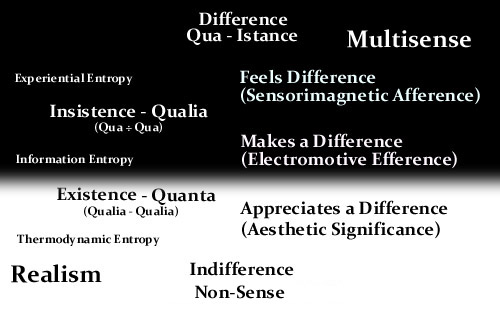
Looking at the Bergsonian-Deleuzian concept of multiplicity, I can see that it shares the same underlying dialectic as Multisense Realism. I noticed that if I add some insight from Bill Gaede’s Rope model of the atom (YouTube 04:25), I can map electromagnetism to the Continuous-Discrete framework of Bergson.
Where Gaede conceives of a literal thread across the diameter and around the circumference of the atomic nucleus, I think that it should be flipped. Rather than a literal thread I see a capacity for felt participation: ‘motive’ or maybe ‘efference’. Electricity is not a thread across the atom, it the experience of jumping from one atom to another. The atoms themselves would not look like balls of magnetic yarn, but feel like obstacles within the private sense field or ‘afference’ of each atom. This corresponds to magnetic field and Difference in kind, however, it’s a loose correspondence. Sense and motive is electromagnetism from the inside, but it is also gravity and electromagnetism, feeling and knowing, being and doing. It’s the absolute fundamental.
Electricity, in the Gaede model, would correspond to that which defines the literal, linear, direct aesthetic. The symmetry and juxtaposition across the diameter of the atom appears to us as a quantum gear shifting mechanism. That’s because we are detecting it from the outside with other bodies, so there is always a spacetime gap to be hopped across. The loop-like aspect of the atom, by contrast It is both a spherical range of sensitivity in public space and a circuit of oscillating affect or disposition (private experience). To make a long story story short, the atom, in my model, is an interaction with continuous-private-aesthetic qualities and discrete-public-anesthetic (skipping) qualities, aka qualia and quanta. The larger cosmological picture involves the division of qualia from the Absolute (Qua), the diffraction of quanta from qualia (spacetime existence), and the saturation of reconstituted qualia (quanta existential spacetime entropy stripped out) on return to the Absolute.

This can work for a neuron as well as an atom, but again, loosely. Each frame of reference has its own unique vocabulary. A neuron is figuratively like Bill Gaede’s atom model. A galaxy or a solar system is similar also, as is the alchemical Caduceus, the chakra system, the ankh… None of them are identical, but the theme is similar. Winding and tightening, spinning and accelerating, contracting and relaxing.


Ehh, How Do You Say…
The use of fillers in language are not limited to spoken communication.
In American Sign Language, UM can be signed with open-8 held at chin, palm in, eyebrows down (similar to FAVORITE); or bilateral symmetric bent-V, palm out, repeated axial rotation of wrist (similar to QUOTE).
This is interesting to me because it helps differentiate communication which is unfolding in time and communication which is spatially inscribed. When we speak informally, most people use a some filler words, sounds, and gestures. Some support for embodied cognition theories has come from studies which show that
“Gestural Conceptual Mapping (congruent gestures) promotes performance. Children who used discrete gestures to solve arithmetic problems, and continuous gestures to solve number estimation, performed better. Thus, action supports thinking if the action is congruent with the thinking.”
The effective gestures that they refer to aren’t exactly fillers, because they mimic or indicate conceptual experiences in a full-body experience. The body is used as a literal metaphor. Other gestures however, seem relatively meaningless, like filler. There seems to be levels of filler usage which range in frequency and intensity from the colorful to the neurotic in which generic signs are used as ornament/crutch, or like a carrier tone to signify when the speaker is done speaking, (know’am’sayin?’).
In written language, these fillers are generally only included ironically or to simulate conversational informality. Formal writing needs no filler because there is no relation in real time between participating subjects. The relation with written language was traditionally as an object. The book can’t control whether the reader continues to read or not, so there is no point in gesturing that way. With the advent of real time text communication, we have experimented with emoticons and abbreviations to animate the frozen medium of typed characters. In this article, John McWhorter points out that ‘LOL isn’t funny anymore’ – that it has entered sort of a quasi-filler state where it can mean many different things or not much of anything.
In terms of information entropy, fillers are maximally entropic. Their meaning is uncertain, elastic, irrelevant, but also, and this is cryptic but maybe significant…they point to the meta-conversational level. They refer back to the circumstance of the conversation rather than the conversation itself. As with the speech carrier tone fillers like um… or ehh…, or hand gestures, they refer obliquely to the speaker themselves, to their presence and intent. They are personal, like a signature. Have you ever noticed that when people you have known die that it is their laugh which is most immediately memorable? Or their quirky use of fillers. High information entropy ~ High personal input. Think of your signature compared to typing your name. Again, signatures are occurring in real time, they represent a moment of subjective will being expressed irrevocably. The collapse of information entropy which takes place in formal, traditional writing is a journey from the private perpetual here of subjectivity to the world of public objects. It is a passage* from the inner semantic physics, through initiative or will, striking a thermodynamically irreversible collision with the page. That event, I think, is the true physical nature of public time – instants where private affect is projected as public effect.
Speakers who are not very fluent in a language seem to employ a lot of fillers. For one thing they buy time to think of the right word, and they signal an appeal for patience, not just on a mechanical level (more data to come, please stand by), but on a personal level as well (forgive me, I don’t know how to say…). Is it my imagination or are Americans sort of an exception to the rule, preferring stereotypically to yell words slowly rather than using the ‘ehh’ filler. Maybe that’s not true, but the stereotype is instructive as it implies an association between being pushy and adopting the more impersonal, low-entropy communication style.
This has implications for AI as well. Computers can blink a cursor or rotate an hourglass icon at you, and that does convey some semblance of personhood to us, I think, but is it real? I say no. The computer doesn’t improve its performance by these gestures to you. What we might subtly read as interacting with the computer personally in those hourglass moments is a figment of the Pathetic fallacy rather than evidence of machine sentience. It has a high information entropy in the sense that we don’t know what the computer is doing exactly, if it’s going to lock up or what, but it has no experiential entropy. It is superficially animated and reflects no acknowledgement to the user. Like the book, it is thermodynamically irreversible as far as the user is concerned. We can only wait and hope that it stops hourglassing.
The meanings of filler words in different languages are interesting too. They say things like “you see/you know”, “it means”, “like”, “well”, and “so”. They talk about things being true or actual. “Right?” “OK?”. Acknowledgment of inter-subjective synch with the objective perception. Agreement. Positive feedback. “Do you copy?” relates to “like”…similarity or repetition. Symmetric continuity. Hmm.
*orthomodular transduction to be pretentiously precise
 Multisense Realism
Recent Comments