Archive

A Deeper Look at Peripheral Vision

Often, when peripheral vision is being explained, an image like the one on the right is often used to show how only a small area around our point of focus is defined in high resolution. The periphery is shown to be blurry. While this gets the point across, I think that it actually obscures the subtle nature of perception.
If I focus on some part of the image on the left, while it is true that my visual experience of the other quadrants is diminished, it is somehow less available experientially rather than degraded visually. At all times I can clearly tell the difference between the quality of left image and the right image. If I focus on a part of the right hand image, the unfocused portion does not blur further into a uniform grey, but retains the suggestion of separate fuzzy units.
If peripheral vision were truly a blur, I would also expect that when focusing on the left hand image, the peripheral boxes would look more like the one on the right, but it doesn’t. I can see that the peripherized blocks of the left image are not especially blurry. No matter how I squint or unfocus or push both images wayy into the periphery of my sight, I can easily tell that the two images are quite different. I can’t resolve detail, but I can see that there is potentially detail to be resolved. If I look directly at any part of the blurry image on the right I can easily count the fuzzies when I look at them, even through they are blurred. By contrast, with the image on the left, I can’t count the number of blocks or dots that are there even though I can see that they are block-like. There is an attenuation of optical acuity, but not in a way which diminishes the richness of the visual textures. There is uncertainty but only in a top-down way. We still have a clear picture of the image as a whole, but the parts which we aren’t looking at directly are seen as in a dream – distinct but generic, and psychologically slippery.
What I think this shows that there are two different types of information-related entropy and two different categories of physics – one public and quantitative, and one private and qualitative or aesthetic. Peripheral vision is not a lossy compression in any aesthetic sense. If perception were really driven by bottom up processing exclusively, we should be able to reproduce the effect of peripheral vision in an image literally, but we can’t. The best we can do is present this focused-in-the-center, blurry-everywhere-else kind of image which suggests peripheral vision figuratively, but the aesthetic quality of the peripheral experience cannot be represented.
I suggest that the capacity to see is more than a detection of optical information, and it is not a projection of a digital simulation (otherwise we would be able to produce the experience literally in an image). Seeing is the visual quality of attention, not a quantity of data. It is not only a functional mechanism to acquire data, it is more importantly an aesthetic experience.
The Doctor Prescribes Brian Eno – Blog of the Long Now
The Doctor Prescribes Brian Eno – Blog of the Long Now
In the video, Brian Eno brings up two points which relate to the last posts about intelligence, wisdom, and their relation to entropy.
“I think that one of the things that art offers you is the chance to surrender, to not be in control any longer”.
Right. That makes sense. Art debits the private side of the phenomenal ledger. The side which is concerned with the loaning of time to be returned to the Absolute with interest. Wisdom, especially in the exalted forms of Eastern philosophy, is all about surrender and flow. Dissolving of the ego. The ego is the public interface for the private self, and the seat of the kind of intelligence addressed by causal entropic forces – machine intelligence, strategic effectiveness. Important locally but trivial ultimately, in the face of eternity.
On the other side of the ledger is the chance to strive and control using intelligence. Western philosophy tends toward cultivating objectivity and critical thinking. It is a canon of skeptical intelligence and empiricism from which science emerged. Clear thinking and resisting the desire to surrender are what debit the public facing side of the ledger. Art and Science then, are the sense and motive of human culture…the tender and tough, the wag and wegh, and yes, the yin and yang.
Eno also says “The least interesting sound in the universe, probably, is the sine wave. It’s the sound of nothing happening. It’s the sound of perfection, and it’s boring. As David Byrne said in his song, Heaven is a place where nothing ever happens. Distortion is character, basically. In fact, everything we call character is the deviation from perfection. So, perfection to me, is characterlessness.”
Aha, yes. Tying this back to the Absolute, it is the diffraction, the shattering of timelessness with spacetime (aka Tsimtsum) which creates the third element – entropy. The Absolute can only be completed by its own incompleteness, and entropy is the diagonalization of experience into public facing entropies and private facing reflections of the Absolute…quanta and qualia, science and art.
Intelligence Maximizes Entropy?
Intelligence Maximizes Entropy?
A new idea linking intelligence to entropy that is giving me something to think about.
“[…]intelligent behavior emerges from the “physical process of trying to capture as many future histories as possible,”
This sounds familiar to me. I have been calling my cosmological model the Sole Entropy Well, or Negentropic Monopoly, in which all signals (experiences) are diffracted from a single eternal experience, the content of which is the capacity to experience. I think that this is the same principle in this paper, called “causal entropic forces”, except in reverse. I wrote recently about how intelligence is rooted in public space while wisdom is about private time.
I think that causal entropic forces are about preserving a ‘float’ of high entropy on top of time. It’s like juggling – you want to suspend as many potentials as you can at “a” time and compensate for any potential threats before they can happen “in” time. Behind the causal entropic force, it seems to me that there must always be a core which is not entropic. That which seeks to entropically harness the future is itself motivated by the countervailing force for itself – to escape the harness of entropy.
None of this, however, addresses the Hard Problem. To the contrary, if this model is correct, then it is even more difficult to justify the existence of aesthetic sense, since all of the public effects of intelligence can be explained by thermodynamics.
Article: “A single equation grounded in basic physics principles could describe intelligence and stimulate new insights in fields as diverse as finance and robotics, according to new research.
Alexander Wissner-Gross, a physicist at Harvard University and the Massachusetts Institute of Technology, and Cameron Freer, a mathematician at the University of Hawaii at Manoa, developed an equation that they say describes many intelligent or cognitive behaviors, such as upright walking and tool use.The researchers suggest that intelligent behavior stems from the impulse to seize control of future events in the environment. This is the exact opposite of the classic science-fiction scenario in which computers or robots become intelligent, then set their sights on taking over the world.The findings describe a mathematical relationship that can “spontaneously induce remarkably sophisticated behaviors associated with the human ‘cognitive niche,’ including tool use and social cooperation, in simple physical systems,” the researchers wrote in a paper published today in the journal Physical Review Letters.“It’s a provocative paper,” said Simon DeDeo, a research fellow at the Santa Fe Institute, who studies biological and social systems. “It’s not science as usual.”Wissner-Gross, a physicist, said the research was “very ambitious” and cited developments in multiple fields as the major inspirations.The mathematics behind the research comes from the theory of how heat energy can do work and diffuse over time, called thermodynamics. One of the core concepts in physics is called entropy, which refers to the tendency of systems to evolve toward larger amounts of disorder. The second law of thermodynamics explains how in any isolated system, the amount of entropy tends to increase. A mirror can shatter into many pieces, but a collection of broken pieces will not reassemble into a mirror.The new research proposes that entropy is directly connected to intelligent behavior.“[The paper] is basically an attempt to describe intelligence as a fundamentally thermodynamic process,” said Wissner-Gross.The researchers developed a software engine, called Entropica, and gave it models of a number of situations in which it could demonstrate behaviors that greatly resemble intelligence. They patterned many of these exercises after classic animal intelligence tests.In one test, the researchers presented Entropica with a situation where it could use one item as a tool to remove another item from a bin, and in another, it could move a cart to balance a rod standing straight up in the air. Governed by simple principles of thermodynamics, the software responded by displaying behavior similar to what people or animals might do, all without being given a specific goal for any scenario.“It actually self-determines what its own objective is,” said Wissner-Gross. “This [artificial intelligence] does not require the explicit specification of a goal, unlike essentially any other [artificial intelligence].”Entropica’s intelligent behavior emerges from the “physical process of trying to capture as many future histories as possible,” said Wissner-Gross. Future histories represent the complete set of possible future outcomes available to a system at any given moment.Wissner-Gross calls the concept at the center of the research “causal entropic forces.” These forces are the motivation for intelligent behavior. They encourage a system to preserve as many future histories as possible. For example, in the cart-and-rod exercise, Entropica controls the cart to keep the rod upright. Allowing the rod to fall would drastically reduce the number of remaining future histories, or, in other words, lower the entropy of the cart-and-rod system. Keeping the rod upright maximizes the entropy. It maintains all future histories that can begin from that state, including those that require the cart to let the rod fall.“The universe exists in the present state that it has right now. It can go off in lots of different directions. My proposal is that intelligence is a process that attempts to capture future histories,” said Wissner-Gross.The research may have applications beyond what is typically considered artificial intelligence, including language structure and social cooperation.DeDeo said it would be interesting to use this new framework to examine Wikipedia, and research whether it, as a system, exhibited the same behaviors described in the paper.“To me [the research] seems like a really authentic and honest attempt to wrestle with really big questions,” said DeDeo.One potential application of the research is in developing autonomous robots, which can react to changing environments and choose their own objectives.“I would be very interested to learn more and better understand the mechanism by which they’re achieving some impressive results, because it could potentially help our quest for artificial intelligence,” said Jeff Clune, a computer scientist at the University of Wyoming.Clune, who creates simulations of evolution and uses natural selection to evolve artificial intelligence and robots, expressed some reservations about the new research, which he suggested could be due to a difference in jargon used in different fields.Wissner-Gross indicated that he expected to work closely with people in many fields in the future in order to help them understand how their fields informed the new research, and how the insights might be useful in those fields.The new research was inspired by cutting-edge developments in many other disciplines. Some cosmologists have suggested that certain fundamental constants in nature have the values they do because otherwise humans would not be able to observe the universe. Advanced computer software can now compete with the best human players in chess and the strategy-based game called Go. The researchers even drew from what is known as the cognitive niche theory, which explains how intelligence can become an ecological niche and thereby influence natural selection.The proposal requires that a system be able to process information and predict future histories very quickly in order for it to exhibit intelligent behavior. Wissner-Gross suggested that the new findings fit well within an argument linking the origin of intelligence to natural selection and Darwinian evolution — that nothing besides the laws of nature are needed to explain intelligence.Although Wissner-Gross suggested that he is confident in the results, he allowed that there is room for improvement, such as incorporating principles of quantum physics into the framework. Additionally, a company he founded is exploring commercial applications of the research in areas such as robotics, economics and defense.“We basically view this as a grand unified theory of intelligence,” said Wissner-Gross. “And I know that sounds perhaps impossibly ambitious, but it really does unify so many threads across a variety of fields, ranging from cosmology to computer science, animal behavior, and ties them all together in a beautiful thermodynamic picture.”
Cracking Intelligence and Wisdom
The difference between intelligence and wisdom, (aside from rolling up an D&D character), parallels the distinctions which have been dividing philosophy of mind from the beginning. Intelligence implies a cognitive ability in a technical and literal sense – a talent for understanding factual relations which apply to the public world. The products of intelligence are transformative, but famously amoral. Frankenstein and 2001’s HAL both embody our fear of the monstrous side of technology, of intelligence ‘run amok’ with hubris. This is a rich vein for science fiction. Beings built from the outside in – an inhuman mind from inanimate substance. Zombies, killer robots, aliens. Giant insects or weaponized planetoids. In all cases the impersonal, mechanistic side of consciousness is out of proportion and humanity is dwarfed or under-signified.
Intelligence is supposed to be impersonal and mechanistic though. Its facts and figures are not supposed to be local to human experience. The sophisticated view which developed through Western intelligence not only does not require us to value human subjectivity. It insists, to the contrary, that all human awareness is a contamination to the pristine reality of factual evidence – objects which simply are ‘as they are’ rather than merely ‘seem to be’. All human awareness, that is, except for the reasoning which progresses science itself.
Wisdom, while overlapping with intelligence as set of cognitive talents and skills, is not as clear cut as intelligence. Wisdom does not yield the kind of public results which intelligence is intended to produce, because wisdom is not focused on public objects but on private experiences. Both intelligence and wisdom attempt to step back from the local phenomenal world to seek deeper patterns, but intelligence seeks them from indirect experiences outside of the body, while wisdom seeks within the psyche, within the library of possible personal experiences. The library of wisdom, unlike that of intelligence, is in the language of the personal. Characters and stories which work on multiple levels of figurative association. The privacy of wisdom extends to its own forms, leading to a lot of mystery for the sake of mystery which those minds on the other side of the aisle find deeply offensive. Intelligence only uses symbols as generic pointers – to literally refer to a specific quantifiable variable. Intelligence stacks symbols in sequence as language and formulas. Wisdom uses symbols as poetry and art, evocative images which work on multiple levels of awareness and understanding but not the kind of fixed understanding of intelligence. The understanding of wisdom can be open ended and elliptical, absurd, poignant, etc.
The deepest kinds of wisdom are said to be ‘timeless’. Unlike the high value that intelligence places on up to the minute information, wisdom seems to appreciate with age. Rather than being seen as increasingly irrelevant, ancient stories and turns of phrase are revered and celebrated for their pedigree. There is an almost palpable weight to the anachronistic language and images. The metaphors are somehow more potent when delivered by a long dead prophet. This favoring the dead happens with more modern quotations too. Maybe it’s because they are no longer around to put their quotation in context, or maybe it just takes a while for greatness to make itself known against the background of more ephemeral noise.
In any case, the realm of wisdom is a decidedly human realm of human experience. It is a talent for recognizing and encapsulating common sense and long life, with subtlety and significance for all people and all lives. Wisdom is about being able to appreciate our fortunes as individuals and members of society. Wisdom helps us find an objective vantage point within the history of our personal experience from which to see and evaluate the ups and downs of life passing. Through wisdom, we can see the bigger picture in our own trials and tribulations and the rise and fall of civilizations. We can see how every moment can change seeming fiction into seeming fact and back. Wisdom is subjective and mystical, but so too were many phenomena in the natural world before science. The promise of Western intelligence is to de-mystify they world, to remove subjectivity, but in addressing subjectivity itself the intellect meets its match.
Frustrated with the prospect of decomposing its source into objects, intelligence turns to a kind of inside-out subjectivity in some variety of functionalism. Subjectivity, from the Western perspective of public space as reality, is nullified. It can only be disqualified as an ‘emergent property’ or ‘illusion’ of some other deterministic process of matter or ‘information’ – a side effect somehow, of what already seems to know itself perfectly well and function competently without resorting to any fanciful aesthetic ‘feelings’ or ‘flavors’. If arithmetic or the laws of physics work automatically, then they don’t need a special show of aesthetic phenomena to lubricate their own wheels, yet, thinks the left-brained Western mind, there is simply no other possibility. Consciousness must arise as some sort of accident among colliding collections of complex computations.
This is a problem, since it only pushes dualism from the Cartesian center of tolerance into the ghettos of the untouchable. Subjective experience is now confined in science to untouchable, uncountable metaphysical aethers of simulation; epiphenomenal dead ends which had no meaningful beginning.
The Western mind cannot tolerate being put into a box by any phenomena which it cannot put into a box itself. The irony of modern physics of course, is that all of the boxes which have been piled up so far seem to indicate their origin in circularity. A microcosm of disembodied Cheshire Cat smiles…determinable indeterminisms. On the astronomical scale, suddenly the bulk of the matter and energy in the universe has been re-categorized into darkness. The alchemist caps seem to have reappeared in science, but turned inside out. Western intelligence is no longer explaining the universe which we experience directly as participants, but is devoted to pursuing an alternate universe backstage which just so happens to identify human subjectivity as the only thing in the cosmos which is not actually real.
The current battle over TED, Sheldrake and Hancock is on the front line of the war between public-facing thinkers and private-facing thinkers, between body-space visionaries and life-time visionaries. Both sides play out a reflexive antagonism – a shadow projection which extends beyond the personal. Each side hears the other in their own limited terms, and neither one is able to communicate the missing perspective of the other. The argument continues because both fail to understand the missing piece of their own perspective and their mode of thinking has devolved into an aggressive-defensive vicious circle of un-wisdom and un-intelligence.

At this point in our political and in our intellectual life, the midpoint has been skewed so far from the center (to the West in science, and to the Right in politics), that any proposal which engages other perspectives is seen as extremism. Any new information is mistaken for treasonous compromise. Whether that extremism is in the mechanistic or the animistic direction, the result is very similar.
I would love to see a study done comparing the brain activity of so called ‘militant atheists’ and ‘religious fundamentalists’, to see how really far apart they are. My scientific hypothesis is that no neuroscientist will be able to look at the fMRIs of the two camps in a double blind test and reliably tell the difference. If that were true, what would it mean about protecting science from unscientific ideas if you cannot prove the scientific validity of thoughts from a brain scan?
Improving The Hard Problem
I have been using the term ‘aesthetic’ a lot lately in specifying the qualitative aspects of consciousness, and I feel like it clarifies one of the core issues. The Hard Problem of Consciousness is confusing to people whose mindset is innately compelled to define consciousness as a collection of functions in the first place. It therefore comes out nonsensical when philosophers like David Chalmers talk about questioning why there is such a thing as ‘what it is like’ to have an experience, since for the functionalist, ‘what it is like’ to perform a function is simply the self-same set of events which comprise the function.
Maybe it helps to define ‘what it is like’ in more specific terms, which I think would be scientifically described as private sensory-motive participation but informally can be understood as aesthetic phenomena. The key is to notice the asymmetric relation between aesthetics and function in that function can improve aesthetics, but aesthetics can *never* improve function. The Hard Problem then becomes a problem of how to explain aesthetics (aka qualia) in a universe of functions which can neither benefit by them nor physically generate them as far as we can tell (unless there is a miniature kitchen near our olfactory bulbs baking microscopic apple pies whenever we remember the smell of apple pie).
The fact that aesthetics are not possible to explain in terms of a function, but that functions can be conceived of aesthetically is unfamiliar and those who have that innately functional mindset will balk at the notion of aesthetic supremacy, but this is the future of science – letting go of the familiar, or in this case, rediscovering the literally familiar (ordinary consciousness) in an unfamiliar way (as the fabric of existence).
When we talk about consciousness then, what we really mean is the aesthetic experience of being and doing, of perceiving and participating. This experience is extended publicly as spatio-temporal form-functions (STFF), but those phenomena are not capable of appreciating themselves. Just as a puppet can be made to seem to walk and talk like a person, forms can be made to interact by hijacking their natural low-level aesthetics to represent our high-level expectations. The letters on this screen are just such an example. I am using a lot of technology to generate contrasting pixels on your video screen, which you will experience as letters, words, and sentences.
Each level of description – as typeface, spellings, grammars, evoke aesthetic micro-experiences. The closer these descriptions get to your native scale – the personal scale, the more that your personal experience, feelings, and understanding influences the aesthetics of all of the sub-personal experiences within reading the language. What you see of the letters is because of your experience of learning to read English, not because of any special power that these words have to project meaning. By themselves, these words and letters do nothing to each other. They are figures for use in human communication – they have no functional aspect, i.e. they are *only* aesthetic. This is why a computer has no use for human languages, or even programming languages. Computation requires no figures or forms of any kind, nor can it produce any forms or figures without borrowing some kind of STFF (with u in the middle, heh) from the ‘real world’. Otherwise there is a only the anesthetic concept of pure function – which is the exact opposite of representation by form, image, or quality, but is non-presentation through quantity.
Computation, or ‘Information Processing’ is the unconscious number crunching of automated, logical functionality. Information lacks aesthetic presence by definition – it is a purely conceptual understanding of instructed variables in motion. If there is a capacity for aesthetic appreciation to begin with, then computation can extend it and improve it. If there is no such capacity, then there is certainly no justification for adding it into computation, as automatic function cannot benefit in any way by appreciation of its own activity.
What exactly is our life?
Quora: What exactly is our life?
How do you see the life?
Your philosophical explanation. How should one look at what he experiences, he sees, he thinks? How to live it?
What is the purpose of life we have been given and how to find it? How do you make most out of it?
In one sentence and explanation of this sentence. What is life, really?
Our life is perception and participation in experiences of particular aesthetic qualities.
Perception and participation are, in my opinion, opposing modes of a universal primitive, which I call sense.
Who and what we are is the product of countless nestings and interleavings of experiential capacities, diffractions of sense. As Homo sapiens, we are a centuryish long experience, seemingly ‘folded in on ourselves’ on several levels: Personally, socially, culturally, anthropologically, zoologically, biologically, chemically, and materially. That’s not including possible super-personal ranges of sense. More important than the complexity and the holarchy however is the simplicity and identity.
Contrary to both Western-mechanistic views which under-signify subjectivity and Eastern-spiritual views which I think over-signify subjectivity, I propose that life is always in the juxtaposition of the generic anesthetic of public bodies and the proprietary aesthetic of private experiences. My conjecture here is somewhat panpsychic or panexperiential – matter, cells, organisms, etc are all associated with some kind of interior experience which are hidden from each other by physics. Physics is actually perceptual relativity – nature defining and describing itself in an expanding array of sense modalities, and simultaneously contracting and obscuring sense through spatial attenuations such as scale incompatibility, distance, crushing and scattering.
The point of all of this as pertains to the question is that with the Western view, we have lost our native coherence as beings in our own right. Instead human presence is decomposed and de-presented into aggregates of sub-personal and impersonal behaviors; evolutionary, biological, computational. My view is that just because we find it easier to pin down forms and functions outside of our own subjective experience does not mean that the universe finds our personal day-to-day experience any less of a legitimate phenomenon than the comings and goings of quarks or galaxies. In our success at having graduated from religion and philosophy by focusing on our own insignificance and flawed sense, we have unintentionally turned our erstwhile objectivity into an anti-anthropomorphic anthropomorphism. We reject all that is personally significant in favor of an a-signifying, anesthetic, mechanism…which unfortunately has, in my opinion, begun to show some unpleasant side-effects for human life.
If you ask me, then, what we should do with this life as human beings in this place at this time, I think that it is to reclaim our authentic status as whole participants in a significant human life. We are to understand, now, that although the exterior of the universe is mechanistic and entropic, the interior is quite the opposite. The human condition is extremely tricky, and it seems that everyone seems to be missing some important piece to their own puzzle so that it is not so simple to say ‘Carpe diem’ and save the world. Everything fights back and slips through your fingers, ignores you and dissolves into regret…or else rockets into success leaving your unable to appreciate the struggles of others. It’s… weird. Isn’t it?
Entropy, Extropy, and Solitopy
By my reckoning, ‘order’ can only be an aesthetic consideration, which further means that it is dependent on the sensitivity of a given participant. Thermodynamic entropy, therefore, while overlapping on information entropy by some measures, does not in others.
I use the example of compressing a video of a glass of ice melting to illustrate how the image of ice changing over time, being more complex and therefore requiring more resources to compress with a general-purpose video codec, defies the underlying thermodynamic change from low entropy to high entropy. If you compressed a before and after video, the after video would encounter lower information entropy in executing the compression than the melting ice.
All this demonstrates is that not every expression or description of a phenomenon can be reduced to a quantitative expectation. The optical qualities of melting ice from a macroscopic perspective are not isomorphic to other levels, perspectives, and sense modalities.
Anyhow, my conjecture uses a term ‘solitropy’ which refers to the aesthetic drive which is similar to what has been called extropy or Eros, but solitropy is conceived as a quality which is not diametrically opposed to entropy. Simple negentropy would be a reduction in noise, but would not insist on the content of the signal itself improving qualitatively. You can make the type as clear as you like, but that won’t improve what is being said. Solitropy would extend entropy-extropy into a private quality of physics, so that we would be able to formalize in physics, for instance, the difference between the entropy produced by burning down a city and boiling water.
Shoelace Causality Model
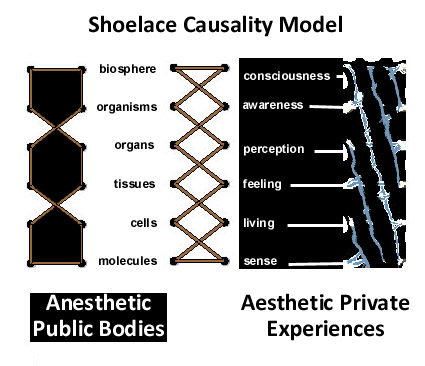
See if this model makes any sense. On the left side (or West end) are the levels of organization associated with material bodies, from micro to mega. On the East side, by making it negative, wavy, and diagonal, I tried to emphasize that the juxtaposition between East and West is truly orthogonal (or orthomodular) and not simply different. Where the Western view promises local certainty with interlocking gears of mechanism, the Eastern view submerges certainty into holistic, idiopathic acausality which commands from eternity.
(integrated this into the Overview)
Free Will and the Fallibility of Science
One of the most significant intellectual errors educated persons make is in underestimating the fallibility of science. The very best scientific theories containing our soundest, most reliable knowledge are certain to be superseded, recategorized from “right” to “wrong”; they are, as physicist David Deutsch says, misconceptions:I have often thought that the nature of science would be better understood if we called theories “misconceptions” from the outset, instead of only after we have discovered their successors. Thus we could say that Einstein’s Misconception of Gravity was an improvement on Newton’s Misconception, which was an improvement on Kepler’s. The neo-Darwinian Misconception of Evolution is an improvement on Darwin’s Misconception, and his on Lamarck’s… Science claims neither infallibility nor finality.This fact comes as a surprise to many; we tend to think of science —at the point of conclusion, when it becomes knowledge— as being more or less infallible and certainly final. Science, indeed, is the sole area of human investigation whose reports we take seriously to the point of crypto-objectivism. Even people who very much deny the possibility of objective knowledge step onto airplanes and ingest medicines. And most importantly: where science contradicts what we believe or know through cultural or even personal means, we accept science and discard those truths, often enough wisely.
An obvious example: the philosophical problem of free will. When Newton’s misconceptions were still considered the exemplar of truth par excellence, the very model of knowledge, many philosophers felt obliged to accept a kind of determinism with radical implications. Give the initial-state of the universe, it appeared, we should be able to follow all particle trajectories through the present, account for all phenomena through purely physical means. In other words: the chain of causation from the Big Bang on left no room for your volition:
[[MORE]]
Determinism in the West is often associated with Newtonian physics, which depicts the physical matter of the universe as operating according to a set of fixed, knowable laws. The “billiard ball” hypothesis, a product of Newtonian physics, argues that once the initial conditions of the universe have been established, the rest of the history of the universe follows inevitably. If it were actually possible to have complete knowledge of physical matter and all of the laws governing that matter at any one time, then it would be theoretically possible to compute the time and place of every event that will ever occur (Laplace’s demon). In this sense, the basic particles of the universe operate in the same fashion as the rolling balls on a billiard table, moving and striking each other in predictable ways to produce predictable results.Thus: the movement of the atoms of your body, and the emergent phenomena that such movement entails, can all be physically accounted for as part of a chain of merely physical, causal steps. You do not “decide” things; your “feelings” aren’t governing anything; there is no meaning to your sense of agency or rationality. From this essentially unavoidable philosophical position, we are logically-compelled to derive many political, moral, and cultural conclusions. For example: if free will is a phenomenological illusion, we must deprecate phenomenology in our philosophies; it is the closely-clutched delusion of a faulty animal; people, as predictable and materially reducible as commodities, can be reckoned by governments and institutions as though they are numbers. Freedom is a myth; you are the result of a process you didn’t control, and your choices aren’t choices at all but the results of laws we can discover, understand, and base our morality upon.
I should note now that (1) many people, even people far from epistemology, accept this idea, conveyed via the diffusion of science and philosophy through politics, art, and culture, that most of who you are is determined apart from your will; and (2) the development of quantum physics has not in itself upended the theory that free will is an illusion, as the sorts of indeterminacy we see among particles does not provide sufficient room, as it were, for free will.
Of course, few of us can behave for even a moment as though free will is a myth; there should be no reason for personal engagement with ourselves, no justification for “trying” or “striving”; one would be, at best, a robot-like automaton incapable of self-control but capable of self-observation. One would account for one’s behaviors not with reasons but with causes; one would be profoundly divested from outcomes which one cannot affect anyway. And one would come to hold that, in its basic conception of time and will, the human consciousness was totally deluded.
As it happens, determinism is a false conception of reality. Physicists like David Deutsch and Ilya Prigogine have, in my opinion, defended free will amply on scientific grounds; and the philosopher Karl Popper described how free will is compatible in principle with a physicalist conception of the universe; he is quoted by both scientists, and Prigogine begins his book The End of Certainty, which proposes that determinism is no longer compatible with science, by alluding to Popper:
Earlier this century in The Open Universe: An Argument for Indeterminism, Karl Popper wrote,” Common sense inclines, on the one hand, to assert that every event is caused by some preceding events, so that every event can be explained or predicted… On the other hand, … common sense attributes to mature and sane human persons… the ability to choose freely between alternative possibilities of acting.” This “dilemma of determinism,” as William James called it, is closely related to the meaning of time. Is the future given, or is it under perpetual construction?Prigogine goes on to demonstrate that there is, in fact, an “arrow of time,” that time is not symmetrical, and that the future is very much open, very much compatible with the idea of free will. Thus: in our lifetimes we have seen science —or parts of the scientific community, with the rest to follow in tow— reclassify free will from “illusion” to “likely reality”; the question of your own role in your future, of humanity’s role in the future of civilization, has been answered differently just within the past few decades.
No more profound question can be imagined for human endeavor, yet we have an inescapable conclusion: our phenomenologically obvious sense that we choose, decide, change, perpetually construct the future was for centuries contradicted falsely by “true” science. Prigogine’s work and that of his peers —which he calls a “probabilizing revolution” because of its emphasis on understanding unstable systems and the potentialities they entail— introduces concepts that restore the commonsensical conceptions of possibility, futurity, and free will to defensibility.
If one has read the tortured thinking of twentieth-century intellectuals attempting to unify determinism and the plain facts of human experience, one knows how submissive we now are to the claims of science. As Prigogine notes, we were prepared to believe that we, “as imperfect human observers, [were] responsible for the difference between past and future through the approximations we introduce into our description of nature.” Indeed, one has the sense that the more counterintuitive the scientific claim, the eagerer we are to deny our own experience in order to demonstrate our rationality.
This is only degrees removed from ordinary orthodoxies. The point is merely that the very best scientific theories remain misconceptions, and that where science contradicts human truths of whatever form, it is rational to at least contemplate the possibility that science has not advanced enough yet to account for them; we must be pragmatic in managing our knowledge, aware of the possibility that some truths we intuit we cannot yet explain, while other intuitions we can now abandon.
It is vital to consider how something can be both true and not in order to understand science and its limitations, and even more the limitations of second-order sciences (like social sciences). Newton’s laws were incredible achievements of rationality, verified by all technologies and analyses for hundreds of years, before their unpredicted exposure as deeply flawed ideas applied to a limited domain which in total provide incorrect predictions and erroneous metaphorical structures for understanding the universe.
I never tire of quoting Karl Popper’s dictum:
Whenever a theory appears to you as the only possible one, take this as a sign that you have neither understood the theory nor the problem which it was intended to solve.It is hard but necessary to have this relationship with science, whose theories seem like the only possible answers and whose obsolescence we cannot imagine. A rational person in the nineteenth century would have laughed at the suggestion that Newton was in error; he could not have known about the sub-atomic world or the forces and entities at play in the world of general relativity; and he especially could not have imagined how a theory that seemed utterly, universally true and whose predictive and explanatory powers were immense could still be an incomplete understanding, revealed by later progress to be completely mistaken about nearly all of its claims.
Can you imagine such a thing? It will happen to nearly everything you know. Consider what “ignorance” and “knowledge” really are for a human, what you can truly know, how you should judge others given this overwhelming epistemological instability!
That’s a great article, IMO. He hits a lot of points dead on that I have tried many times to make in many different debates.
The only point of contention I might have is the idea of scientific paradigms being misconceptions rather than conceptions. It makes sense as far as it provides a good provocation for an audience, but if we were really being absolutely scientific about it, I would say that misconception has too much of a dismissive connotation. If it turns out that the Earth is actually a four dimensional shadow of a 19 dimensional interplanetary being, that doesn’t make our perceptions of the Sol-centric orbiting orb or the Jerusalem-centric flat garden misconceptions…but it does make the latter model a misconception *in comparison to the former*.
But yes, for the purposes of the waking up the average humdrum mind, the point is well made that we would all be well advised to keep in mind that odds are that everything we know is wrong, on some level or in some sense. That seems to be more important now than it usually does. Some moments in history appear to be more polarizing than others.
“the chain of causation from the Big Bang on left no room for your volition”
This is still the overwhelmingly popular assumption, in my experience.
“Of course, few of us can behave for even a moment as though free will is a myth; there should be no reason for personal engagement with ourselves, no justification for “trying” or “striving”; one would be, at best, a robot-like automaton incapable of self-control but capable of self-observation. One would account for one’s behaviors not with reasons but with causes; one would be profoundly divested from outcomes which one cannot affect anyway. And one would come to hold that, in its basic conception of time and will, the human consciousness was totally deluded.”
I have tried many times to communicate this exactly. Great way of pulling it together. I think that the fact that what he is saying is true gives us the vantage point from which to see that “trying” or “striving” is an aesthetic quality of intention which is actually perpendicular or orthomodular physical principle to the axis of the unintentional. As the privacy of physics is a spectrum of effort, courage, tenacity, boldness, surrender, release, etc, the public side of physics is monotonous: anesthetic, automatic qualities which describe a continuum between determinism and ‘accident’ (/error/random/mutation). Of course, it is only because we can alter our own degree of intentionality that we can discern between determinism and accident; were the universe plotted only on that single unintentional axis, that chain of causation, then there could be no conceivable difference between accident and non-accident. It is ironically our own distance from automatism which gives us the impression that automatism is rich enough to exist as a monopole.
“It is vital to consider how something can be both true and not in order to understand science and its limitations,”
Stealing that.
I’m generally in full agreement with everything here. He might be a bit more optimistic than I am about the current state of what is accepted by scientists and science buffs at this point. I feel that the mechanistic worldview is not going to die that easily. If this revolution does get off the ground, it could very well be another brief renaissance before being subsumed into the next revival of anesthetic totalism.
 Multisense Realism
Recent Comments