Archive
Updated Introduction
3. Overview
I am always trying to sum up multisense realism in a simple way, as I think it ultimately is pretty simple, but it is hard to put it simply because it requires that we overturn some core assumptions about how we look at the self and the universe.
I consider my model to be neither dualist nor monist, but an “Ouroboran” monism, meaning that physics itself is the capacity for sensory experience and discernment and that it is involuted in a reflexive, “umbilical” relation to itself. The idea is that experience and matter are the private and public ranges of physical phenomena. The involution (like a Klein bottle or Möbius strip) refers to the orthogonal or perpendicular juxtaposition between sensorimotive-based private experience and spacetime-based public realism.
If we begin with this diagram which I have pilfered from memeengine:

and then progress, like those schizophrenic cat portraits, into the mind bending rabbit hole that is Multisense Realism…

Here, I am trying to introduce the notion of a continuum between the three ‘ism’s above, to indicate that the cosmos supports all three inherently because it is that juxtaposition/symmetry which is actually more primary than any of them. Not the symmetry itself – which is more of a mathematical relation that is somewhat abstract, but the capacity to detect and respond to patterns like symmetry – the capacity to sense and participate in the universe. What I wound up with was more of a yin yang taijutsu arrangement which maybe hints at an East side where experience is purely subjective, a West side which is all representations of what is presumed purely objective, and a midrange which is about perception as a body in the world of comparably scaled bodies.

Not content with that, I went on to try to get more of the flavor of it with nested scale bodies in a Cartesian grid of blue vector arrows representing energy and function (the disowned idealism of the West haunts the machine as ‘energy’ and ‘information’). On the East side, there is the solipsistic fisheye distortion which is all cluttered up with my conceptions of sub-personal, super-personal, and the arrow of motive power.

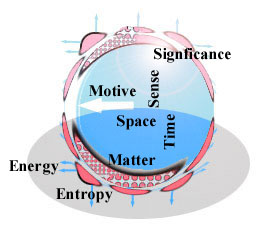
Wrapping this mess up, I put the atomic dots where they belong, on the inside surface of the experiential bubble of the Absolute. Make sense? Haha.
In Multisense Realism, all of physics is understood to relate to the capacity to discern between public and private views of phenomena. Public physics appears to us as ‘matter and energy’ on the outside and ‘perception and participation’ on the inside. The gap which makes this involution or twist possible is the modulation between the presence and absence or sensory presence, with the absence being what is called entropy or spacetime (which become essentially the same thing under this model of physics). To make things more confusing, this modulation of entropy and sensitivity is nested within many layers of itself, as a fractal. A cell encapsulates a world of molecular interaction. An organ encapsulates a world of cells, etc.
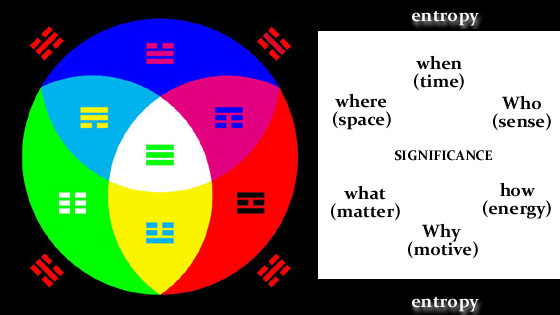
What started as an observation about the common positions that people seem to take within philosophy of mind debates became a hypothesis about the continuum of public and private sense experience, a re-interpretation of light, cosmology, consciousness, and the introduction of new concepts like significance and solitropy.
These two images try to capture the overall picture of how all major features of the cosmos can smoothly fit together.

The Future of Computing — Reuniting Bits and Atoms
A great presentation on computing with hardware and software which are homomorphic to each other. Logical automata (explained 11:51 to 15:50) is just this sort of a WYSIWYG architecture where the software is executed from a bulk raw material, i.e., not Gb of memory or number of processor cores, but square feet or pounds of programmable matter. Atoms, or groups of atoms, are here used directly as bits.
Gershenfeld compares how our current approach of computing requires multiple stages of compiling disparate formats, but that to more closely match nature, we should strive to imitate nature in the sense of having a consistent zoomable format on every scale.

In nature, the map is the same graphically regardless of the scope of magnification. Marrying these two concepts, the idea is to design shapes which are themselves instructions, i.e. physical interactions with other physical shapes, so that computation is not encoded but rather, embodied. As in biochemistry, the output is a material product, and the machine is itself is a self fabricating machine tool as opposed to a manufacturer of inert objects.
I think that he is probably right that this is the direction of the future in general, “computing aligned with nature” which brings computation into matter. It is compelling to imagine that this kind of embodied computing could be the Holy Grail of nano-engineering, giving us control over virtually anything eventually.
At the same time I can see that there is something which has been overlooked. To quote Deleuze:
“Representation fails to capture the affirmed world of difference. Representation has only a single center, a unique and receding perspective, and in the consequence a false depth. It mediates everything, but mobilizes and moves nothing.”
– Gilles Deleuze, Difference and Repetition, p56
(source http://sleepinginthegreenery.blogspot.co.uk/)
To understand why this universe of embodied computation is not the universe that we live in, Difference is the key. An overhead map is only so useful to us. Even if we can zoom down to the human scale level, we really need to switch to a first person street view to make the transition from outside-looking-down to inside-looking-around. To get further into the subjective view, we would have to have access to feelings and thoughts, so that at some level of description the model of zoomable shapes is less than useless. In our personal awareness, the appearance of neurological structures in our view would be hallucination.
The assumption then of this uniformly computational matter, while fantastic for our purposes as human beings, would be a catastrophe for the universe in general. It would be the ultimate monoculture, with everything and anything reinvented as collections of positionable nano-Legos. The problem of conformity to a generic, universal structure is not that it won’t work, but that if it does, there will be no Difference possible.
Given Deleuze’s assertion that representation moves nothing, this intention of “reuniting bits with atoms’ seems to presume that they were united to begin with but doesn’t address why they were ever separated. Indeed, if this method of embodied computation is the way of nature, how and why could it ever seem otherwise? Where have these Different perspectives on different levels emerged from, and for what purpose?
I think that on closer inspection, even though this new approach is brilliant and revolutionary in some important ways, it still is founded on a sloppy assumption. It presumes that hardware which looks and acts like the software is identical to it. If this were the case, instead of images we would see the shapes of ganglia and retinal cells, but we would see the same thing instead of smells, sounds, and feelings. We could not feel dizzy, but rather be informed of some vestibular condition by means of these same shapes – which we think of visually or tangibly, but without the Difference, there really is no reason to assume anything perceptual at all.
Once again, even though I am impressed with the futuristic thinking, it still takes us away from the missing piece in physics – the privacy and interiority and qualia. Buying into the universe as undifferentiated plenum of self-machining bubbles we are betting that there is no difference between biology, chemistry, and physics. It’s all physics, all surfaces and volumes in public spaces. Is that really what the universe is though? Could our experience be understood that way if we didn’t have our own familiarity with it already? I think if we lived in a universe that was really all about universal computation, then we would never have separated bits from atoms in the first place. We never would have approached bits as encoded abstractions because we would have been comfortable already with the universal format.
Instead, the universe appears to be the opposite. On every level, even though there are repeating themes and forms, it is never exactly the same presentation. A whirlpool would not be mistaken for a galaxy and a grain of salt is not the same thing as a cube of ice. In the universe we actually live in, the only thing which seems truly universal is Difference. More universal than mathematics and physics is the variety of sensory qualities and modalities. It is not just formations or embodied information, but direct experience.
Multisense Perception Model

Another crazy looking attempt at organizing the multisense model of perception. The top diagram emphasizes how the contemporary model assumes that all phenomenal interaction is at the particle level, effected via tangible collisions of microcosmic bodies in spacetime. Higher level experiences are imagined to be epiphenomenal abstractions tied to each other through exclusively bottom up logical mechanical functions. In this model, it must be admitted that consciousness can only be a metaphysical layer of unexplained illusion.
In the bottom diagram, the dualism of private experience in white on black, and public spacetime realism in black on white gives an idea of the involuted or ‘Ouroboran’ relation between the two aesthetics. The center region depicts the public stack of spatiotemporal scale relations from microcosm to macrocosm (particles<>cells<>tissues<>sense organs/organisms). The Caduceus like split helix implies a loose hierarchical, bidirectional overlap of interlocking forms and functions on different scales and their implicit interaction with the corresponding private experiences on corresponding levels (personal, sub-personal interiorities corresponds to macrocosmic, microcosmic exteriors).
The label ‘Sensory-Motor Experiences’ at the base designates that the totality can be understood literally as sensory motor phenomena but the label and dashed halo at the top refers to the figurative capacities for empathy, semiosis, social quorum and teleology.
In this model, all layers are phenomenal and physical and consciousness or sense is a fully enfranchised, participant in physics on every level. Interaction is multivalent and multi-directional, bottom up, top down, inside out, outside in, past forward, future back.
Chalmers – Consciousness: The Logical Geography of the Issues
The argument for my view is an inference from roughly four premises:
(1) Conscious experience exists.
(2) Conscious experience is not logically supervenient on the physical.
(3) If there are positive facts that are not logically supervenient on the physical facts, then physicalism is false.
(4) The physical domain is causally closed.
(1), (2), and (3) clearly imply the falsity of physicalism. This, taken in conjunction with
(4) and the plausible assumption that physically identical beings will have identical conscious experiences, implies the view that I have called natural supervenience: conscious experience arises from the physical according to some laws of nature, but is not itself physical.
The various alternative positions can be catalogued according to whether they deny (1), (2), (3), or (4). Of course some of these premises can be denied in more than one way.
Denying (1):
(i) Eliminativism. On this view, there are no facts about conscious experience. Nobody is conscious in the phenomenal sense.
Denying (2):
Premise (2) can be denied in various ways, depending on how the entailment in question proceeds—that is, depending on what sort of physical properties are centrally responsible for entailing consciousness. I call all of these views “reductive physicalist” views, because they suppose an analysis of the notion of consciousness that is compatible with reductive explanation.
(ii) Reductive functionalism. This view takes consciousness to be entailed by physical states in virtue of their functional properties, or their causal roles. On this view, what it means for a state to be conscious is for it to play a certain causal role. In a world physically identical to ours, all the relevant causal roles would be played, and therefore the conscious states would all be the same. The zombie world is therefore logically impossible.
(iii) Nonfunctionalist reductive physicalism. On this view, the facts about consciousness are entailed by some physical facts in virtue of their satisfaction of some nonfunctional property. Possible candidates might include biochemical and quantum properties, or properties yet to be determined.
(iv) Holding out for new physics. According to this view, we have no current idea of how physical facts could explain consciousness, but that is because our current conception of physical facts is too narrow. When one argues that a zombie world is logically possible, one is really arguing that all the fields and particles interacting in the space-time manifold, postulated by current physics, could exist in the absence of consciousness. But with a new physics, things might be different. The entities in a radically different theoretical framework might be sufficient to entail and explain consciousness.
Denying (3):
(v) Nonreductive physicalism. This is the view that although there may be no logical entailment from the physical facts to the facts about consciousness, and therefore no reductive explanation of consciousness, consciousness just is physical. The physical facts “metaphysically necessitate” the facts about consciousness. Even though the idea of a zombie world is quite coherent, such a world is metaphysically impossible.
Denying (4):
(vi) Interactionist dualism. This view accepts that consciousness is non-physical, but denies that the physical world is causally closed, so that consciousness can play an autonomous causal role.
Then there is my view, which accepts (1), (2), (3), and (4):
(vii) Property dualism. Consciousness supervenes naturally on the physical, without supervening logically or “metaphysically”.
There is also an eighth common view, which is generally underspecified:
(viii) Don’t-have-a-clue physicalism: “I don’t have a clue about consciousness. It seems utterly mysterious to me. But it must be physical, as physicalism must be true.” Such a view is held widely, but rarely in print (although see Fodor 1992).
To quickly summarize the situation as I see it: (i) seems to be manifestly false; (ii) and (iii) rely on false analyses of the notion of consciousness, and therefore change the subject; (iv) and (vi) place large and implausible bets on the way that physics will turn out, and also have fatal conceptual problems; and (vi) either makes an invalid appeal to Kripkean a posteriori necessity, or relies on a bizarre metaphysics. I have a certain amount of sympathy with (viii), but it presumably must eventually reduce to some more specific view, and none of these seem to work. This leaves (vii) as the only tenable option.
—David Chalmers, The Conscious Mind
My view would require an extra option in between vi and vii –
(vi.5) Oroborean monism. Physics supervenes reflexively on its own (proposed) capacities to experience. Interaction is not logical but self-evident, with multivalent causation to and from private intention and public extension as ordinary sensory-motor participation.
 Multisense Realism
Recent Comments